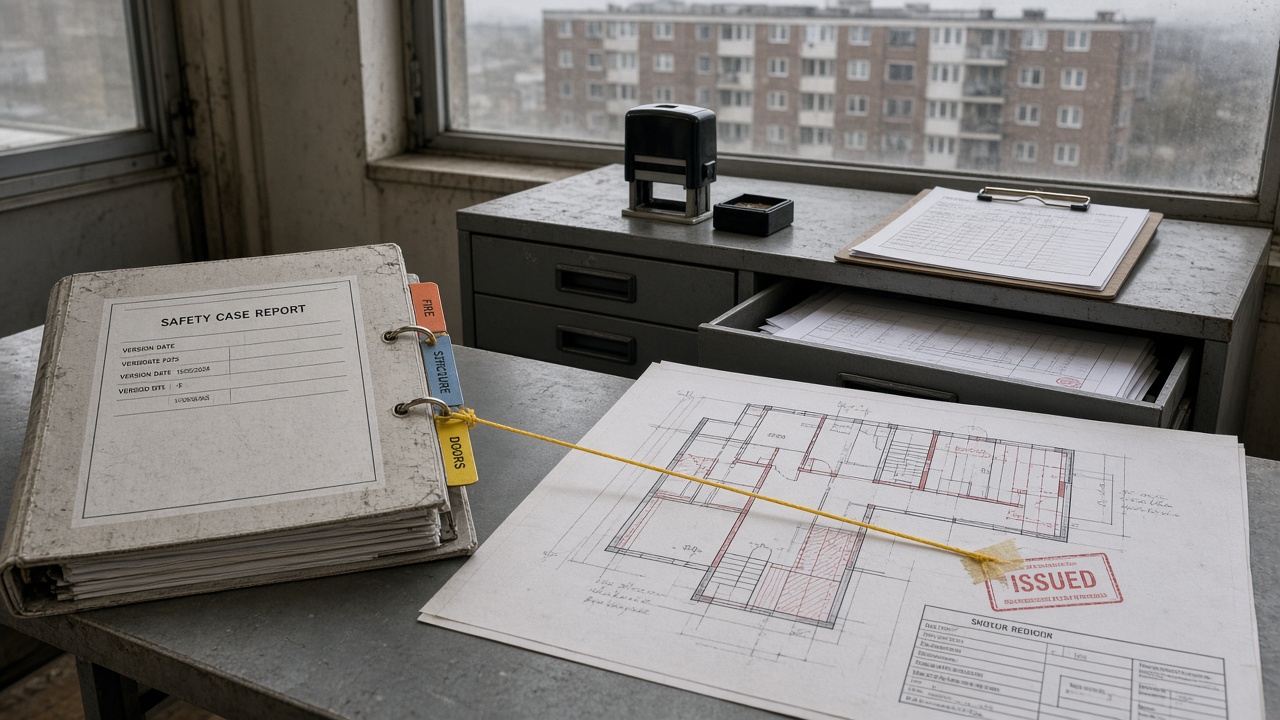
The request, when it comes, is rarely dramatic. The regulator tells a principal accountable person to apply for a building assessment certificate, and a block quietly occupied for years has to describe itself. Somebody then spends a fortnight in a managing agent’s shared drive, opening folders named by year, trying to establish which fire strategy the building is actually run to.
The golden thread is not a new drawing type. It is a duty to keep a digital, current, producible record of a higher-risk building — who is responsible for it, what the building is, and how the spread of fire and structural failure are being managed — and to hand that record on when the regulator, another duty-holder, or a resident asks. A ZIP named GOLDEN_THREAD_FINAL does not discharge that duty, and neither does a safety case assembled the week the letter lands.
The phrase comes from the Independent Review of Building Regulations and Fire Safety. The Building Safety Act 2022, and the later keeping-and-provision rules for occupied higher-risk buildings in England, turned it into a records job with named holders.
A duty to keep, not a new kind of file
Published regulator guidance is blunt about the form. The record is kept digitally. It is secure from unauthorised access. It is available when someone needs it, in a form they can use, written so a reader can understand it. It is treated as the building’s single source of truth. Changes are version-controlled so a later reader can see what moved. When an accountable person leaves, the information they held moves with the holding.
That is a keeping standard rather than a product category. Paper can be scanned. A common data environment can still fail the standard if the live fire-strategy sheet is one revision behind the building, or if the only person who knows where the safety case lives is on leave. Retrieval is the test. A record nobody can produce is not being kept.
The duty sits on different desks at different moments. During design and construction of a higher-risk building, the client, the principal designer and the principal contractor keep the digital record that will later be handed over. In occupation of a high-rise residential building, the accountable person — and, where there is more than one, the principal accountable person — keep it. The objects change name at handover; the failure mode does not.
The accountable person holds the record
An occupied high-rise residential building in this regime is, in the published definition, a building in England of at least seven storeys or 18 metres, with at least two residential units. It must be registered with the Building Safety Regulator before people live there. The accountable person is the organisation (or person) responsible for repairing the structure and exterior, or a common part. Where more than one exists, each keeps the information relating to the part they are responsible for. The principal accountable person coordinates the building-level holdings — including the safety case report — and must make sure the other accountable persons understand how information is kept.
That is a named holding rather than a line in a management agreement. If a managing agent runs the day-to-day file, the accountable person still has to be able to produce it. Where there are two accountable persons, each must be able to give the other their golden-thread information. And when an accountable person or principal accountable person stops being responsible for the building or a part of it, they must give the information they held to the incoming holder. A sale, a transfer of the repairing obligation, or a change of resident-management company that leaves the thread in somebody’s personal mailbox has already broken the duty. Anyone who has taken a block over will recognise it: keys, contracts and arrears at the meeting, records promised for later.
Construction is the other half of the same holding. At the end of the job the client applies for a completion certificate and must demonstrate that the building information has been given to the principal accountable person or accountable person — and, for fire-safety information, to the responsible person under the Fire Safety Order where that person is not the same desk. The recipient confirms they have received it, and that it is in a format they can use. A crate of PDFs the incoming accountable person cannot query is a delayed failure rather than a completed handover.
The assumption underneath all of this is not that the industry will have a pack, but that a named person can find the current record, keep it current, and pass it on.
The safety case report is an argument, and the thread has to support it
The principal accountable person prepares a safety case report. It sets out the building safety risks — the spread of fire or smoke, and structural failure — and how those risks are being managed. It is not itself the golden thread; it is the argument the thread has to hold up.
Published guidance tells the principal accountable person to prepare the report as soon as possible once the building is occupied, or as soon as they become the principal accountable person. A copy goes to the Building Safety Regulator when the regulator tells them to apply for a building assessment certificate, and whenever the regulator asks for it. Date it, or version it, or both. Update it when improvement or other work changes the risks, and tell the regulator if the update adds a new or increased risk, or further measures to manage one.
The report has to speak for the building. It needs basic building information — identity, height, storeys, layouts, uses, isolation points — and the names of the people responsible. It needs construction methods and materials, the structural condition, and a history of work that could have affected the risks. It needs the fire-safety measures that actually exist — compartmentation, doors, smoke control, escape, detection, suppression — rather than the measures drawn on a superseded elevation. And it needs a summary of each accountable person’s building-safety risk assessments, what is being done about the findings, the emergency plan, and the safety-management system supposed to keep all of that true.
None of that can be written from a filename. A safety case citing “see the fire strategy”, with no title and no revision, is the same object as a health-and-safety file still pointing at last year’s roof plan. The labour that writes such a report in a fortnight is archaeology. Those facts were cheap while the issued set was being kept.
Prescribed information is a named set
The keeping-and-provision regulations prescribe information and documents accountable persons must keep. That prescribed set is what the official texts call golden-thread information, and it is narrower than “whatever we filed under safety.”
Regulator guidance names the occupation holdings that must be there: the health and safety file, the safety case report, the residents’ engagement strategy, and the mandatory occurrence reporting system. It also expects, where they exist, information about later work on the building, information inherited from a previous owner — inspection reports, maintenance records — and the standard the building was built to. The wider prescribed set, in the published regulations, reaches registration and key building information, up-to-date assessments of building safety risks, and records of maintenance and repair planned to manage those risks.
Two published rules do most of the practical work.
Most recent, unless the text says otherwise. The live thread is the current version of each prescribed object. A folder holding every superseded fire-risk assessment is not the prescribed holding. History can be useful — occasionally it is the only way to explain a detail nobody can otherwise account for — but it is not a substitute for being able to produce what is true now.
Keep the change. Information is kept electronically, accurately, securely, and in a form that can be transferred without corruption. A change carries who made it and when. An accountable person who cannot say who last revised the compartmentation record, and on which date, is not keeping the prescribed set. They are keeping a pile.
The same set has to be able to move. On request it goes to the Building Safety Regulator, to other accountable persons for the building, and to residents or owners of residential units. The safety case report also goes to each relevant responsible person under the Fire Safety Order and to the fire and rescue authority. A record that only opens on the laptop of the consultant who compiled it is not available in the sense the duty uses.
The issued set is what “current” means
Document control already has a name for the object the golden thread keeps asking for. The issued set is the current approved identity of each relevant title: the fire strategy approved for use, the structural drawings the last alteration was built from, the as-built plans that match the stairs, the door schedule the last inspection used. Work in progress is not that set. Neither is a dump of every revision treated as live, nor a model that has moved on while the PDF on the accountable person’s share has not.
The golden thread fails at that distinction far more often than it fails at “we have no documents.” Buildings are awash with files. What nobody can do is point, for one stair, one external wall, one riser, at the current issued identity and the date it was last confirmed.
| Dump | Issued set | Golden-thread holding | |
|---|---|---|---|
| What you have | Every PDF that ever arrived | The current approved title and revision | That current identity, plus the prescribed objects that depend on it |
| How you know it is current | You do not | The register says which revision is live | A change record says who moved it, and when |
| What a safety case can cite | A folder | A title, a revision, a date | The same citation, still true when the regulator asks |
| What happens when a sheet revises | Another file lands | The previous revision leaves the live set | The prescribed objects that pointed at it move, retire, or are reconfirmed |
If the fire-strategy sheet revises and the safety case, the resident-facing summary and the information given to the fire and rescue authority do not move with it, what you are holding is a compilation rather than a thread. The same test applies to a structural alteration, a change of evacuation strategy, and a completed remediation. The issued set is the spine; prescribed information is the set of sentences that must stay true against it; and the accountable person is the one who has to show both.
No new file type is needed for that. What is needed is that each live safety sentence — compartmentation, doors, smoke control, structure, isolation — carries a title, a current revision, and a date last checked against that revision. Entries that cannot show those three are notes, and notes will not survive a building assessment certificate request.
A Monday test
Take one building, and accept only a record as the answer. No consultant required.
- Holder. Can you name the accountable person, and the principal accountable person if they are different, without opening a personal mailbox?
- Registration. Can you produce the current registration information the regulator already holds for the building?
- Issued set. For one stair and one external wall, which title and revision are current — and is that the revision the site or the facilities team is actually using?
- Safety case. Is there a dated or versioned safety case report, and do the drawings and assessments it cites still match (3)?
- Prescribed objects. Can you put your hand on the health and safety file, the residents’ engagement strategy, and the mandatory occurrence reporting arrangements without hunting through a ZIP?
- Change. For the last revision to a fire-safety or structural title, who moved the record, and on which date?
- Production. If the regulator, another accountable person, or a resident asked this week, could you give them the current objects electronically, in a form they can use?
- Handover of the holding. If the accountable person has changed, can you show the thread passing to the incoming holder? If the building was newly completed, can you show the client handing the construction record over in a usable format?
Whatever you cannot answer is the part of the duty that exists only as a folder name.
Where to start, and what it will cost
The Act, the keeping-and-provision regulations and the regulator’s guidance are the texts that bind; none of the above stands in for them. The practical work, though, does not start with a procurement.
Start with a register of titles. For one building, list the safety-relevant titles — fire strategy, compartmentation, structural alterations, evacuation, riser and shaft arrangements — and record against each the current revision and the date somebody last confirmed it against the building as it stands. That is usually a week for someone who already knows the block, and the cheapest week in the regime, because everything else cites the list. Then hold the citation rule: nothing in the safety case, the resident-facing material or the information given to the fire and rescue authority refers to a drawing without a revision and a date. Be honest about what costs real money, though. Version control that records who changed what, and when, needs a system rather than a folder, and an inherited record can take months to make usable, sometimes with survey work where the drawings have gone.
Clients and principal contractors hold the lever on the construction half, and completion is where to pull it. Before the final account is agreed, put the incoming accountable person in the room and ask them to open the fire strategy, the structural set and the operating information for one stair and say which revision is current. If they cannot, the record has not been handed over, whatever the programme says. The alternative is finding out in the fortnight after the regulator writes, by which time the people who knew have moved on.
Read next: Turning the health and safety file into a live asset instead of a binder, CDM 2015, ten years on: what the regulations assume about information, The handover readiness review, run at sixty per cent complete.