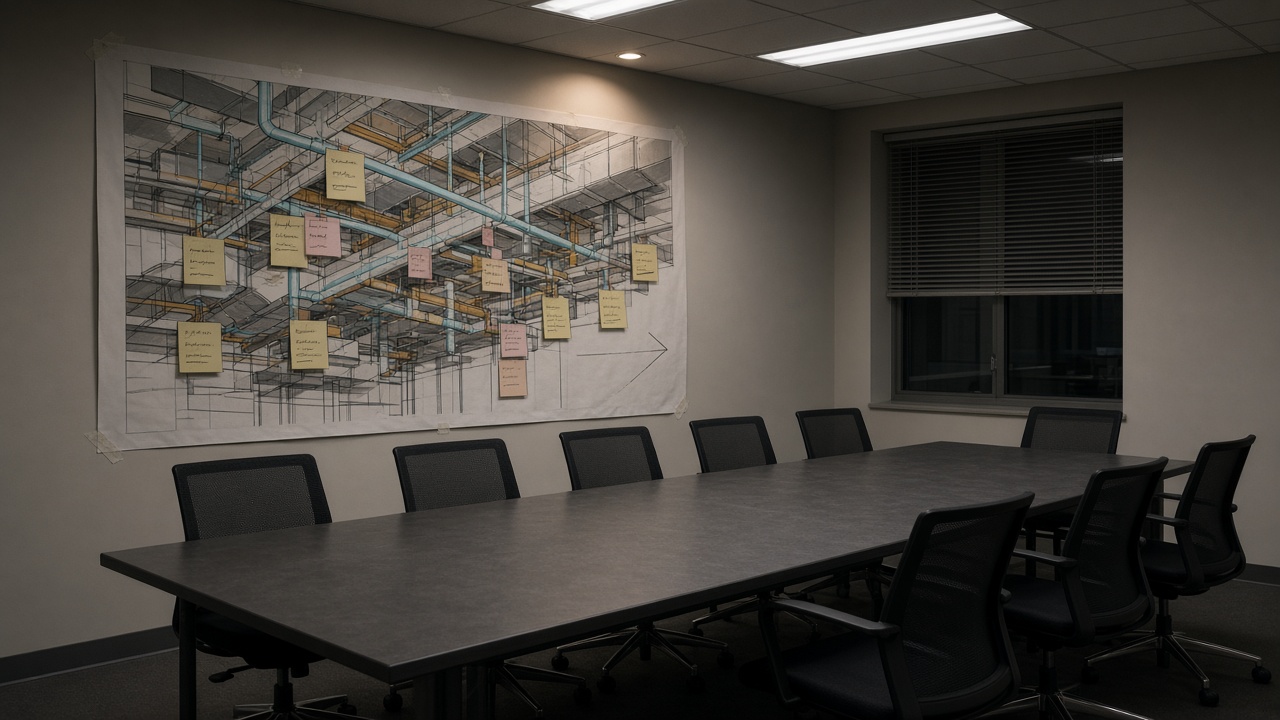
Sit through enough sessions on agentic BIM and the pitch settles into the same shape. The model finds its own clashes. Software writes the action, routes it to whichever trade owns the element, and marks the item closed before the coordinator has opened a laptop. Tuesday's meeting begins with the decisions already drafted, so the hour goes on the two that are genuinely contested. It is a good demonstration. Nobody in the room has yet been asked what happens on the morning after.
The distinction worth arguing over is smaller than the pitch and rather more awkward. Agentic coordination would change how conflicts get found, queued and proposed. It would not change who is allowed to issue. An agent that closes a clash with no duty-holder standing behind it has not coordinated anything; it has created a liability nobody has been appointed to carry.
Clash detection was never the agentic part
Federated models and weekly reports have been ordinary for years. Twelve thousand issues with a colour legend is a count. The meeting that turns a count into decisions either happens or it does not, and the unofficial set in the trailer gets written either way.
What people mean by agentic BIM is the step after the report: software that acts on the model rather than describing it. It keeps looking between exports. It groups duplicates. It works out which authoring team should make the move. It drafts an offset, a reroute, a request for information. In the bolder version of the story it applies the change and updates the federation overnight, with no slot in anyone's diary.
That is a claim about coordination, not about managing information, and the two collapse into each other because both involve a model on a screen. Coordination is the work of making geometry and responsibility agree. Issue is the work of releasing a named container, to named organisations, in a stated state, for a stated purpose. Software getting better at the first does not carry it across into the second, however confidently it words the notification.
What would actually change
The first change is time. Clash finding today is a batch: someone federates on a Thursday afternoon, runs the test, exports a report that is already out of date when it lands in the inbox. An agent working against live models turns that batch into a queue. New conflicts surface when a file is shared rather than when the coordinator has a free afternoon, and the old ones that were never closed stop hiding behind last month's filename.
The second is routing. A twelve-thousand-row report does not know who may move the duct and who may only move the sprinkler. The MEP coordinator knows, on a good day, if he has been on the job long enough to remember. An agent that can read ownership, discipline and the last person to touch the element would let the meeting spend its hour on the argument instead of the hunt for a name. That would not be magic, just a fix to a directory problem the industry has been quietly failing at for a decade.
The third is the proposal itself. Today's report says two objects occupy the same space. It does not say which move is cheaper, which one breaks a clearance the fire strategy depends on, or which one was settled three weeks ago and then forgotten by everybody except the engineer who has since left. A proposal is still only a proposal. But a meeting that opens on a drafted option is a different meeting from one that opens on a number.
The fourth is closure theatre. The problem was never that clashes exist. It is that they get found and not fixed, and the report becomes the deliverable instead of the change. An agent that keeps an item open until the geometry actually moves — and that can tell when somebody typed "resolved" while the solids still overlap — makes that harder to get away with.
None of this needs a new standard. ISO 19650 already separates shared from published. Shared is where coordination is meant to happen; published is where the site is allowed to build. Software that makes the shared state less theatrical would be a genuine improvement. It would not, on its own, put anything into the published state.
Somebody still has to issue it
Issue is a contractual and professional act rather than a button. A person with a duty — a designer, the principal designer, the contractor, an information manager working under an appointment — releases a container that has an identity: number, revision, suitability, date, originator. Named organisations receive it. The previous revision is superseded, or it is not. The site may rely on the new one, or it may not.
An agent can propose that a duct drops two hundred millimetres. It cannot accept the commercial consequence of that drop landing in another company's package. It cannot decide that a shared model has become suitable for construction. It cannot walk over to the plot rack and pull last week's sheet out of it. It cannot sign the transmittal. Those remain human acts because they create reliance, and reliance is the thing that gets picked apart when the argument starts.
Suitability codes exist for this, and they are not decoration on a title block. A model issued for coordination does not become a construction issue because an agent was confident. A drawing marked for information only does not become a build-from sheet because the federation happens to look clean this morning. Blur those codes in the name of speed and the unofficial set writes itself, the site plots whatever looks newest, and the document controller finds out about it weeks later.
CDM does not appoint a model. The principal designer's information duty sits with a person or an organisation, adequately resourced or not, and an automated close that no duty-holder will own is not a close at all. It is a timestamp somebody will be asked to explain, alongside a question the room usually cannot answer: who let this go out, and on whose authority?
An issued set is also a package rather than a live opinion. Geometry in a federated view changes whenever somebody saves. A set the site may build from does not: it is dated, it is transmittable, and it can be reconstructed six months later without ringing the coordinator who has moved on to another job. A model that coordinates itself overnight has issued nothing overnight. If the site builds from the overnight opinion, the project is carrying two records, and it will discover which one was unofficial at the pour — or later and more expensively, in adjudication.
A machine that can see every collision on a job is worth having. A machine allowed to declare the live issued set has been handed a role that no appointment on the project describes.
What to ask when the pitch arrives
Agentic coordination, if it turns up in anything like the form being sold, should make shared models less of a weekly PDF and more of a queue with owners and drafted options attached. It should make "found but never fixed" harder to bury. It should give the Tuesday meeting something to decide rather than something to count.
It should not close a clash without a duty-holder, treat a geometry change as published, or let a site build from whatever state the model happened to be in at four in the afternoon. The appointing party should write that limit into the appointment before anyone signs a licence: the agent may queue and draft; a named duty-holder still issues. That sentence costs solicitor time and a slower purchase. Leaving it out costs a second record the site will discover at the pour.
The plotter will still be running. Somebody will still want a drawing in their hand before the pour, and the engineer checking it will look at the revision box before anything else. Make the vendor reconstruct, while you watch, who released the last ten closes and which issued revision the site was allowed to build from. If the answer is the model, do not buy the queue.
Read next: Model quality gates: what to check before you accept a delivery, The site team has the truth. The office has the system. Neither talks., Clash detection found twelve thousand issues. Nobody fixed any of them..