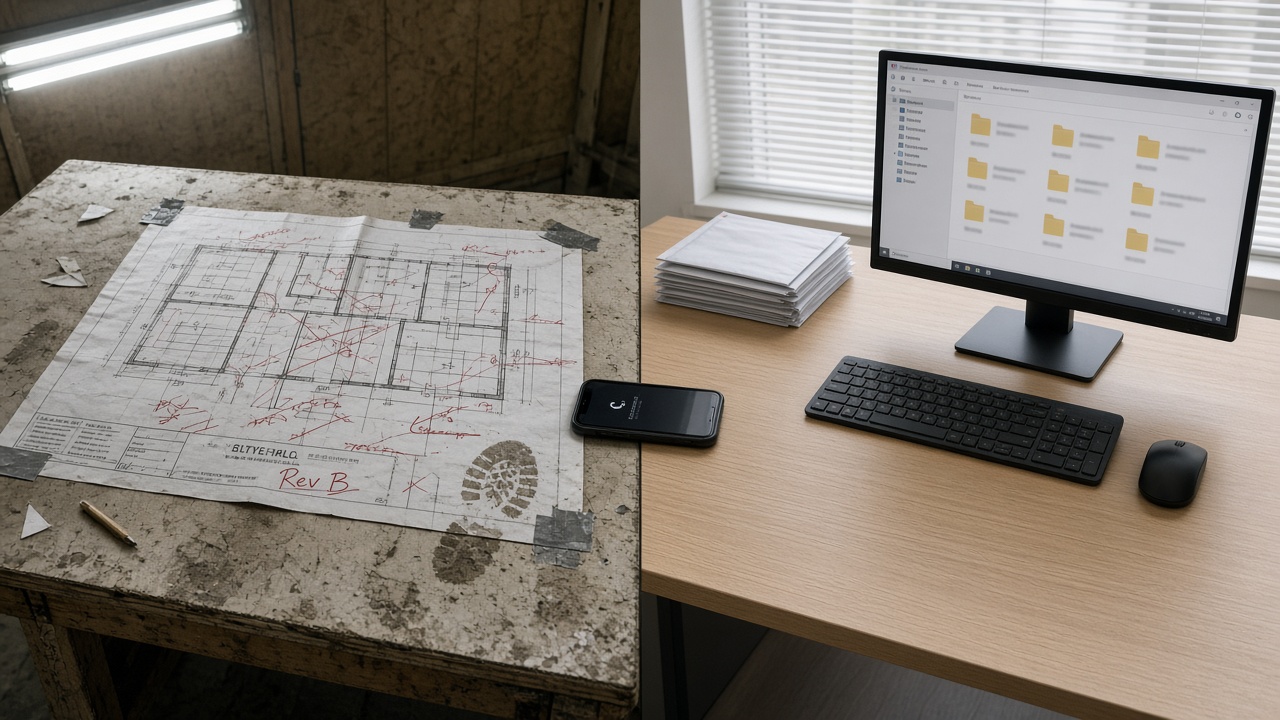
Ask two people on the same job what revision is live for level four and you can get two answers, both honest. The setter-out says B, because the A1 taped to the plywood table in the cabin says B and has a coordinator's mobile number written on it in marker. The document controller says C, because C went into Published on Friday afternoon and there is a transmittal number to prove it. Nobody in that exchange is careless. They are reading two different objects.
The office version of information on a live job is tidy enough to put in a bid. A common data environment was bought. The register looks current on a Monday. Transmittals went out. The models federate. Someone is "on BIM". Site, in that account, is a consumer: it downloads, it plots, it builds. As a description of how construction information actually travels, it is close to useless.
On most jobs there are two records. The office holds the one that claims to be the record — published containers, a register, a transmittal log, a portal that will produce a screenshot for the steering group. Site holds the one it builds from: the A1 on the table, the cabin folder, the crop in a group chat, the sheet that was good enough yesterday. Both are treated as truth. They are allowed to disagree, and on any job of size they do.
What the office means by "the system"
When the office says "the system" it means the thing the BEP named. Work in progress is not shared. Shared is not published. Published is authorised for a stated purpose. Archive is what used to be true. A suitability code is a sentence about use rather than a courtesy stamp, and an issued set is a bounded act: these revisions, this purpose, this list of recipients, this moment.
None of that vocabulary is decorative. ISO 19650 describes a managed process for information containers, with named states and an issue event attached to each move between them — not a cupboard with a login. A transmittal is meant to be evidence that an issue happened. A register is meant to be able to say, on any given morning, which container is current.
The office can generally prove that something happened in there. A file was uploaded. A state was changed. A zip went to a named mailbox. A screenshot shows Rev C in Published at 16:40. In a progress meeting that screenshot is the job, because it is the only version of the job anyone in the room can open without getting in a van. It is a real record. It is not the only one.
What site means by "the set"
Nobody builds from a philosophy of information management. They build from what they can hold, plot and trust before the gang is stood down.
That is what the unofficial set in the trailer is for. It is not insubordination, and I have never met a foreman who kept one out of spite; it is what people assemble when the official route cannot be relied on in time, offline, or in a gloved hand. A print that has survived three days of tape and weather looks more issued than a PDF sitting behind a naming convention. A crop that arrived at ten past seven looks more current than a transmittal still in a queue. A folder on a laptop that will open in the basement beats a portal that will not.
Call it the hut set, the wall set, the package pack, "what we're working to". The furniture varies by job. The pattern does not: the workface keeps a local truth, and that truth is an artefact rather than a login.
The same foreman will often know the real sequence better than any programme in the office knows it — which crane pick has to happen before the deck can be closed, which subcontractor is genuinely two days behind rather than saying so. He does not write it down, because writing it down was never his job and there is nowhere obvious to put it. So the most accurate account of the job lives in somebody's head and on the back of a drawing, and the system that claims to be the record has no idea it exists.
What "neither talks" actually means
It is not a request for more meetings. Coordination meetings exist. Weekly progress exists. A document controller exists on plenty of jobs that still plot the wrong revision. The failure is mechanical: the two records do not share an identity for "this container", and they do not share an event for issue and withdrawal.
Issue is not receipt, and receipt is not the package that will place the work. A common data environment can show a complete transmittal and still not have reached the setter-out. The subcontract may well say the main contractor must cascade the information downwards. Cascading is work, it has a clock, and it loses to the pour, the delivery and the gang that is already booked.
Publishing is not plotting, either. Plotting is a coded activity that somebody is paid to do; collecting the old prints is not. The plotter does not withdraw the previous run. Until the old sheet is marked, collected or replaced, the job carries two live-looking issued sets of the same sheet number, and the expensive one is always the one already at the workface.
Then there is the interface. The official system lives in the cabin, on a seat, behind a convention designed for a desktop. The unofficial set lives where the work is, in sunlight and dust, on a six-inch screen with a glove on. A four-hundred-page PDF in a portal is not a field interface, and when those constraints win the office hears nothing about it. The portal still looks tidy.
Withdrawal, meanwhile, is barely part of issue in most systems of record. Version history is a stack of saves; it does not say who still holds the previous revision, or whether they are still entitled to use it. You cannot supersede a crop. You cannot withdraw a spoken instruction from the twenty people who heard it.
So the conversation that does happen is a failed one. An email with a screenshot. A mark-up on last week's plot. A question answered in a chat with no title block anywhere near it. Each of those looks like communication. None of them updates the other record. The office files the screenshot, site keeps the plot, and the container quietly acquires two filenames and two revision stories.
Both can be right, and that is what it costs
The version that gets written into a letter needs a villain. Site was careless. The office was slow. Somebody should have checked the register. It names a person, which is convenient, and it explains nothing about a split record.
Nobody on the ordinary sequence has to be careless for this to happen. The designer published. Document control transmitted, or was about to. The coordinator answered a question over the phone. The setter-out used the sheet in his hands. Every step is locally reasonable, and the gap sits between them: a system that can prove it issued, a workface that can prove it built, and no contemporaneous file joining those two facts.
Which is why the split costs more after the event than on the day. Rework gets coded as labour, because the wall is standing there in front of you. A claim asks something narrower and much harder: who at the workface knew which revision was live, and which copy had been withdrawn. A transmittal log naming a company does not prove the gang had the sheet. An unmarked plot on the wall is fairly good evidence that the previous revision was still in use. A project can be entirely right in its common data environment and still lose that argument, because the argument concerns the artefact that authorised the work rather than the artefact that was stored.
Closing the gap
Nothing here is fixed by buying another seat, renaming a folder Published, or telling site to check the portal. Three changes do most of the work, and none of them is free.
Make withdrawal an event with a name against it. Whoever plots a revision collects the one it supersedes, and that collection is a coded activity on somebody's day, not an act of faith. Record receipt at the installing package rather than at the first mailbox — a person who can be asked, six months later, whether they had Rev C on the Thursday. And give the foreman with the real sequence in his head somewhere to put it that takes less than a minute, on the device already in his pocket, or accept that the office programme will stay a work of fiction.
That costs money. It is a line in the document control resource, probably a clause about cascade in the subcontract, and a field tool procured for a gloved hand rather than for a demonstration. Clients and principal contractors are the ones who can make it a condition rather than an aspiration. If you are appointing this year, ask at tender for one thing: on a named morning six months into the job, show me the cabin set and the published container for the same sheet, and tell me whether they matched. Anyone who cannot do that is selling you a register, not a record.
Read next: Why site teams keep a second, unofficial set of records, Everyone says they have a CDE. Most have a shared drive with permissions., Anatomy of building from a superseded drawing.