A wrong-revision pour gets written up as a lapse. Someone used the old sheet, supervision slipped, the gang should have checked the register. That version of events is handy in a commercial letter because it contains a person, and people can be charged for. As an account of how an out-of-date drawing reaches a slab, it is close to useless.
What actually happens is a sequence, and it runs the same way on jobs that are in no sense badly organised — a proper common data environment, a document controller who knows the naming convention backwards, a transmittal process with a procedure number against it, a drawing register that looks immaculate on a Monday morning. The sheet number never changes. The opening moves. Concrete goes in from whichever piece of information was easiest to pick up.
The revision goes out late
Usually it is a structural slab or an opening drawing. Coordination lands a change later than anyone wanted: a penetration shifts three hundred millimetres, starter bars are recast, an opening comes out altogether. The designer publishes a new revision, the register updates, the suitability code says the container is for construction. That is the last moment at which the official record and the workface have a realistic chance of agreeing with one another.
Nothing about that is exotic. ISO 19650 separates work in progress from shared and published because those are genuinely different facts about a file, and publishing is an act with consequences attached. Dropping a file into a folder is not that act. Neither is getting the file into the hands of the fixer who will mark out the slab at seven tomorrow morning. The anatomy lives in the gap between those three things.
A late revision is also a programme fact, which the standards are quieter about. The pour date does not move because a container changed state. The gang is booked, the pump is ordered, and the batching plant does not read transmittals. Whatever information is already on site is the information that will be used.
Issue is one thing, receipt is another
The published container sits in the CDE. The transmittal to the trade is queued, or it has gone to the main contractor's document control and stopped there, because the subcontract says the main contractor cascades. Cascading is work. It sits in somebody's afternoon, behind two RFIs and a payment application, and it loses to the pour.
Sometimes the transmittal goes out and is never opened. Sometimes it is opened by a contracts manager who will not be setting anything out. Sometimes it is a zip of thirty sheets and the one that changed is not the one anybody bothers to plot. The log reads as a complete issue either way. The workface still has yesterday's sheet, and it will keep having it for hours — across a weekend, if the timing is unkind.
That is what makes the argument afterwards so expensive. A project can demonstrate that it issued Rev C and still have nothing to show that the people placing concrete knew Rev B was dead.
The print on the wall
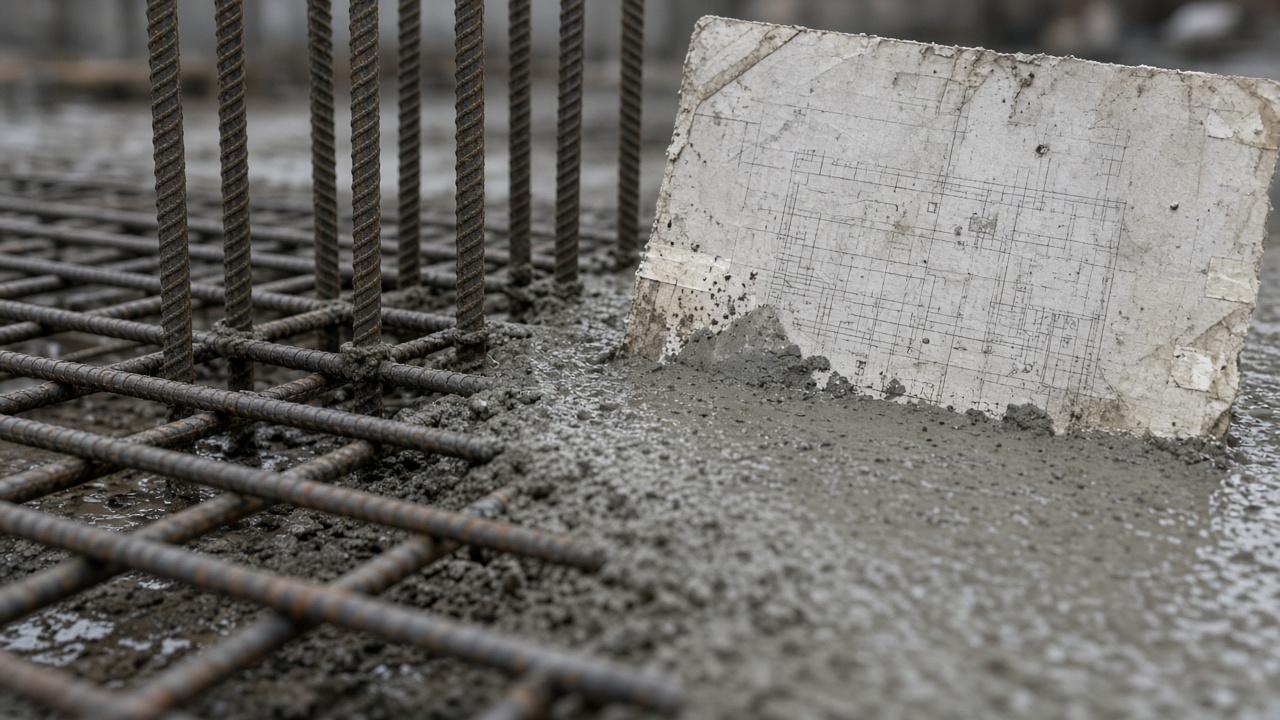
Somebody plotted the previous revision when the package started. The A1 is taped to plywood at the workface, or pinned in the cabin, or rolled in a rack that everyone treats as the live set because it is paper, it is big, and it was correct yesterday.
Plotting is a coded activity. Walking round collecting old prints is on nobody's list. The plotter produces a new sheet and leaves the previous one looking perfectly issued, and to a setter-out a print that has survived three days of rain and gaffer tape feels more trustworthy than a PDF nobody has told them to go and fetch.
Which is why "check the CDE" has never really been a site procedure. The CDE is in the cabin, behind a login, behind a naming convention, on a laptop that takes four minutes to wake up. The print is in a hand. Until the old one is collected, struck through or physically swapped, the job has two issued-looking sets of the same sheet number in circulation, and the expensive one is the set already standing at the pour.
The crop that arrives on a phone
A query comes back because the print and last week's conversation do not agree. A coordinator crops the relevant detail out of whatever PDF happens to be open on their laptop and sends it. No title block, no revision letter, no suitability code, frequently no sheet number at all. It arrives in seconds, and because it arrived last it reads as the most current thing anyone holds.
There are now three artefacts in play. The crop may show the new detail or the old one, and the phone will not say which. Group chats do not keep a register. Forwarding strips out whatever metadata survived the screenshot. What is left is a picture of geometry — exactly what you need to mark an opening, and exactly what should never stand in for an issued container.
Nobody would call that a formal channel, and yet on a normal job it is how the last instruction travels. It is also how the identity of a drawing gets destroyed. You cannot supersede a crop. You cannot withdraw it from the twenty phones now holding it. All you can do is hope the next person opens the published file rather than the picture.
Nothing marks the old sheet as dead
Keeping Rev A, Rev B and Rev C in a folder is storage. Control means being able to say who is still holding the previous revision and whether they are still entitled to work from it, and that is the half most projects never operationalise.
Without a mark on the print, a collected sheet or a recorded withdrawal, the old plot carries on looking issued indefinitely. The set in the trailer is not insubordination; it is what people build from when the official route cannot be trusted to arrive in time. A rubber stamp reading SUPERSEDED is a small and deeply unfashionable piece of information management. Its absence is how a dead drawing keeps its authority at the workface.
The register can show Rev C as current and be telling the truth. The print on the trestle is telling one as well: on this job, withdrawal was never treated as part of issue.
The slab does not wait
Concrete is a clock. Setting out happens from the biggest, nearest, most recently handled artefact within reach, which is usually the print and occasionally the crop. The opening goes in its old position. The pour proceeds. The published container remains correct, untouched and ready to be screenshotted later as evidence that the CDE was up to date.
Nobody in that chain has to be careless for this to happen, which is the uncomfortable part. The designer issued. Document control transmitted, or was an hour from transmitting. The coordinator answered a question in good faith and answered it quickly. The setter-out used the sheet in his hands, as setters-out have always done. Every step is locally reasonable. The damage is in the chain: a late revision, a transmittal that never caught up with the plotter, a crop that stripped the sheet of its identity, and a print that nobody marked.
What the paperwork cannot answer
The break-out, the programme recovery and the letters all arrive after the concrete has gone off. By then nobody is asking whether Rev C was in the CDE, because everyone can see that it was. The question is who at the workface knew Rev B had been withdrawn, and which contemporaneous record shows it.
A transmittal log naming a company does not prove the setter-out ever held the sheet. A crop in a chat has no standing as an issued container. An unmarked print is fairly direct evidence that the previous revision was still in service. You can be entirely correct in the system of record and still lose the argument, because the argument concerns the artefact that was built from rather than the artefact that was stored.
Treat withdrawal as a named step of issue, the way the transmittal already is. When Rev C goes out, the principal contractor — they are the ones the subcontract already makes responsible for the cascade — puts a named person from document control or site supervision on the workface to strike through or collect the old plot, and to write that they did. Stop treating a company-level transmittal as proof the setter-out held the sheet, and stop letting a crop in a chat stand as the last instruction.
That collection is an afternoon of someone's time on every late revision, and it will lose to the pour unless those hours sit on the same list as the issue itself. Mobilisation is when you name the person and budget the walking; waiting until the break-out is how the unofficial set in the trailer keeps its authority.
Read next: Monthly Register — January 2025, The transmittal nobody read, Revision control and version control are not the same thing.