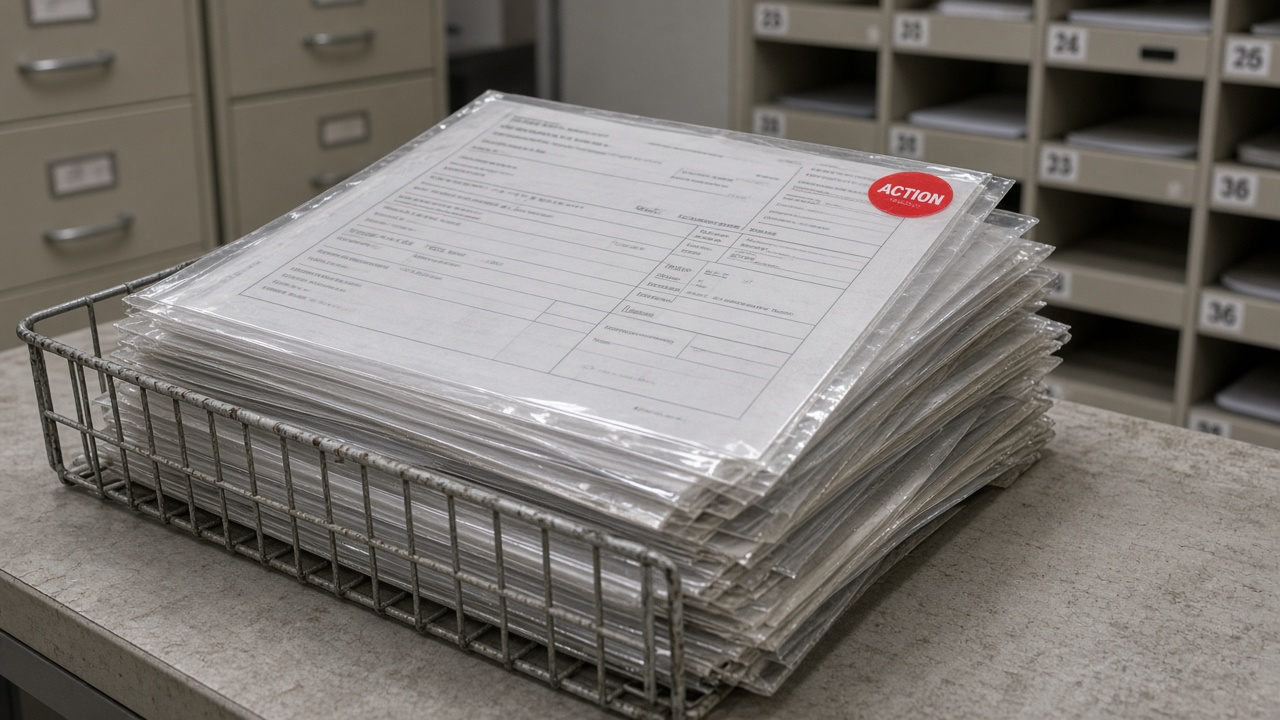
There is a ritual in document control that everybody recognises and nobody quite defends. The pack is zipped. The cover sheet generates itself. The distribution list — forty-odd addresses, of which perhaps a quarter belong to people who will ever hold a drawing on site — is ticked, and send goes at twenty to five on a Friday. Out in the supply chain, a great many inboxes acquire an unread item with a red flag beside it. The register turns green. Everybody has discharged an obligation, and on the Tuesday the slab still gets poured to Rev B.
Calling that a communications failure is too kind to the process. What has happened is that three separate facts have been compressed into one word. Issue is not receipt. Receipt is not understanding. A transmittal nobody read is a small legal fiction: a dated act the project can point at, and a workface that never absorbed what the act contained.
Issue is an act, not a folder
Issue is a dated, attributed release: these containers, these revisions, this purpose, these named recipients, this information state. The published state in ISO 19650 exists precisely because "the file is on the disk" and "the file is authorised for this use" are different sentences. A zip in a folder called Issued is storage; the transmittal is meant to be the act that converts storage into an instruction.
Most of what gets recorded as issue is thinner than that. Somebody uploaded a pack. Somebody ticked a distribution list. Somebody generated a PDF cover sheet, and the register wrote a time next to it. From that moment the project speaks as though construction information had moved. It has moved within the office. The workface has not yet been party to any of it.
Two substitutions hide in there.
Issue as upload. The common data environment accepted the file, which is a server event. It does not name who must act, what they must do, or whether the previous revision has been taken off the hut wall.
Issue as send. An email left with a link or an attachment, which is a mail event. It does not prove the named company opened the pack, never mind the installer, and it does not prove the pack they opened is the one the register now displays.
If you cannot reconstruct the act — number, date, containers, revisions, purpose, named recipients — what you have is a timestamp wearing the costume of an issue.
Receipt is a different fact
Receipt is the moment a named person at a named company holds the issued containers in a form they can use. Not "the contractor". Not "the package". A person who can be asked, later and possibly under oath: did you have Rev C on the Thursday?
The ways projects fake this are wearily familiar. Nothing bounced back, so the mail is treated as received. A download log shows that somebody in the main contractor's document-control mailbox opened the zip. A portal reports "acknowledged" because a clerk clicked the box the workflow insisted on. A site engineer forwarded a link to a subcontractor's phone at twenty to seven in the evening. Every one of those is a real event, and not one of them is receipt at the workface.
The cascade is where the fiction gets expensive. The contract usually says the main contractor must pass issued information down the chain. The wall does not read the contract. If the named recipient is a mailbox and the installer sits two companies further along, you have proved delivery to an inbox. The unofficial set in the trailer exists because the official route never reached the table anyone plots from.
Receipt has a clock, too. A transmittal issued at 16:55 for work starting at 07:00 has been issued; it has not been received in time. A revision that lands after the pour is a record of what site was not permitted to know. Dating the send does not date the use.
You can test this without any theatre. Take last week's transmittal, name the installing company, and ask who — by name — had the pack before the work started, and from which source: the published location, an email, a messaging app, the plotter tray. If the honest answer is a role, a mailbox, or "they've got access", you have issue and nothing more.
Understanding is the third fact
Understanding is the point at which the recipient can say what changed, what they must now do differently, and what they must stop using. A download is not that. An acknowledgement tick is not that. "Received with thanks" is emphatically not that.
A transmittal of eighty drawings is, whatever the intention, designed to defeat understanding. Nobody reads eighty drawings. They look for their package, their level, their sheet number. If the change that matters is a moved penetration on a sheet they never opened, the pack was received and the instruction was not.
Revision clouds and notes are supposed to carry the delta, and they fail in ways any document controller can list from memory. The cloud marks a note belonging to somebody else's trade. The note says "as coordinated" rather than saying the riser moved 200 millimetres. The architectural sheet changed and the services sheet sharing that grid did not. The suitability still reads "for information" while the programme is treating the drawing as issued for construction, or the transmittal purpose says "for construction" while three of the containers inside it are still S2.
Understanding also fails when the pack reaches the wrong discipline entirely. The fire engineer needed the compartmentation change. The transmittal went to the architect's job mailbox and the main contractor's document controller. Both can prove they received a file. Neither is holding the saw that will cut the opening.
For a cheap test, stop asking whether people got the transmittal and ask the person who will install three things:
- Which revision of this sheet are you working from?
- What changed since the last one you used?
- What must you stop using?
If they cannot answer the second and third from the pack they were sent, without ringing whoever issued it, the transmittal was not understood. It was filed.
How the three get collapsed
The collapse is administrative rather than malicious.
The register has one column, generally called Issued, or Sent, or Distributed. One green cell is cheaper to maintain than three facts. Commercial letters want to say "as issued on", because a letter needs a date and not a psychology of reading. Auditors ask whether transmittals exist; they rarely sit beside a supervisor and ask what changed on the sheet in his hand.
So the project reports issue and then talks as though it also had receipt and understanding. Site, perfectly reasonably, carries on with last week's plot, because last week's plot is the last thing anybody was sure about. When the wall comes down the cost is coded as rework, while the cause sits back in the chain: an act that never became a received instruction, and a received file that never became a change the installer could name.
None of this is a mood. It is a set of files. The cover sheet is in the common data environment. The zip was downloaded by a mailbox. The A1 on the plywood table is still Rev B. All three are true on the same morning.
Reconstruct one transmittal on Monday
No consultant required. Take one transmittal from the last ten working days, ideally one that carried a change site is now building.
Write down six facts from the system of record rather than from memory:
- transmittal number and date
- named recipients, not company names
- exact containers and revisions
- purpose, or the action requested
- dated evidence of receipt at the installing company, not only at the first mailbox
- what the hut or the tablet actually showed on the morning the work started
Then add a seventh that almost no register keeps:
- who, by name, can state what changed and what was withdrawn
Complete 1–4 but not 5 and you have issue without receipt. Complete 1–5 but not 7 and you have receipt without understanding. If 6 disagrees with 3, the workface is running a fourth record, and that is the one that got built.
Do it three times rather than once. A single tidy pack proves nothing; three in a row tells you whether the chain is a habit or a performance.
What to change without buying a new stamp
Treat the three facts as three records. The issued act stays as it is — number, date, containers, purpose, named list. Beside it, record receipt as a named person at the installing company, with a time that sits before the work. Beside that, record understanding as a short confirmation of the delta, what changed and what is withdrawn, given by the discipline that will install and not by the mailbox that clicked acknowledge.
Shrink the pack that has to be understood. "Eighty drawings, see clouds" is a hope. Six named sheets, the revision they supersede, and the action required of each recipient is an instruction. The other seventy-four can still exist; they should not be what an installer is asked to "read".
Close the cascade in the record rather than in the contract appendix. Where the named recipient is the main contractor, the record stays open until the installing package is named as well.
And make withdrawal a job rather than an article of faith. If Rev C is issued and Rev B is taped to the wall, the job carries two live instructions, because receipt of C did not kill B. Somebody has to walk over and take B down, and that somebody needs a name and ten minutes in their day.
What a standard will not do for you
Any template presented as a certification is misleading you. ISO 19650, CDM, the Building Safety Act, NEC, FIDIC, JCT and the project's own BEP each have their own owners and their own remits. What they share is an assumption: that issued information can be found, and that the people entitled to rely on it knew what they had. None of them will tell you whether last Thursday's pack was read.
Which leaves that part to whoever holds the pen on the information requirements. If you are the appointing party, ask for receipt at the installing package and a named delta confirmation as deliverables in the exchange information requirements, and price the document control resource to match, because splitting one green column into three facts is somebody's hours every week. If you are the document controller, you can start smaller and sooner: pick three transmittals, run the seven lines above, and take the result to the next progress meeting. It is an uncomfortable half hour and it is considerably cheaper than the letter you will otherwise write in eighteen months about a slab.
Read next: Anatomy of building from a superseded drawing, Revision control and version control are not the same thing, Designing a document control workflow for a two-hundred-firm supply chain.