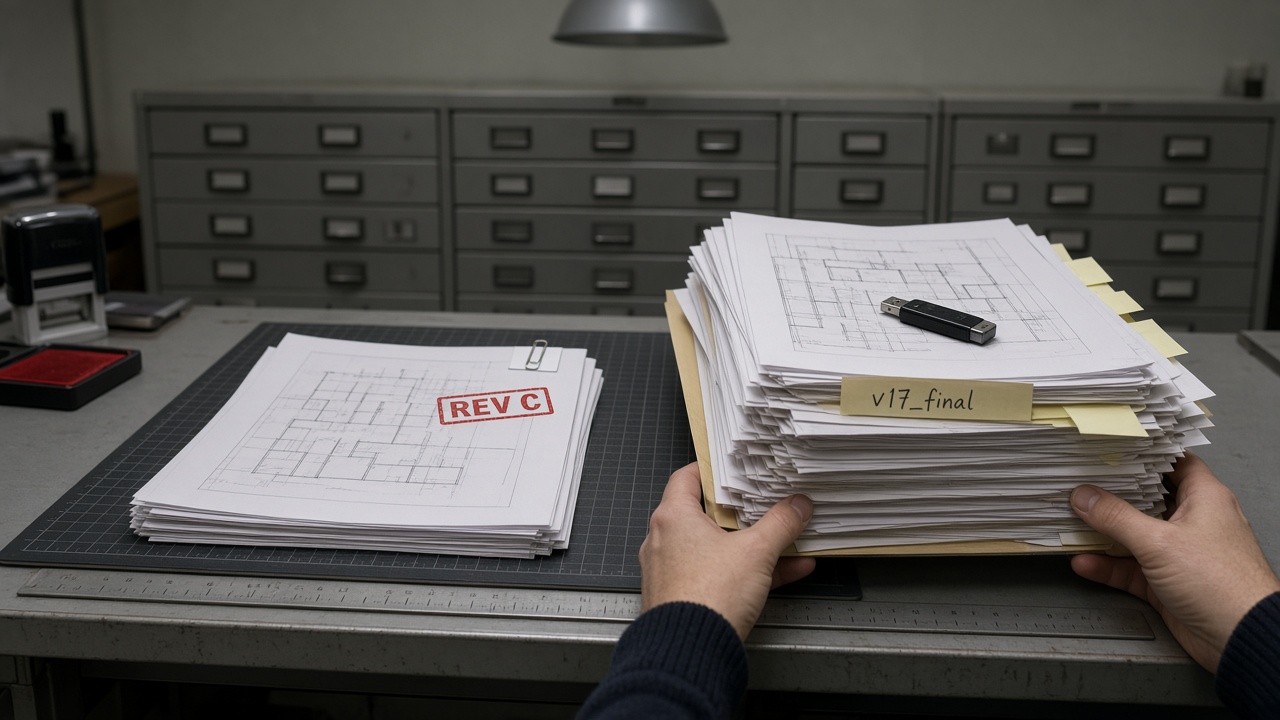
Sit in on a design progress meeting and count the jobs the word “version” is doing. The design lead means the model she saved last night. The project manager means the sheet that came back from the client with comments. The vendor means a row in a file history pane.
Good document controllers head this off in week one. Asked for “version 2 of the plan”, they will explain, patiently, that P02 means the second preliminary issue, not version two, and that the difference is who may build from it.
A revision is the contractual identity of an issued information container: which issued set it belongs to, which series it sits in, what purpose it was issued for, and what it supersedes. A version is the file history that got the container to that identity — the check-ins, autosaves and git-like increments nobody on site may build from.
Collapse them and a superseded drawing eventually gets plotted as if it were live.
What a revision actually is
Revision control answers a question that arrives late, usually in a solicitor’s letter: on the day that wall went up, which drawing was the site entitled to work from, and who had it?
The object is not “the latest file”. It is the issued set. A drawing number plus a revision — the title at C02 — states what the site, the fabricator and the reviewer may rely on. The transmittal is the evidence; the register is the list of statements in force.
A revision therefore has to do four things a save cannot:
- Sit in a bounded issued set — these sheets, this purpose, this moment, this list of recipients.
- Carry a series that says where the sheet is in the life of the job.
- Carry, or sit beside, a purpose or suitability — issued for information, for coordination, for construction — so “current” is never a synonym for “build this”.
- Supersede the previous identity, so the live set has one current revision per title and the retired one stays findable as history, not instruction.
If you cannot point at all four without opening a personal inbox, you have a pile of files with numbers in the names.
The letter in front of the number
UK practice commonly prefixes the revision with a letter marking the series: P for preliminary, C for construction (or contract), A for as-built. P01, P02, P03 is one series. C01 starts another. A01 a third.
That letter is not decoration and not a version bump. Moving from P03 to C01 is a change of contractual identity: the purpose of issue has usually changed, and so have the people entitled to rely on the sheet. Treat C01 as the next save after P03 and you have promoted a coordination drawing to a construction instruction without anybody deciding to.
Nor should P, C and A be collapsed into ISO 19650 suitability codes. Suitability — S1, S2, A1 and the rest — says what the container is fit for; the series says which issued identity it is. A sheet can be C02 and still only suitable for coordination; a sheet can be P04 and already published for a stated purpose. The two codes travel together.
Projects with their own series — T for tender, numeric-only — need the same rule.
Superseding is something somebody does
Supersede is the moment the previous revision leaves the live issued set. It has a date and an owner.
C01 does not vanish when C02 is issued; it is retired. The register shows C02 as current, the transmittal shows who received it, and the archive still holds C01 so a claim or an as-built reconstruction can establish what was true last Tuesday.
File history will not do that job. Overwriting drawing.dwg and keeping “v7” in the authoring tool tells the person at the plotter nothing. Emailing a PDF called FINAL_v3 supersedes nothing. A version stack records who saved; it has no opinion about which identity the site may rely on.
If a superseded sheet can still be plotted as current, revision control has failed, whatever the file history says.
What version history is good for
Version control answers a different question: how did this file come to look like this?
That is the git-like job. Check-out and check-in. Autosave. “Version 14” in the file pane. A comparison of two DWGs showing who moved a gridline at 16:42, occasionally the most useful half hour of a coordinator’s week. Necessary for authors; insufficient for issue.
A version increment can happen twenty times inside one revision. The architect saves, the checker comments, the author amends, the file reaches v6, and the issued identity is still P02 until someone issues P03. A revision can equally be a single exported PDF with no version trail at all.
Software people collapse the words because their tools version files; construction people because “Rev C” and “v3” both look like counters. They count different things.
The two words held still
| Revision | Version | |
|---|---|---|
| Object | Issued identity of a container | File increment and its history |
| Typical mark | P02, C01, A03 — plus purpose or suitability | v3, check-in 14, commit, FINAL_rev2.dwg |
| Who may rely on it | Whoever the issue and transmittal named | Usually nobody outside the authoring team |
| What “latest” means | Current in the issued set; previous identities superseded | Last save or last commit |
| Characteristic failure | Building from a superseded drawing | Losing the work-in-progress trail, or treating the trail as an issue |
Hold those rows still and most arguments about “we have versioning” become specific: either the file history is missing, or the issued identity is. Different repairs, different bills.
Four questions, in writing
Ask them of the project; accept only a record.
- For this title, what is the current revision, in which series, issued for which purpose?
- Which issued set and which transmittal put that revision in someone’s hands?
- What did that revision supersede, and can you still retrieve the retired identity?
- How many file versions sit under the current revision — and is anyone on site being told to build from one of them?
If the first three point at a register and a transmittal, you have revision control. If they point at a modified date, a filename or a commit log, you have version control wearing a revision’s clothes.
Where to start on Monday
The cheapest repair belongs to you, not to anyone senior. When someone asks for the latest version of a sheet, ask which revision, in which series, issued for what. It sounds pedantic for a fortnight, then people start saying what they mean.
The second costs a slice of a document controller’s week and is worth defending at budget time: the register decides what is current, not the folder and not the inbox. One current revision per title, series and purpose against it, retired identities still retrievable.
The third is not in the gift of the delivery team. Only clients and appointing parties can impose a numbering and revision protocol across a supply chain of two hundred firms, and the place for it is the information requirements at appointment, with the supersede rule spelled out: who marks a revision retired, how recipients are told, how long a superseded sheet may sit at the workface. Leave it out and every subcontractor brings their own numbering.
Then pick a package this week — the one with the most revisions, since that is where the damage will be — and put the four questions to the people who issued it, in front of each other. Whatever comes back is the honest state of your revision control, and a better progress-meeting item than a chart of uploads.
Read next: The transmittal nobody read, Designing a document control workflow for a two-hundred-firm supply chain, Anatomy of building from a superseded drawing.