Before the gang arrives, a site engineer updates a spreadsheet the project will never see. Columns for sheet number, the revision he actually plotted, the photograph that arrived after that, a note about a hold. The common data environment was current at close of play yesterday. The pour is this morning.
He is not running a rival document-control office. He is trying to start the day without building the wrong thing.
The preferred explanation for that spreadsheet, and for the lever-arch beside it, is flattering to everyone who does not have to set out at dawn. The site will not use the system. Supervision is weak. Document control issued, therefore the gang should have fetched. The unofficial folder is treated as a behaviour: a failure of discipline, a refusal to follow the information protocol the project already paid for. That sentence is useful in a coordination meeting because it names a person. It is a poor account of why a second record exists at all.
Site teams keep a second, unofficial set because the official one cannot be trusted at the point of work. Cabin folders, WhatsApp photographs and marked-up prints are not a parallel culture. They are what the workface builds when the published container is slow, contradictory, offline, or addressed to someone else.
Why the office prefers a people problem
Call the hut set indiscipline and you already know where to look. You send a note about process. You lock the plotter. You remind the package that the CDE is the system of record. You treat the lever-arch file as evidence that the site prefers paper, as if preference were the finding.
The story persists because it is administratively convenient. The project can prove it bought a CDE. Folders have names. Models have federations. Someone is “on BIM.” The register is current on a Monday morning. From that position any local copy looks like a refusal. The office has already done its part. The unofficial set is what remains to be managed.
Site skill is real, and so is poor housekeeping. A competent setter-out will still build from the artefact they can hold, plot and trust that morning. If that artefact is not the published container, the failure is not that they built a second set. The failure is that they needed one.
What they are actually holding
The unofficial set is a local reconstruction of construction information: whatever answers “what do we build here today?” It is unofficial because it is not the container the project will later produce in a claim, an adjudication or a handover. It has no suitability code. It has no transmittal. It often has no revision letter. It is still the set that gets used, because use is a dawn decision, not a governance ceremony.
Three artefacts do most of the work. They look like clutter. They are a records architecture.
Cabin folders
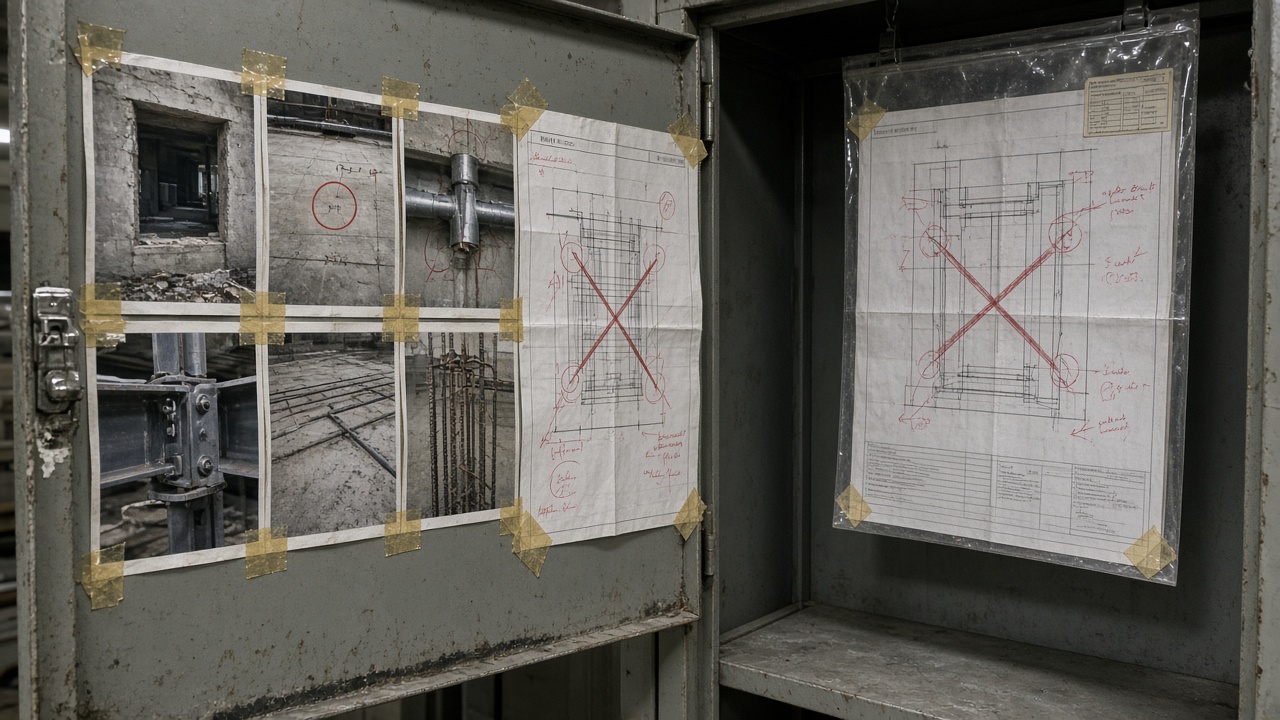
The cabin folder is the project’s second register. It is a lever-arch, a crate, a rack of rolled A1s, a plywood wall with the live plots taped where the gang can see them. It is assembled by the people who will be blamed if the pour is wrong, which is why it is usually more current than the folder the office thinks is current.
It exists for dull reasons. The CDE is behind a login, a naming convention and a machine that is not at the workface. Issue is not receipt. Receipt is not the package that will place the work. A transmittal that names a company is not proof that the setter-out has the sheet. Plotting is a coded activity; collecting old prints is not. The print that has survived three days of weather and tape looks more issued than a PDF nobody has been told to fetch.
The cabin folder is also a withdrawal system the official record rarely runs. When a revision arrives, someone — if anyone — writes on the old plot, pulls it off the wall, or stuffs it at the back of the file. That labour is unofficial because the project treated publication as the end of issue. Until the previous revision is collected, marked or replaced, the job has two live-looking issued sets of the same sheet number. The expensive one is the one already at the workface.
A tidy cabin folder is not proof of control. It is proof that someone on site decided the official register could not be the only one.
WhatsApp photographs
The photograph is how the last instruction travels. A query arrives because the plot and the last conversation do not agree. A coordinator crops a detail from whichever PDF is on their laptop and sends it. The crop has no title block, no revision letter, no suitability code, and often no sheet number. It arrives faster than a transmittal. It looks more current than the plot because it arrived later.
The recipient now has a third artefact. It may be the new revision’s detail or the old one. The phone does not say. The group chat does not keep a register. Forwarding strips whatever metadata the file once had. What remains is a picture of geometry, which is exactly what you need to mark an opening and exactly what you must not treat as an issued container.
This is not a side channel. On a typical job it is the channel. The official record can still be complete: the container is published, the transmittal is queued, the register is right. The workface has a photograph, because a photograph is what a gloved hand can hold in direct sunlight while the pump is booked.
You cannot supersede a crop. You cannot withdraw it from the twenty phones that now hold it. You can only hope the next person opens the published file instead of the picture, and hope is a thin basis for a pour.
Marked-up prints
The marked-up print is the unofficial coordination record. A dimension is circled. A penetration is crossed through. A note in the margin says “as discussed” or “hold — wait for Rev D.” The ink is contemporaneous in the only sense that matters on site: it was applied by the person who had to decide.
The official coordination path is supposed to do this work. A meeting closes a clash. An RFI is answered. A designer issues a revised sheet. Closing an issue in a register is not the same as issuing a changed drawing, a changed specification clause, or a decided dimension the installer can build. If the model moves and the 2D issued set does not, the site will annotate the set it has. That is what issued means when the next revision has not arrived.
The mark-up is locally reasonable. It is also how the identity of the instruction is destroyed. The published container still says what it said when it was issued. The print now says something else. Neither artefact knows about the other. After the event, the project will produce the container and call it the record. The labour hours will have followed the ink.
How a morning accumulates a second set
A revision is published late. Suitability says the container is for construction. The pour date, the lift, the first-fix window does not move. The information that will actually be used is whichever copy is already on site.
The transmittal lags, or it goes to the main contractor and not to the trade, or it is a zip of thirty sheets and the one that changed is not the one anyone plots. Hours pass. Sometimes a weekend. The register is already right.
Someone plotted the previous revision when the package started. The A1 is on the wall or on the table. A query produces a crop. Someone marks the print because the crop and the plot do not agree and the gang is already booked. By mid-morning the cabin has a folder, a photograph and a marked sheet that together answer the question the official record was supposed to answer: which sheet is current here, who actually received it, and has the last one been taken off the wall?
Nobody in that sequence needs to be careless. The designer issued. Document control transmitted, or was about to. The coordinator answered a question. The setter-out used the artefacts in their hands. Each step is locally reasonable. The unofficial set is the chain.
What the official record cannot do in time
The official record can store. Storage is not the same as being usable at the workface.
It cannot, on a typical job, answer four questions fast enough for a dawn decision. Is this the current issued revision of this container? Am I the recipient? Has the previous revision been withdrawn from this cabin? What informal instruction has already changed the geometry?
ISO 19650’s language is unromantic about the first half of that list. Work in progress is not shared. Shared is not published. Published is not whatever happens to be in a folder named “Issued.” Suitability is a statement about use, not a courtesy stamp. Projects that skip those distinctions still pour concrete. They just cannot say, afterwards, which state the concrete was poured from.
The second half is worse, because the official record often refuses to know about it. WhatsApp is not a container. A margin note is not a revision. A cabin folder is not a transmittal. The project’s system of record is complete in the only way that protects the office: it never ingested the artefacts the site actually used.
That is why “check the CDE” is not a site procedure. The CDE is in the cabin, on a login, behind a naming convention. The unofficial set is in the hand. Until the official record can be held, trusted and withdrawn as fast as a photograph, people will keep a second one.
Why the office still calls it indiscipline
The attribution sticks for three dull reasons.
The unofficial set is visible at the workface. A crate of plots, a group chat, a red pen: that is what a walk-round can see. The missing transmittal, the unpublished decision and the revision that never reached the package do not appear as a line item.
The codes already exist. “Site not following process,” “uncontrolled copy,” “poor document discipline” are how audits talk. “Built a local register because issue without withdrawal left two live revisions” is a sentence, not a finding. Sentences lose to codes.
Discipline is a story the industry already knows how to buy. More supervision, a locked plotter, a toolbox talk about using the portal. Information management is a story that implicates design, commercial, document control and the client’s own late comments. It is harder to commission a week of that than to tell the site to stop keeping folders.
None of that makes every local copy innocent. A gang that ignores a current, received, withdrawn-and-replaced issued set is not running a diagnostic. They are ignoring an instruction. The default diagnosis is still lazy. If you want to know whether a given unofficial set is a discipline failure, you do not start with the folder. You start with whether the official record could have been used instead.
What the second set is telling you
Read the unofficial set as evidence about the official one.
A cabin folder that is more current than the register is diagnosing latency: publication without receipt, receipt without the trade, issue without withdrawal.
A WhatsApp crop that decided a dimension is diagnosing identity: the official container was too slow, too heavy, or too locked to travel, so the geometry travelled without its title block.
A marked-up print that disagrees with the published sheet is diagnosing coordination that never became construction information: a closed clash, an answered RFI, a meeting minute that did not change what was issued.
A second set that exists at all is diagnosing trust. People do not photocopy a system they trust. They photocopy a system they cannot rely on at the moment the pump is on site.
The engineer with the spreadsheet is behaving rationally. He will keep it until the official record can answer, on a Tuesday morning, which copy was actually in the cabin and whether it was still current. Software that cannot answer that is storage. The trailer set is what you build when the official one cannot be trusted in time.
Ask the setter-out, this week, which sheet they will build from and how they know it is current. Then ask document control whether that same sheet has been received by the trade, and whether the previous revision was collected from the wall. The gap between those two answers is the measure that matters.
Closing it costs labour the project already spends, just in the wrong place. Make withdrawal a coded activity the way plotting already is — a named person, the same day a revision is published. Stop letting a cropped photograph stand as an instruction: if a coordinator answers a query, the answer has to travel as an issued container, even if that means a one-sheet transmittal rather than a thirty-sheet zip. Principal contractors can write both of those into the information protocol; clients can refuse to accept a CDE that cannot show receipt and withdrawal, not only publication. Until they do, the spreadsheet in the cabin will stay the more honest register, and the person keeping it will be right.
Read next: Monthly Register — July 2025, The last mile: getting information to a gloved hand in direct sunlight, The site team has the truth. The office has the system. Neither talks..