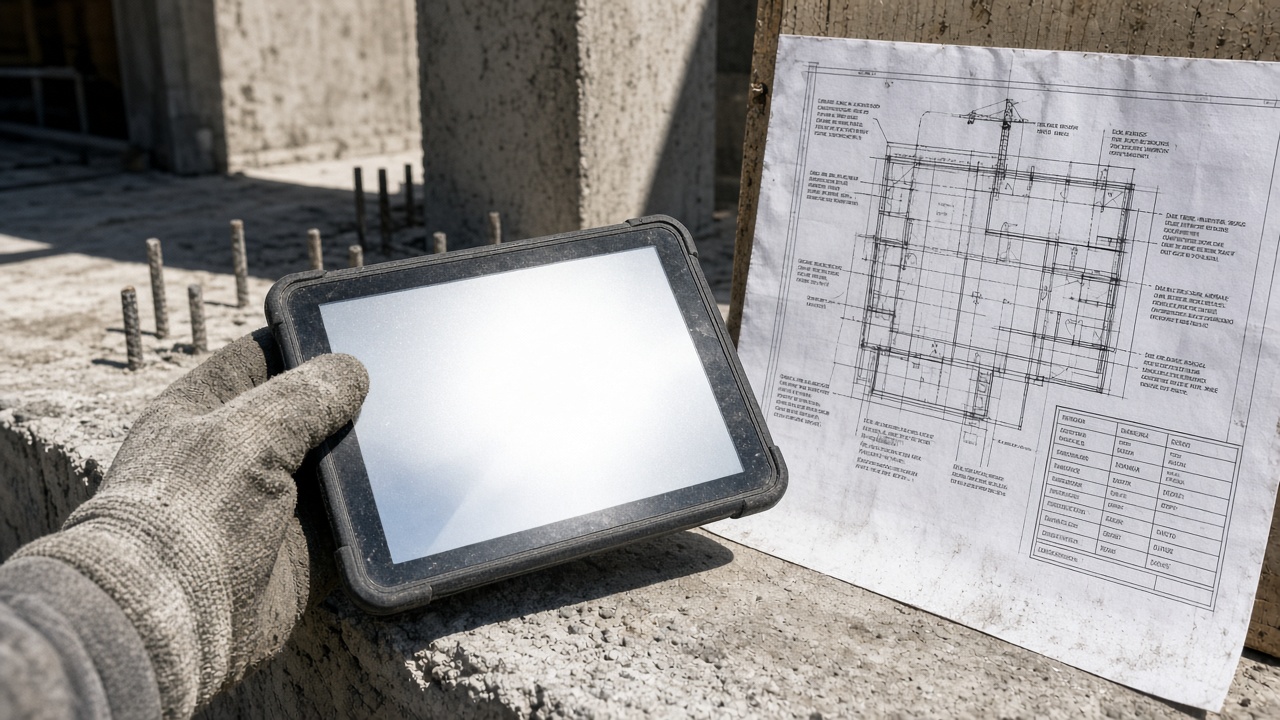
Ten past ten on a July slab edge, and a fixer stands with his back to the sun, holding a phone under the brim of his hard hat to make a shadow. The screen has a crack across one corner and dust over the rest. He is trying to work out whether the sheet that opened is the one mentioned at briefing, and the revision letter sits in a title block he would have to pinch twice to reach, cut-resistant gloves on, wagon waiting. He gives it fifteen seconds. Then he uses the print taped to the plywood since Tuesday.
That fifteen seconds is the last mile. The office sees a delivery problem — upload, transmittal, green cell on the tracker. The slab sees a constraint problem: sun, gloves, dust, no bars, a dying battery and a gang standing about. Those are different jobs, and only one of them has a dashboard.
ISO 19650 and CDM both assume issued information can be found and used at the point of work. Neither assumes a six-inch phone, a glove over a capacitive screen, glass that turns to a mirror by ten in the morning, and a login that dies somewhere between the second lift and the core. The gap rarely gets written down as physics, because the people who write information protocols sit at desks with good lighting. The people who use the issued set do not.
It is physics, not a folder
What the industry calls “getting it to site” is several different events wearing one name. A transmittal left the office. A zip landed in a mailbox. A tablet was handed out at induction. A print was taped to plywood. None of those is the last mile. The last mile is the moment a gloved person has to decide, from the artefact they can actually see, which sheet, which revision, and which purpose they are allowed to build from.
Digital delivery did not abolish that moment. It moved it. Paper fails by weather and by never being collected. Screens fail by glare, by battery, by signal, and by an interaction model designed for a bare thumb. Both fail in the same final way — by going unofficial. A crop in a thread. A photo of a title block. A print that was good enough yesterday.
Worth naming these as facts rather than as user error. If the official set cannot survive them, the unofficial set is not insubordination. It is what people build when the official one cannot be trusted at the workface.
Gloves
Work gloves destroy the interaction model that every field viewer inherited from a consumer phone. A gloved thumb cannot hit a forty-four-pixel target. Pinch-to-zoom on a general arrangement is theatre. Nobody is typing a twelve-field container name at a slab edge. So people photograph instead, or shout a short number over the radio, or open whichever file already loaded last time.
That is why a naming convention written for a folder tree dies on site. The field list in the execution plan is not the problem. The problem is that the only unique token in it is a hyphenated essay nobody can say, select, or read without peeling a glove off.
Gloves also change what “latest” means. The latest file is whichever one opens without a hunt. A swipe that misses the current revision and lands on last week’s download is an input surface doing what it was built to do, not a training gap. And if two sheets can only be told apart by a suffix you have to pinch to see, a second identity has already been minted.
Glare
Direct sunlight is not a preference setting. A tablet at full brightness is still a slab of glass with the sky in it. Contrast that looked crisp in the cabin vanishes on the deck. People cup the screen with a spare hand, walk to the shade of a column, or give up and go back to paper. Paper has its own glare and fade problems, but a high-contrast title block at A1 still beats a washed-out phone.
Nobody needs the whole drawing readable at arm’s length. What they need is the issued identity: sheet number, revision, suitability or purpose, and the change that is actually going to be built. If you have to pinch, rotate and wait for a tile to render before you can find the revision box, the issued set has not arrived at the workface. The geometry may be on the device. The sentence the site is entitled to rely on is not.
Shade-seeking is itself a record problem. The person who walked twenty metres to read a screen is no longer standing at the opening. The person who stays at the opening works from memory, from a crop, or from the print that is already taped up. Glare does not only hide pixels; it separates the artefact from the place of work.
Night shifts and basements fail the opposite way — not enough light, a torch in one hand, a device in the other, gloves on both. Same diagnosis. If identity and revision are not readable in the light the shift actually has, they are not in the issued set.
Dust
Construction dust is an abrasive film. It coats capacitive glass, clogs charging ports, and turns every swipe into a smear. A screen that was clean at seven is a fog by lunch. Add gloves, sweat and sunscreen and people stop trusting it for fine geometry and go back to the print.
Dust hides the analogue set too. A title-block revision box that read perfectly on the plotter tray is a grey smudge after three days on plywood. A plot stamp already sitting at its character limit becomes a rumour. Somebody writes REV C on the sheet in marker, and that marker is now the identity of record — the next plot of revision D does not erase it, because the sheet with the marker on it is still pinned up.
Treat dust as a design constraint rather than poor housekeeping. High-contrast revision boxes, short numbers and a withdrawal mark that still reads when the sheet is filthy are information-management decisions, made at a desk, with consequences at a slab edge. A protocol that assumes clean glass and a clean title block was written for the cabin.
No signal
The published set lives behind a login and a network. Basements, cores, steel cages, remote compounds and temporary power all drop the session, usually at the least convenient moment. A workflow that assumes live search is a cabin workflow. Nobody is climbing back up two levels to confirm a revision letter.
When the session dies, what remains is whatever was already cached, photographed or printed — and those become the unofficial set by default. “Sync later” without an honest conflict rule is how two issued-looking copies of the same sheet end up in circulation: one on the server, one in somebody’s hand, neither willing to admit which is stale.
Designing round that is its own discipline — see offline-first field workflows — but the constraint itself is simple enough. If finding the current issued identity needs a live connection, information has not been delivered to the workface. It has been delivered to the last place the radio worked.
Battery
Heat kills batteries and so does cold. A device that spent the night in a van will not last a shift. Charging lives in the cabin, on a trolley, or in a supervisor’s bag that is not at the pour, and the person at the workface is not walking back for a charger with a wagon booked.
When the device dies, the last mile collapses onto paper, a photo, or memory. All three can be right. All three can be yesterday’s revision. A project that measures field adoption by licences issued, and never once measures what the charge reads at three in the afternoon, has measured a procurement rather than a delivery.
Battery is also why the unofficial print outlives every app rollout. Paper needs no cable. Print is not backward; the problem is that the official set often has no survivable form once the battery hits zero, and until it does, the rack in the hut is the system of record for the people placing the work.
What a readable issued set looks like
“Issued” is an office word. At the workface the only issued set is the one that can be read — identity, revision, purpose, and the geometry that will actually be built — on a device that still has charge and contrast, or on a print that still has a legible title block.
Device against print is not a culture war. Both fail for physical reasons. A tablet that cannot show a revision in sunlight is holding the information, not delivering it, and so is an A1 whose revision box has been dusted into a rumour. A messaging-app crop with no title block is geometry with no identity at all. You cannot supersede a crop, and you certainly cannot withdraw it from the phones that now hold it.
Four conditions have to hold at once:
- Speakable identity. A short number one person can shout over a radio and have another find the same sheet.
- Revision and purpose at arm’s length. Readable on the print without a hunt, or on the device without pinch-and-pray, in the light the shift actually has.
- Withdrawal of the previous artefact. The old print collected, stamped or marked dead; the old download no longer the one that opens first.
- Survivable form. The same identity still available after gloves, glare, dust, signal and battery have each done their worst.
Fail any one of the four and somebody will build from whichever artefact was easiest to hold. The unofficial set in the trailer is what you get when the official last mile cannot answer them in time.
Six questions, answered at the workface
Take last week’s issued set — one live package, not the archive — and walk it out to where the work is happening.
- Glove it. In the gloves the job issues, can you find sheet number and revision without typing and without taking a glove off?
- Sun it. At the workface, in the light the shift has, can you still read identity and revision on the device? On the print?
- Dust it. Wipe nothing. Is the revision box still a fact, or has it become a smudge and a marker note?
- Kill the signal. Aeroplane mode, or just walk into the core. Does the current issued identity still open, or only the last file that happened to cache?
- Read the charge. What is left at mid-afternoon, and when it hits zero, which artefact is still standing?
- Withdraw it. Is there a dead mark on the previous print and the previous download, or are two live-looking copies of the same title still in circulation?
Write the answers as sheet numbers rather than as a rating. “The app is rolled out” is a licence count, not an answer.
What has to change, and who pays for it
Two of the decisions sit inside the project’s own gift. Give sheets a short, speakable identity, and put revision and purpose in high contrast at a size that survives dust — which means reopening the naming convention and the title block, politically tiresome and cheap in cash terms. Then make withdrawal a named duty. Collecting the superseded print and killing the stale download belongs to a person with a name and a slot in the week, the way issuing the next plot already does.
The rest costs money, and pretending otherwise is how it gets cut. Charging at the workface, plotting to a readable size and replacing cracked devices are line items, and they are usually the principal contractor’s to fund rather than the trade contractor’s to absorb quietly.
Clients and appointing parties hold the leverage that matters. Put last-mile readability into the information requirements alongside ISO 19650 and the rest — and then, before the first issue, ask to see a package read at the workface in the conditions the shift will have, rather than demonstrated on a laptop in a warm meeting room. ISO 19650, CDM, the Building Safety Act, NEC, FIDIC, JCT, COBie and MOMRA each have owners, and none of them is a field checklist. They assume issued information can still be identified and used after it leaves the desk — not a filename only an information manager can parse, or a viewer that only works in the cabin.
And give your document controller explicit cover to refuse a plot nobody will be able to read at the pour. That refusal costs a morning. The alternative is a gang building from a crop.
Read next: Why site teams keep a second, unofficial set of records, Naming information containers so the convention survives contact with site, Offline-first field workflows: designing for no signal.