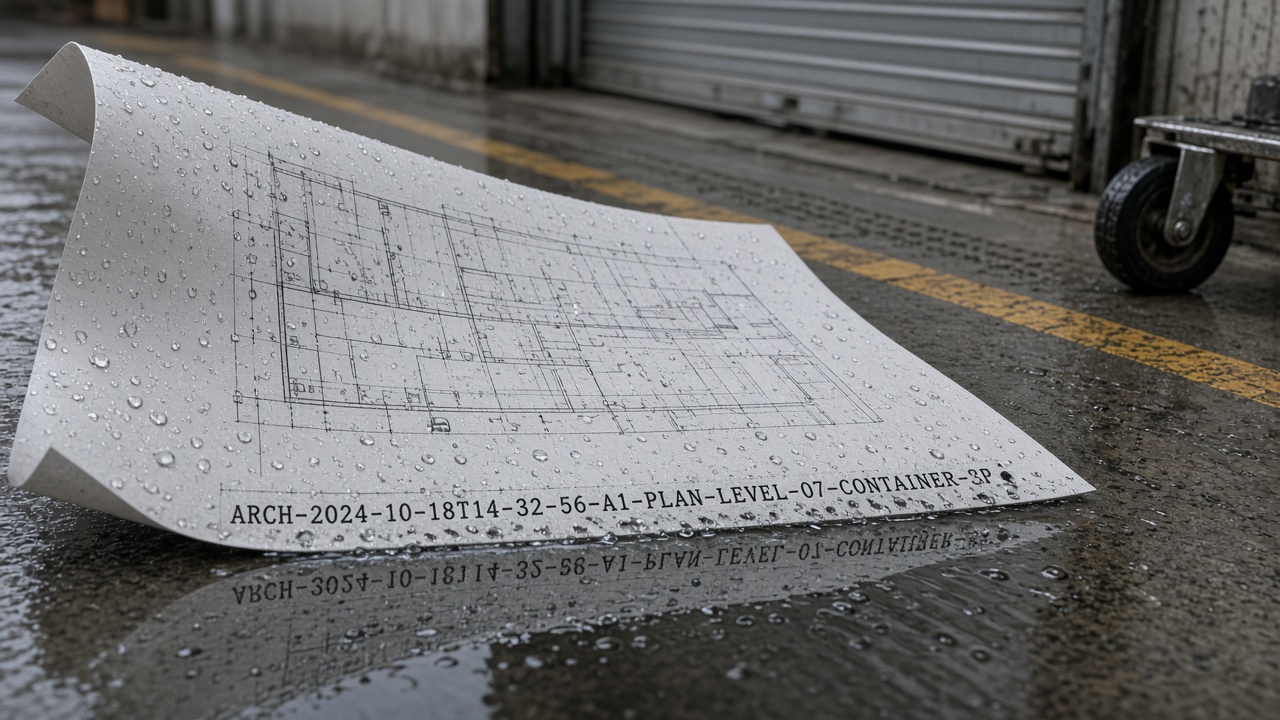
Somewhere on most projects there is a folder called something close to LATEST — USE THESE. Everybody knows about it, the document controller included, and she has stopped raising it in the weekly meeting because nobody there can do much. It is a workaround for a convention agreed round a table where everyone had a laptop and a column wide enough for sixty characters.
The field list in the standard is rarely the culprit. Project, originator, volume, level, type, role, number is a sensible way to describe an information container, and in the register it behaves. Things come apart once the container leaves the common data environment. The plot stamp truncates. A Windows path swallows the tail of the file. Someone emails a copy called FINAL_v3_USE_THIS because the client's portal rejected the real name. And a site engineer in gloves, in a wet loading bay, has to decide which sheet the gang builds from in the next twenty minutes.
That decision is what the convention has to survive.
The convention meets a gloved hand
Nobody on site browses a twelve-field hyphenated string. A gloved thumb cannot pick a seventy-character name out of a phone list in July sunlight, and over the radio you do not get the string at all — you get “the services drawing for level four, the new one”, or a short number somebody can shout. If the only unique token sits in the middle of a code built for a desktop file browser, site invents a nickname, and inside a fortnight the nickname is the identity.
People in gloves do not type. They photograph, they screenshot, they open whatever loaded last. Ask a field user to reconstruct a code from an appendix in the execution plan and you are competing with the last PDF in a messaging thread, which you will lose.
The working rule is narrower than the standard. The container needs one short, speakable identifier that appears on the file, the title block, the plot stamp and the register. Everything else can live in metadata. Two people, one radio, under a minute, same sheet — if that does not work, the folder in the trailer is the evidence.
What the plotter actually prints
The plotter prints a raster. It does not print your metadata and it will not apologise. Title-block boxes have a fixed width; plot-stamp fonts have a character budget. When the name outruns the box, revision is usually first over the right-hand edge — or the number truncates so that two different sheets read identically at arm's length.
Then somebody writes “REV C” on the print in marker, and that mark becomes the working identity of the sheet. Revision D arrives later without erasing the marker on the wall behind it. The gang's spoken name for the drawing and the register's name have diverged, and nothing recorded the moment.
Treat the plot as a design constraint rather than a courtesy.
- The number on the title block is the container identity. It has to be legible at two metres, on a wall.
- Revision gets its own box: large, high contrast, never implied by the filename.
- The plot stamp repeats number, revision, date of issue and suitability. If the stamp software truncates, shorten the number. Do not drop the revision.
- Do not put work in progress, shared or published into the filename and expect the plotter to explain the state. A print is a published act.
Short filenames are a site constraint
Long names fail for dull reasons, weeks after the upload looked clean. Windows still bites on long paths when an export lands nested under a user profile and a package folder. Email and messaging clients truncate or substitute characters. Zip tools and USB sticks flatten folders and collide two files that differed only in a parent directory. Raster software driving some large-format printers rejects characters a Mac accepted. Spaces, ampersands, hashes and plus signs come back from a download as encoded junk. Save the same file twice and you have drawing (1).pdf — a competing identity with equal standing in somebody's pocket.
The unofficial set in the trailer is usually a folder of shortened names: site translating a convention that would not fit a phone, a zip file or a plot queue.
Keep the filename to a short, stable container identity plus a safe extension. Aim for a name that survives the path remainder once the project folder has taken its share; eighty to a hundred characters is plenty, and two hundred is how exports break on a Friday. Pick hyphen or underscore, then forbid the characters that break a URL or a Windows path. Do not encode the folder tree in the name. Where volume or level matters for retrieval, put it in metadata and on the title block, so a gloved reader can see it without opening a path.
One check almost nobody runs: the download name should still be the register identity. If the system appends a username, a timestamp or the word “export”, it has minted a second container, and site keeps whichever is shorter.
Revision belongs in a field
This is the failure that looks most like compliance.
Teams bake P01, C02 or _RevC into the filename because that is how they have always known which file to open, and it works — for one person, for one week. Every revision then becomes a new container identity. The register fragments. Links break. “Latest” becomes whoever last saved a longer suffix. In a dispute, two files differing only by a revision token are treated as two containers, and the history of a single sheet has stopped existing.
The identity of the container is stable. Revision is an attribute of it: this issue, this purpose, this date. Confuse the two and superseded drawings get built.
The opposite failure gets less attention. Revision lives only in a metadata column, and the download, the email and the plotter all strip it on the way out. Site holds a correctly named file with no idea which issue it is, so the suffix habit comes back — not out of ignorance, but because the field did not travel with the file.
Revision needs to live in three places that agree: the metadata field, the title-block revision box and the plot stamp. When they disagree, stop the plot. Do not settle it by editing the filename.
Suitability and state are the same class of fact, and fields too. Putting a status code or PUB into the name teaches everyone that a rename is a release. A rename is not a release. It is a new identity, where a release is a recorded issue with a date and a recipient.
Walk it to site on a Monday
You can test a convention in a morning. Take last week's issued set and walk it out.
- Speak it. Can an engineer say the container identity over the radio and have the cabin find the same sheet inside a minute?
- Glove it. On a phone, in daylight, with a work glove on, can you tell this sheet from its neighbours without pinching to zoom a hyphenated essay?
- Plot it. Print the title block and the stamp. At two metres, can you read number and revision? Did anything truncate?
- Copy it. Email it to a personal account, drop it on a USB stick, zip it inside a nested folder. Is the filename still the container identity?
- Revise it. Issue the next revision. Does the identity hold? Do the three revision surfaces agree? Did anybody produce a
…_RevD_USE_THIS? - Reconcile it. Do the register, the transmittal, the title block and the print in the hut all name the same object?
- 01Speak itWhat it checksCan the identifier be said over a radio and found inside a minute?
- 02Glove itWhat it checksCan it be told apart from its neighbours on a phoneglovedin daylight?
- 03Plot itWhat it checksLegible at two metres on the printed title block and stamp?
- 04Copy itWhat it checksDoes it survive emaila USB sticka nested zip?
- 05Revise itWhat it checksDo the three revision surfaces — metadatatitle blockstamp — still agree?
- 06Reconcile itWhat it checksDo the register, the transmittal, the title block and the hut print all name the same object?
Six passes and the convention has survived contact with site. One failure and it is a folder convention.
On the file, keep to a project token, who originated it, a type, and a unique number a person can shout. Keep out revision, suitability, state, the word “final”, dates, initials, and anything the title block already shows. What belongs in the execution plan is the mapping — which field is identity, which is revision, which may change on issue — not a table copied out of an annex.
Who owns the field list
Not the information manager's preference, and not the CAD standard from the last office you worked in. The project's exchange information requirements own it, along with the national documents they point at. ISO 19650, CDM, the Building Safety Act, NEC, FIDIC, JCT, COBie and the Gulf mandates each have custodians. What they share is an assumption: that a container can still be identified after it has been issued, by someone who has never read the annex.
Fixing this is not free. Shortening a number already in circulation means a change to the naming section of the execution plan, a revised title block and plot-stamp template, and a document controller losing most of a week reconciling the register against the hut wall. Mid-project that is disruptive enough that most teams live with the workaround, which is how the workaround becomes the record.
Which puts the leverage at appointment. Appointing parties can write into the exchange information requirements that the container identity must be readable at two metres on a plot and speakable over a radio, and that revision, suitability and state are fields rather than filename characters. Lead appointed parties can refuse a subconsultant's set where the download renames the file. Anyone procuring or configuring a common data environment can ask for one demonstration first: issue a sheet, revise it, download it, print it, and show that the register, the stamp and the downloaded file still agree on which object and which issue. It is a short demonstration, and it settles an argument that otherwise runs the length of the job.
Read next: Suitability codes: the part of ISO 19650 almost everyone gets wrong, Thirty-one questions to ask a CDE vendor before you sign, Everyone says they have a CDE. Most have a shared drive with permissions..