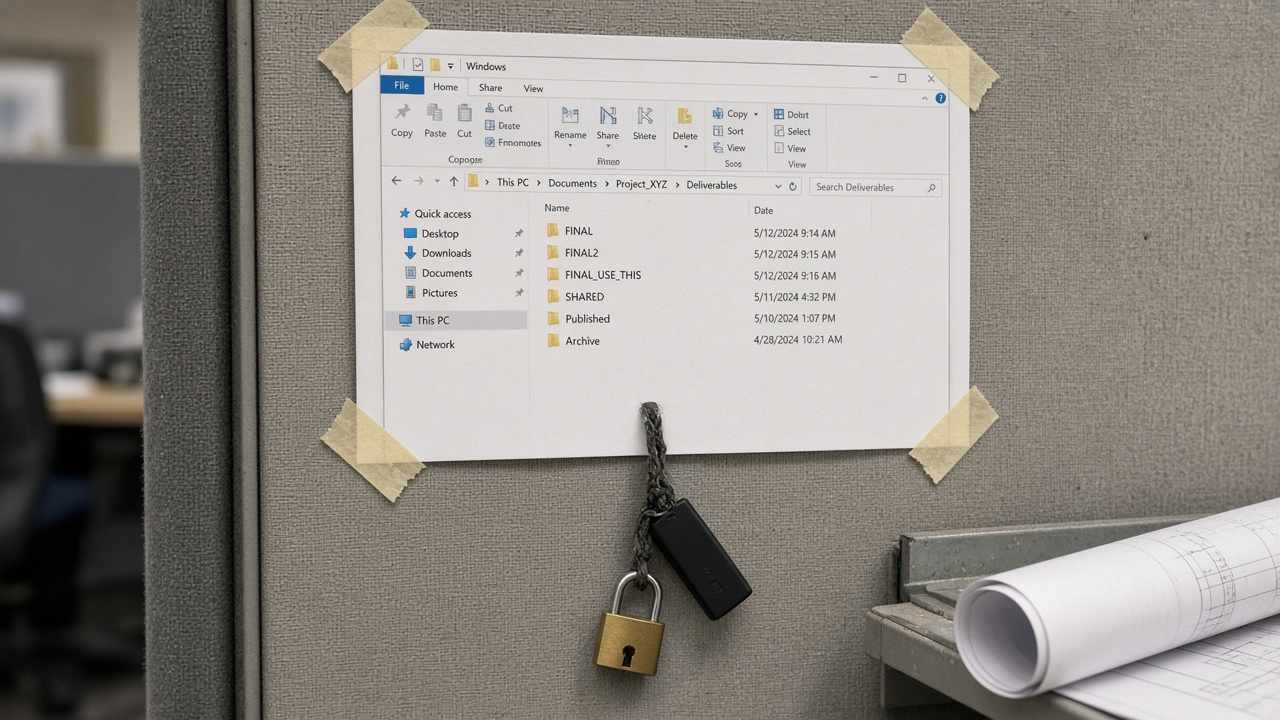
Every project has the folder. Four directories at the top level — WIP, Shared, Published, Archive — inside a library with security groups on it, and a paragraph in the bid calling the arrangement a common data environment. Open Published and there are two files for the same sheet, one of them ending in _FINAL_USE_THIS. The information manager can send you a link to the right one in ten seconds, cheerfully. That link is usually what "we have a CDE" means.
A shared drive with permissions is a cupboard with a lock, and locks are useful. The argument is not about the licence fee, or whether the BEP contains the words "ISO 19650". It is about whether the thing you call a CDE can do three jobs a permissioned folder cannot: hold a state, carry a suitability, and produce one issued set.
The costume is convincing
Most organisations are fairly sure they bought the system of record years ago. Someone paid for a document library with security groups, or a platform sold as a CDE, or a SharePoint that IT will defend in an audit. The folders are named after the standard. The models federate. Somebody is "on BIM". Compressed into a bid, all of that becomes one URL and a screenshot.
Access-control lists do real work, and it is worth saying so. They keep the client's commercial folder away from a groundworks subcontractor. They answer the question on every security questionnaire — who can see this? — which you do have to be able to answer. It is also, on most jobs, the whole of what the so-called CDE does.
A lock on a drawer tells you who holds a key. It says nothing about whether the drawing inside is work in progress, shared for coordination, published for construction, or archived because it was superseded on Thursday. Those four things are states, and a folder name only impersonates one; anyone with write access can move the file, and the costume moves with it.
A state is a gate, not a folder
ISO 19650 describes a common data environment as an agreed source of information for collecting, managing and disseminating each information container through a managed process. The practice that grew up around the standard uses four states: work in progress, shared, published, archive.
Each is a claim about the container, and it means something only if something enforces it. WIP says nobody else should be relying on this yet. Shared says it is offered for coordination or review, with a suitability stating what for. Published says authorised for a stated purpose — including, when you mean it, issued for construction. Archive is the trail of what used to be true.
A permissioned folder cannot hold a claim like that. You can create four folders, apply groups and write the names into the BEP, and end up with four cupboards. The same file sits in two of them as copies. A coordinator downloads from Shared, marks it up and emails it to a fabricator. A site engineer keeps last month's Published on a laptop because the cabin connection is what it is. The plotter does not ask which cupboard was authoritative at two o'clock on a Tuesday; it prints whatever reached the queue.
The test is mechanical. Can the system stop a WIP model being treated as published without a recorded review? Can it show, for one container, the sequence of states and the person who moved it between them? Can it tell you what was in Published for a package on a named date? If the honest answer to the last one is that somebody would piece it together from folder history and a mailbox, that is archaeology, and archaeology takes weeks.
Suitability, and where it actually lives
The other thing the standard asks of a container is a status: a suitability. In UK practice that means the S and A codes — suitable for coordination, for information, for review, for stage approval, for published documentation. The code is a sentence about purpose. S2 is not a decoration. It is the difference between "use this to coordinate" and "build this".
On a shared drive, suitability survives as folklore. Someone appends _S1 to filenames for three weeks and then stops. A document controller keeps a spreadsheet column that lags the files by a week, knows it lags, and cannot fix it from her desk. Everybody assumes anything in Published must be authorised, because why else would it be there. None of that is attached to the container as a fact the next person is obliged to look at.
Misuse is how a shop drawing becomes a construction drawing in a dispute. The folder will not help you there, and neither will the ACL: the person who plotted it had permission, which was rather the point. If the system cannot refuse to issue a container whose suitability still says coordination, suitability is a letter in a filename with no teeth.
An issue is an act; an upload is not
The argument after handover turns on something narrower than whether there was a system. Which authorised pack left, which recipients received that revision, and on what date — and can anyone still show it?
An issued set is a bounded, authorised collection: these revisions, this purpose, this list of recipients, this moment, with a transmittal as evidence that the act took place — not simply the newest files in a folder. A permissioned folder contains no act at all — uploads, downloads if logging was on, and a modified date that records a save.
Which is why site teams end up keeping a second, unofficial set. If the official cupboard cannot be trusted to say which sheet is live, the trailer prints its own, the office argues back with a screenshot, and two years later a commercial manager is trying to build a position out of both. That is the ordinary way a claim dies — not for want of a system, but for want of a contemporaneous file.
The objections, and what they are worth
You will tell me the BEP names a CDE. A BEP is a promise made before anyone had to print anything. Tuesday on site is the test.
You paid for a real platform, not a drive. Fair. A CDE used as a drop-box is still a drop-box; the licence does not create states, the workflow does. If the expensive system is a library with groups and a search bar, you bought a prettier ACL.
The metadata columns are there. Columns nobody is required to complete, and nobody is prevented from contradicting, are decoration. A suitability that can be skipped will be skipped, usually at half four on a Friday.
Version history exists. Version history is a stack of saves. It will not tell you what was authorised for construction, who received it, or which superseded sheet was still in the plotter tray.
Permissions are security-minded information management. They can be — who should see what is a real requirement, sometimes a statutory one. It is simply a different job from moving containers through states. A locked cupboard can still hold the wrong drawing.
Call the shared drive a CDE if that keeps the peace with IT. At the next tender the appointing party should treat the costume as a fail. Write into the appointment that the environment must hold an enforced state, carry a suitability that can stop a plot, and produce one issued set for a named date — and that a permissioned folder does not meet it. Standing that up will cost mobilisation, and it may mean retiring the library already sitting in the IT catalogue. Both are cheaper than arguing from an access log after handover. If the bid still offers four folders and a screenshot, send it back.
Read next: What an information-first project looks like in 2030, What ISO 19650 actually requires of a common data environment, clause by clause, The four CDE states: work in progress, shared, published, archive.