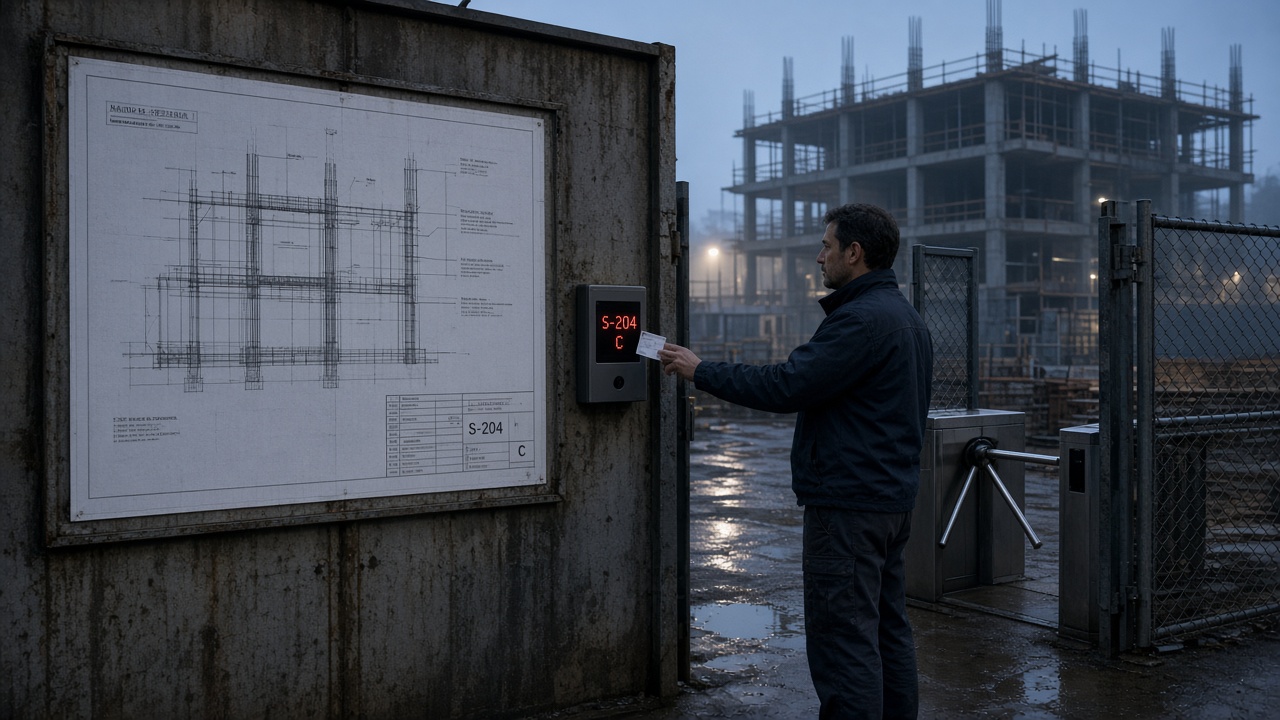
Ask most people to describe a construction project in 2030 and you get a showreel: drones, a twin that glows, a chatbot that knows the job. I would bet against any of that being the interesting part. Much of what completes in 2030 is already in somebody's pipeline, which makes the guess less wild than it sounds — though a guess is all it is, and the scenario below is a projection rather than a forecast I would defend in front of a client.
The version worth aiming at is dull to visit. A mid-size frame is going up in weather that has not improved. The site office smells of plywood and instant coffee, there is still a plan rack, and someone is still plotting A1s because gloves and low winter sun do not care about a tablet. The companies have not merged into one happy platform; the commercial tension is exactly where it is today. The site manager wants a drawing in his hand before the pour.
What has changed, in that version, is not the kit. It is that anyone on the job can say which package was released for construction, to which firms, at which revision, without a hunt through mailboxes — and that the gantry, the trailer and the contract administrator's folder agree.
The job, not the kit
None of the ingredients would be new. The expensive failure is rarely the missing PDF; it is not knowing which issued set the site actually built from, and rework follows the revision that never reached the gang doing the pouring. Forty systems can sit on one project and still leave nobody holding the issued set, because each purchase was rational on its own terms and none of them was bought to do that. Instructions hide in email. A federated model is not the same thing as a managed record, and a folder convention is not a common data environment. The chain from exchange information requirements, through the four container states, into an asset information model has been written down for years.
So 2030 adds no fifth idea. Either it is the year those sentences describe how ordinary jobs run, or the showreel wins and we carry on with better lighting.
An information-first job in that scenario still has models, still has a register, still has a common data environment named in the appointment. The test is narrower than the sales material. On an ordinary morning, three people who do not share an employer — a subcontractor's foreman, the design coordinator, the client's project director on a walk-round — can each name the current issued set for the work in front of them, and the record backs all three.
Who can prove the issued set
The issued set is not a feeling, and it is not whatever sits in the most recently touched folder. It is a dated, named, transmittable package: drawings, models and specifications released for a stated purpose, to named organisations, at a stated revision and suitability. Someone can rebuild that package six months later without ringing the coordinator who has since left for another job.
On this kind of project the site does not keep a second unofficial set in the trailer, because the official one is neither late nor unreadable nor quietly distrusted. If a print is taped to the wall, it matches the published container. Where it does not, that is a recorded exception rather than a way of life.
When a variation is argued — and variations will still be argued in 2030 — the contemporaneous file is already sitting in the record: the issue, the recipients, the state the container was in, the suitability code it carried. Nobody's claim collapses because the decisive attachment lived in a personal mailbox that was closed when the sender moved firms.
States that actually bind
The four states are the ones the industry already wrote down: work in progress, shared, published, archive. The difference in the scenario I am describing is that a container cannot sit in two of them at once without anybody noticing.
Work in progress belongs to the authoring team. Shared is for coordination, not for construction. Published is what the site is allowed to build from. Archive is where superseded and rejected containers go, so that they can be found and cannot be plotted as current.
Suitability codes do the work they were designed for. They are not decoration on a title block; they govern who may use a container and for what. A drawing marked for information only does not quietly become a construction issue because a subcontractor needed something before Friday.
Naming survives contact with site, too. The container identity does not reset the moment someone emails a PDF called FINAL_v3_USE_THIS, and the register, the transmittal and the plot all point at the same object. None of this needs a new standard written for it. ISO 19650 already describes the environment meant to do it, so the open question for 2030 is not whether the clauses exist but whether projects are living inside them.
Handover as the same record
Handover, on this job, is not a skip of PDFs wheeled in at practical completion. It is the same chain, continued past the ribbon.
The project information model does not freeze into a twin nobody updates, and the asset information model is not reconstructed from scratch by a facilities team walking corridors with a clipboard. Commissioning records, inspection and test plans, warranties, spare-parts fields and the health and safety file are tied to the assets they describe, because they were captured against those assets while the work was live and the installer was still on site.
Operations can then query what was installed, to which revision, with which certificate. They will still complain about data quality — facilities managers are professionally unimpressed, and rightly. What they should not have to do is invent a third model because the first two never met.
What 2030 still has
Companies. Commercial tension. RFIs, delays, weather, and people who will plot a superseded drawing the moment the system lets them.
What it lacks is five private copies of the current set, email doing the job of the contract record while the CDE plays a supporting role in the monthly report, and the habit of calling a permissioned shared drive a common data environment and stopping there. No flying interface required. Just a record that can be argued with in a coordination meeting and still hold up at adjudication and at handover.
Getting there is a procurement decision
The people who can make 2030 look like this are the ones who write the appointments, and they will have to spend to do it. Three things are worth putting on the table now rather than in 2029.
Fund the information management function as a named appointment with a fee line against it, not as a duty bolted onto a design manager who already has a day job. Put the information protocol in the contract, with the CDE obligation inside it, so that use of the environment is enforceable rather than aspirational. And move handover data capture into the construction programme, priced, instead of leaving it as an unpaid scramble in the last eight weeks — which is where it becomes a crate of PDFs.
Then test it. At the next milestone, pick a package at random and ask three people from three firms which revision governs the work in front of them, and see whether the record agrees. A client's project director can run that in half an hour on a site visit, and it costs nothing but the awkwardness of the answer.
Read next: Monthly Register — October 2024, Everyone says they have a CDE. Most have a shared drive with permissions., The most expensive thing on your project is the document nobody can find.