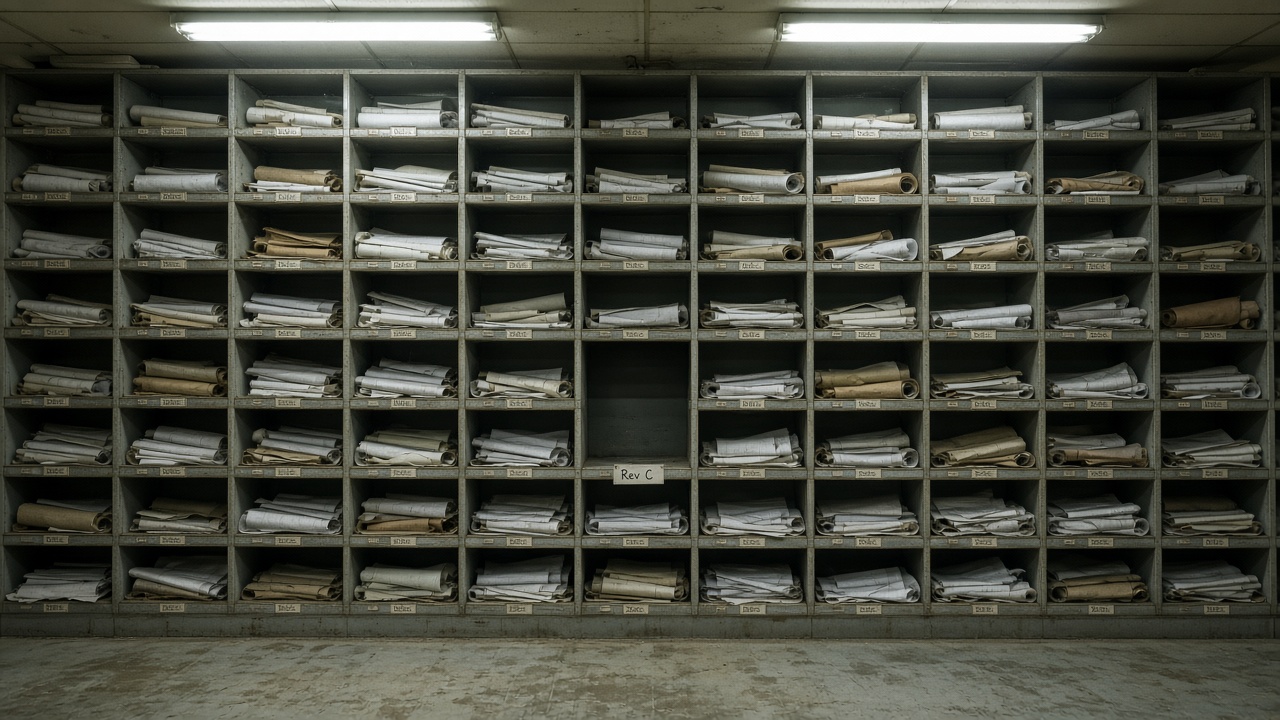
Ten past seven on a slab, four men, a drawing in a plastic wallet, and somebody asks the question that costs this industry more than anything on the risk register: is this the latest?
Nobody in that huddle is short of a file. The sheet is in the common data environment, in last Thursday's transmittal zip, taped to the hut wall, photographed on the foreman's phone, and marked up on a tablet that has not synced since Friday. Each copy carries a revision letter that looked current when it was taken. Nothing is lost. What nobody standing there can do, before the first wagon arrives, is say which of the five the gang may build from and prove it.
We file this under filing. Someone could not find a PDF, document control is behind, the search is poor, buy something better. That reading is popular because it points at storage, which is a thing you can purchase.
The bill is somewhere else. It sits in the interval — ten minutes, a shift, occasionally three weeks — in which nobody on the job can say with evidence which issued set the site is building from. The interval does not pause the works: the pour happens, the riser goes in, the delay notice still gets a date on it. What the project lacks is a contemporaneous answer to a plain question — which sheets, at which revision and suitability, went to which companies, for what purpose, on that day.
The document was rarely missing
When people say nobody can find the drawing, they usually mean one of four things, and a vanished file is not one of them.
Sometimes the latest approved revision is sitting in the system and the site is working from a sheet plotted the afternoon before a late comment landed. Sometimes two companies each hold a "for construction" set dated the same week and the two do not agree. Sometimes the model was federated to one coordination issue while the sheets went out from another. And sometimes — the ordinary case — five copies are in circulation, none tied to the same issue event, with nothing to say which carries authority. The document nobody can find is the one that would settle which of those is true.
Search assumes you already know the object you want. The expensive failure is not knowing which object in the pile is the record.
Put a cost on that interval
The interval has a bill, and it does not wait for the cost report to name it.
Rework. The Get It Right Initiative's research, widely used in the United Kingdom, puts the measured direct cost of recorded error at around five per cent of construction cost — already above typical contractor margin. A Delphi exercise in the same programme puts the total cost of error nearer 21 per cent of spend once indirect cost, unrecorded process waste and latent defects are counted. GIRI's Strategy for Change also frames the wider literature as a 10–25 per cent band when unmeasured costs are included. Those figures are not a single measured ledger, and they are not all "lost drawings". They are the industry's best published attempt to price error, and a large share of it is building the wrong thing once, then building it again.
PlanGrid and FMI's 2018 Construction Disconnected survey of nearly 600 construction leaders attributed 48 per cent of United States rework to poor project data and poor communication (22 per cent and 26 per cent). Globally they put the same pair at 52 per cent of rework. The top causes they recorded for poor project data were erroneous or outdated information, and difficulty accessing what the team needed. That is retrieval failure described from the site, not the IT catalogue.
Standing time. The same survey reported that respondents spent 35 per cent of their time — more than fourteen hours a week — on non-optimal work: looking for project information, resolving conflict, and dealing with mistakes. FMI priced the United States labour cost of those activities at $177.5 billion for 2018. A gang standing about while somebody "just finds the latest" is paid labour waiting on a set that should never have been ambiguous. The wait is cheaper than the wrong install; both are retrieval costs.
Wrong-revision install. This is the cost that does not look like searching, because the document was found. It was the wrong one. A superseded penetration drawing, an obsolete setting-out, a door schedule that predates the last architect's instruction — each produces work that must be broken out, or left in and argued over for the rest of the job. The waste shows up as concrete, copper and programme. The cause sat in the record: two live copies, no single issue event, a site obliged to choose.
Claims that die. Adjudication and the delay file do not ask whether your team remembers what was current. They ask what can be proved. If the instruction lived in a mailbox, if the transmittal cannot be reconstructed, if the hut set and the published set disagree and neither carries a closed issue history, the commercially right argument still loses. The contemporaneous file is not a courtesy to the lawyers; it is the only record left when the people have moved on.
Add those four together and the missing document stops being an inconvenience. It is a cost centre that outruns the subscription for the system meant to prevent it.
The expensive thing is the issued set you cannot name
An issued set is not a folder of PDFs. It is a dated, attributed act: these sheets, this model state, this revision of the specification, released to these companies, for this purpose, in this information state. ISO 19650's language of work in progress, shared and published information exists because those states are different legal facts. A common data environment that stores every state and cannot tell them apart is a warehouse.
Ownership of that record has nothing to do with whose logo is on the platform. It belongs to whoever can sit down on an ordinary Thursday afternoon, without pulling three people off their work, and reconstruct which containers went out at which suitability, to which firms, on a named date. Where no such person exists, the project holds no record — only files and a shared belief about what happened.
The unofficial set in the trailer exists because the official one cannot be trusted at the point of work. Email becomes the contract record because the issued set was never closed as an event. Forty systems can all be rational purchases and still leave no single source of truth, because none of them was ever asked to own the issue.
And the project that cannot name its issued set pays twice: on the day, in standing time and in the odds of a wrong-revision install, and again later, when the as-built cannot be reconciled to any issue, the facilities team rebuilds the register off nameplates, and the delay narrative has photographs but no transmittal.
What to stop accepting
Start by naming the person who may publish and withdraw: a role on an appointment, with the authority to close an issue and to kill a superseded one. Make every issue carry a time the system captured rather than typed in afterwards, a stated purpose, and the list of companies it went to. If your tools cannot produce that list a year later, you have your requirement for the next procurement. Give somebody the job of collecting superseded prints off the hut wall, and pay for it; nobody volunteers for that work. At tender, stop accepting the name of a common data environment as an answer to how issue is controlled; that tells you where files sit. Ask to be shown the issue register for one week last spring: containers, suitability, recipients, dates.
Clients and appointing parties are the only ones who can make those conditions of appointment; principal contractors are the only ones who can make withdrawal of superseded paper a coded activity, not a good intention. None of it is free — a fee line, a slice of somebody's week, a redrafted schedule of services. Set that against the rework figures above and it is not a close call, but the line still has to be in the budget before the first drawing goes out.
Read next: Rework is not a site problem. It is an information problem., Why a project runs forty systems and still has no single source of truth.