A project director will often sign for the fifth system of the year because someone in the room has a real problem that the first four do not touch. Commercial cannot wait for the document platform to grow a cost module. The planner needs dates that are not a folder. Site will not log a defect in a portal that takes a VPN. Each purchase is an answer to a different question, asked by a different buyer, on a different week. “Single source of truth” is the sentence that arrives after the other thirty-nine are already on the invoice.
The purchases were not mistakes. The failure is not the shopping. The failure is that none of those answers is an issued set of record — the container the site is authorised to build from — and a document controller who has been told the common data environment is that container still cannot say which revision the gang used on Tuesday.
Start with an inventory, not a sermon
Before suitability codes, before a naming convention, before anyone files a claim, someone has to map what the job actually runs. On a live job, copy the groups below into a sheet. For each system write three lines: who bought it, what question it answers, and whether it can name a revision, a recipient list, and a state. If it cannot name those three, it is not a candidate for the issued set, however expensive it was.
Keep vendor names out of the first pass. The question is the function, not the logo on the login.
What an issued set of record would have to be
A single source of truth, if the phrase meant anything on a construction job, would be the container the site is authorised to build from. It would carry a revision, a suitability, an issuer, a list of who received it, and a state that still answers after the people who remembered it have left.
That is a narrower claim than “we have a database” or “everyone is on the CDE.” Storage can hold a file. A model can hold geometry. A programme can hold dates. An ERP can hold a cost code. None of those facts, by themselves, tells you which issued drawing was live on Tuesday.
Use that test on every row of the map. A typical mid-size job — a school, a mid-rise, a hospital ward block, a mixed-use core — already fails it in ordinary places.
Communication that was never bought as a CDE
Email is the default corridor of the contract. It was not procured as information management. It was already there: a licence the company pays for, a habit the supply chain already has, a channel that will accept a PDF at 18:40 when every portal is closed. That is rational. It is also how instructions fork. The same attachment leaves the sender once and arrives as five local copies, none of them obliged to die when a later revision is issued. Personal mailboxes, leavers, and “please see attached” with no revision in the subject line are not edge cases. They are how email works.
WhatsApp — and the other messengers that behave like it — was adopted because site work does not wait for a seat, a VPN, or a naming convention. Gloves, dust, sunlight, and a trade who will answer in ninety seconds are a better specification than most software requirements. Photographs move. A sketched mark-up moves. A “build this, ignore the plot” sentence moves. That is rational. It cannot name a revision, a recipient list, or a state. The thread is not a transmittal. When the phone is wiped, or the group is renamed, or the person who posted the photo leaves, the instruction has no home that a later enquiry can open.
Teams, Slack, SMS, and the site radio sit in the same family. Each one was adopted to close a latency gap. None of them was designed to be the issued set.
The systems that were bought to look like the record
The CDE is the purchase most often asked to carry the phrase “single source of truth.” The buyer is usually the employer, the project manager, or a principal contractor answering a tender requirement. The question it answers is real: where do controlled containers live, who may see them, and can we transmit a package without attaching it to an email? That is a rational purchase. It still fails the test on a typical mid-size job for ordinary reasons. Not every company on the job has a seat. The people who build from the drawing are not the people who were trained on the workflow. Uploading a file is treated as issuing it. A superseded revision remains downloadable, or remains on a plot, or remains in last week’s inbox. A CDE can be a genuine common data environment, or it can be a shared drive with a login and a nicer name. Either way it is not the issued set until a document controller can reconstruct, from the system itself, which revision the site was authorised to use last Tuesday — and until the unofficial copies have been given a reason to die.
Model coordination was bought because clashes cannot be found in a folder of PDFs. A federated model, a clash run, an issue list: that is rational for anyone paying for coordination. The question it answers is geometric interference, not issue-for-construction. Closing a clash in the coordination tool does not, by itself, change the container the site is authorised to build from. The clash report and the issued drawing are different objects. Teams that treat the model as the record discover this when the site builds from a PDF that never received the fix.
Authoring tools, site viewers, and a separate issue tracker for coordination comments often sit beside that purchase. Each is rational. Each adds another place a “current” model can live.
Commercial, programme, people, money
Cost systems — taking-off, the bill, the cost-value report, the variations log — were bought by commercial managers and quantity surveyors who cannot wait for a document platform to become a cost platform. The question is: what did we price, what has changed, and what are we due? That is rational. A bill of quantities is not an issued set. A variation that cites “as drawing” without a revision is a commercial fact attached to an information failure.
The programme — a Primavera-class master, an Asta or Project file, the Excel lookahead the site actually uses — was bought because dates and logic need a planner, not a folder. That is rational. An activity code is not a drawing revision. When the lookahead and the issued set disagree, the site will follow whichever one was in the room that morning.
The ERP was bought by accounts to close the month, raise a purchase order, and hold a job-cost code. That is rational, and it is usually a company-wide decision made years before this project existed. It is not document control. The danger is not that the ERP exists. The danger is that people who live in it all day will upload a drawing there because that is the system they trust, or will treat a cost code as proof that a revision was issued.
HR — timesheets, right-to-work, inductions, agency labour, training records — was bought because you cannot pay people, or let them on site, without it. That is rational. It is also the clearest exhibit in the argument. A job can run an impeccable HR stack and still have no issued set. “We have systems” is not the same sentence as “we can name the drawing.”
Procurement, payment applications, plant hire, and the insurance folder are the same family: necessary, locally true, and silent on suitability.
Site, paper, and the unofficial set
Snagging apps were bought because a paper snagging list does not survive practical completion. A phone, a pin on a sheet, an assignee, a photograph: that is rational, and it is why field products win on day one. The question they answer is defect status, not which revision the pin sits on. If the PDF under the pin is last week’s issue, the snag is a precise note on the wrong record.
The plotter is not a metaphor. Mid-size jobs still print. Site still hangs A1s. The print room was funded because a gloved hand in sunlight cannot interrogate a portal, and because a marked-up sheet on a wall is faster than a login. That is rational. The moment the sheet leaves the tray it is a fork. There is no supersede on a nail. The unofficial set in the cabin is not a cultural failure. It is what paper does when the official path is slower than the work.
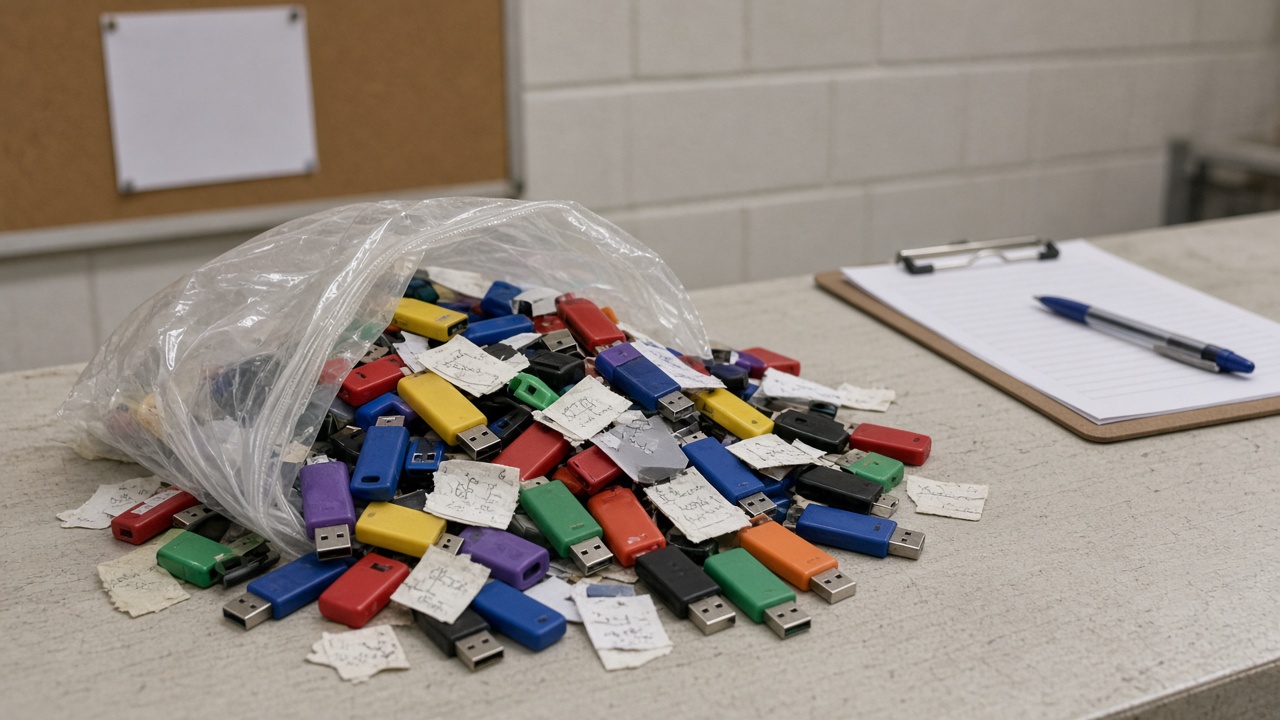
Personal drives — the desktop folder, the OneDrive, the USB in the drawer, the “IFC_FINAL_v2” on a laptop that will be reimaged in March — exist because the official path failed a person at a time they still had to deliver. No seat. Slow upload. Friday afternoon. A consultant who will not use the CDE. That is rational for the person. It is fatal for the record. The file that gets built from is the file that was to hand, not the file that was issued.
The rest of the forty
Forty is not a flourish. Count functions, not brands. A typical mid-size job will pass thirty before anyone is trying. The named systems above are the ones people point at in a steering group. The rest live beside them:
- a company SharePoint or shared drive that predates the CDE and never got switched off
- a second portal the consultant already pays for
- a vendor or specialist portal that will not accept your naming convention
- a file-drop for anything larger than the mail filter
- a local PDF mark-up licence on one person’s machine
- an Excel drawing register that is the only list anyone trusts
- a paper wall-set that is treated as current because it is visible
- a daily diary, a permit-to-work book, an incident log
- inspection and test plans on a form tool that does not share identity with the CDE
- a camera roll that is the real progress record
- an RFI log and a submittal register, sometimes modules, sometimes spreadsheets
- an authority or municipality portal that will not federate
- a handover drop created in the last six weeks because nothing else will assemble
Add the authoring tool, the site model viewer, the coordination issue list, the lookahead, the whiteboard, agency labour, plant, and training, and you are at forty without invention. A gigaproject will double it. The count is not the scandal. The scandal is that the count is treated as maturity.
Why rational purchases still yield no issued set
Each system is locally true. Email is true about who was written to. WhatsApp is true about what was said at 07:10. The CDE is true about what was uploaded. The coordination model is true about a clash on a given run. Cost is true about a rate. The programme is true about a logic link. Snagging is true about an open defect. HR is true about a timesheet. The ERP is true about a posting. The plotter is true about what left the tray. The personal drive is true about what one person could find.
Local truth does not compose. There is no shared identity for “this container.” The same sheet acquires five filenames, three revisions, and two suitability stories. Export and import are copies. A copy is not a record of issue. Licence walls mean the people who need the set are not the people who can see the workflow. Latency means the unofficial path wins: messenger, plot, personal folder. Nobody is paid to federate the forty. The document controller is paid to keep one of them tidy.
So the job can be full of systems and empty of an issued set of record. “Single source of truth” is what a product page calls one vendor’s database. A mid-size job is a federation of local truths with no agreed issued container.
A Monday inventory
Run this without a consultant. It should fit in a week if you already know the job.
- List every system that holds a drawing, a model, an instruction, or a photograph of either. Include paper and phones.
- Against each, write the buyer, the question it answers, and whether it can name revision, recipient, and state.
- Mark the unofficial set: the wall, the cabin folder, the group chat, the personal drive.
- Pick one live sheet. Follow it through every system on the list. Write down every filename and date you find.
- Ask the site, not the steering group: if the project manager left tomorrow, which file would you still build from?
- The systems that cannot survive that question are not candidates for the issued set. Stop calling them the source of truth.
If two systems disagree, do not average them. Name the one the site used. That is the record you actually have.
You do not need forty replacements. You need one container that can be issued, superseded, and still found — and a reason for the other thirty-nine to stop pretending they are that container.
The project director who keeps buying the next system is also the person who can stop treating the stack as proof of control. Spend the week on the inventory before the next licence is signed. Name, in writing, which container is the issued set — revision, recipients, state — and give a document controller the authority to refuse work that is being built from a plot, a chat or a personal drive that disagrees with it. That authority costs political capital more than software: unofficial copies die only when using them has a consequence, and someone has to be paid to apply it. ISO 19650, CDM, the Building Safety Act, NEC, FIDIC, JCT, COBie and MOMRA each assume that issued container exists. They do not fund the person who keeps the other thirty-nine honest. Until the employer or the principal contractor does, the fifth system will feel like progress, and Tuesday’s drawing will still live wherever it was to hand.
Read next: Monthly Register — September 2024, The hidden cost of treating email as the contract record, The most expensive thing on your project is the document nobody can find.