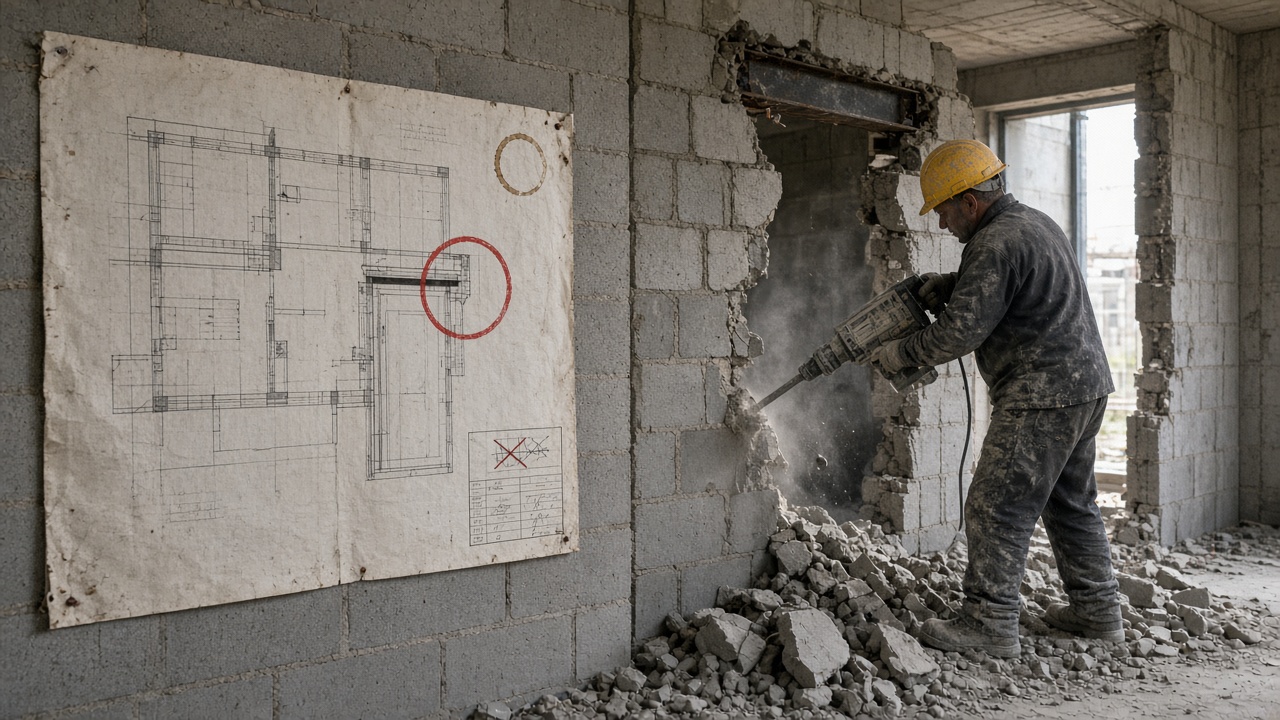
Somebody is taking down a blockwork partition that went up nine days ago. The foreman has the breaker, two of his lads are stacking the whole blocks against a column, and pinned to the standing leaf is the A1 the wall was built from — lintel in the wrong place, a revision letter the register stopped recognising a fortnight ago. Nobody on that floor did anything careless. The wall is plumb. It is also coming out.
By the time that reaches the progress report it has turned into a productivity event. The site was slow. The gang was green. Supervision failed. And somewhere in the pack behind it sits the figure everybody recognises: rework is 20–30 per cent of the job, therefore construction cannot organise labour.
The explanation flatters everyone who does not pour, fix or first-fix. It is also a poor account of that particular wall. The money landed in labour hours and material because blocks get laid on site. The cause had been sitting in a register for a fortnight.
Why the blame lands on the slab
Call a thing productivity and you already know where you are going to look. You add gangs. You write a recovery programme. You send a commercial letter about workmanship. You engage somebody to measure output per hour at the workface, because the workface is visible and the record is not.
Site skill is real, and so is poor workmanship; neither is the argument here. A perfectly competent bricklayer will build the wrong wall if the plot in the cabin, the PDF on a phone and the published container in the common data environment are three different revisions of the same sheet. The workmanship can be immaculate. The instruction was not.
The productivity account also survives because it is administratively convenient. Timesheets have codes for “defect” and “rework by package.” They rarely have a code for “built from a superseded issue that the transmittal never reached.” Commercial teams settle what they can price, productivity teams measure what they can see, and the records failure looks, from the slab, like people doing their job on the wrong instruction.
The 20–30 per cent claim
Treat the 20–30 per cent figure as a claim, not as a census.
It is the industry’s favourite productivity statistic because it is large, round and portable. It turns up in keynotes, in vendor decks and in board papers, usually without a source, a year, a geography or a definition. Sometimes it is offered as a share of project cost. Sometimes it is labour hours. Sometimes it is “waste” in the lean sense — waiting, motion, over-production — quietly relabelled as rework. Sometimes it is the top of a published range that has been rounded upward until it sounds like a law of construction. A number that cannot say what it counted cannot tell you what to fix.
The studies that actually measured jobs do not hand you a single 25 per cent. Construction Industry Institute material has long put typical rework in a band of about 2–20 per cent of contract value. Peter Love’s 2002 paper in the Journal of Construction Engineering and Management, based on 161 Australian building projects, is one of the pieces of work people are gesturing at when they say “the literature”: direct rework around 6.4 per cent of original contract value, indirect around 5.6 per cent, and rework taking a large share of cost growth. Hwang, Thomas, Haas and Caldas, writing in 2009 from hundreds of projects in the CII database, put direct rework costs in the region of 5 per cent of construction cost, with the impact varying by project type. Other papers — Barber and colleagues among them — report cases heading toward a quarter of contract value. Josephson’s Swedish benchmarking sits lower again.
The scatter is the finding. Definitions differ. Direct costs are easier to catch than the knock-on: the idle gang, the recut material, the programme that slips because a room got built twice. A slide reading “industry rework is 20–30 per cent” has collapsed all of that into a slogan. That rework is expensive is not in doubt; treating the slogan as a primary study of your own job is where the trouble starts.
Three questions are worth asking before you manage to the number. What counted as rework — field only, or design change as well? Of what — original contract, construction cost, labour hours? And what would have to be true for it to fall? If the answer to the last one is “better trades,” you have not left the productivity story.
Follow the issued set
Nobody builds from a philosophy of information management. They build from what they can hold, plot and trust that morning.
An issued set is construction information that has been authorised for use, sent to the people who will use it, and still current when they use it. All three conditions have to hold at once. When they do not, somebody builds the wrong thing with a perfectly level spirit level.
The failure is completely ordinary. The published revision in the CDE is C. The transmittal that reached the package was B. The A1 on the plywood table is A, because that is what the plotter ran the morning the gang started and nobody walked round collecting the old prints. The site manager’s phone holds a crop of a PDF from a WhatsApp group that was current last Thursday. Four artefacts, one sheet number, and no single answer if you stand on that floor and ask which revision was issued for construction here.
Skill does not come into it. The wall comes down later and the cost is coded as site rework, because the wall is on the site.
ISO 19650 is unromantic about the distinctions people skip. Work in progress has not been shared. Shared has not been published. A folder somebody named “Issued” is not a suitability code, and suitability describes what the information may be used for rather than being a courtesy stamp on the way out. Projects that blur those states still pour concrete. They simply cannot say, afterwards, which state it was poured from.
Follow the revision
A folder holding Rev A, Rev B and Rev C tells you what exists. Control is a record that can say who received Rev C, when, under which suitability, and whether Rev B ever came off the plywood table.
The revision failures that turn into rework are specific, and most people will recognise at least two of them.
A change lives in the model and in a set of meeting minutes. It has never been issued for construction, so the site, quite reasonably, builds the last sheet it was sent.
A revision goes to the main contractor and not to the package that actually places the work. The contract says the main contractor will cascade it. The wall does not read the contract.
A sheet is revised for a clash on the west elevation. The east elevation, sharing a grid and a riser, is not, and the site trusts the set because the set looks complete.
A suitability code still reads “for information” while the programme treats the drawing as issued, because the activity has started and somebody needed a plot.
None of that requires a careless tradesperson. It requires a record that cannot answer, quickly, the question the workface has to answer every morning: is this the current issued revision of this container, and am I on the list of people who should have had it?
When the answer is slow or contradictory, people make a local copy. The unofficial set in the trailer is not insubordination; it is what you build when the official one cannot be trusted in time. Two records of the same sheet, and the expensive one is whichever got built.
Follow the coordination record
A great deal of rework is blamed on the site missing the clash, as though clash detection were a pair of eyes. The more common failure is a coordination record that never became construction information.
A detection run can produce thousands of issues. A meeting can close them. Closing a row in a register is not the same as issuing a changed drawing, a changed specification clause or a decided dimension the installer can build to. A design manager can chair a well-run hour, work through forty rows, get agreement on every one of them, and change nothing anybody on site is allowed to build from. If the coordination model moves and the 2D issued set does not, the site builds the set. That is what issued means.
The RFI path fails the same way in correspondence. A question is asked because the issued information is incomplete or contradictory. The answer comes back in an email, a comment or a minute. The drawing is never revised. Now there are two instructions, one of them informal, and no amount of workmanship resolves a split record.
Design change, error and omission sit at the top of the cause lists in the measured studies — Love and Li, Burati, the CII work — far more often than anything resembling “the bricklayer cannot lay.” Poor contract documentation, weak briefing and late information are not site behaviours. They become site costs because the first time a contradiction is forced into three dimensions is when somebody tries to install it.
If your coordination hour ends in decisions that do not change what is issued, you have not coordinated. You have held a meeting.
Why the site still gets the blame
The attribution sticks for three dull reasons.
The money is visible at the workface. Labour, plant, material, a programme activity that runs twice — that is what a cost report can see. A missing transmittal never appears as a line item.
The codes already exist. “Defect,” “rework,” “package failure” is how commercial systems talk. “Built to a superseded issue that the register still showed as current” is a sentence rather than a cost code, and sentences lose to codes.
Productivity is also a story the industry knows how to buy. More supervision, more training, more hours, a lean workshop on motion waste. Information management implicates design, commercial, document control and the client’s own late comments, which makes it harder to commission a week of.
None of that makes the site innocent of every error. It makes the default diagnosis lazy. If you want to know whether a given piece of rework was a site problem, do not start with the gang. Start with the set they were entitled to trust.
What would have to change for the number to move
You do not need a better percentage. You need a different object of measurement.
When a defect or a rework activity is raised, record the issued identity the work was built from: sheet number, revision, suitability, and whether the person holding it was on the transmittal. That is one more field on a form the quality team already completes. It will be resisted, because it moves the question off the gang.
Close coordination against issued information. A clash row goes green when the construction information has changed, or when a recorded decision says the issued information was right and the model was wrong — not when the room agrees.
Treat revision as a distribution problem rather than a filing one. The useful question is not whether you have Rev C. It is who is still holding Rev B, and whether they are entitled to use it. Somebody has to walk the cabins and collect superseded prints, which is an hour or two a week and belongs in a job description.
Most of the rest sits with the appointing party. Turnaround times on client comments, a CDE that publishes rather than stores, information requirements naming who must receive what, and a document controller who is not also running the site diary: those are procurement decisions, they cost fee, and they will not show as a saving against any one package. Principal contractors hold the other half. They can refuse to let a package start until the recipient list for the current revision can be confirmed — programme lost in week two, returned somewhere around month nine.
And retire the slide. If a number has to go into a board paper, use one you can define on this job: rework hours against original contract, tagged by whether the information in use at the time was current, complete and actually received. Carry that instead of the slogan, and be ready for where it points, which will not be the man with the breaker.
Read next: The most expensive thing on your project is the document nobody can find, Monthly Register — September 2024, Why a project runs forty systems and still has no single source of truth.