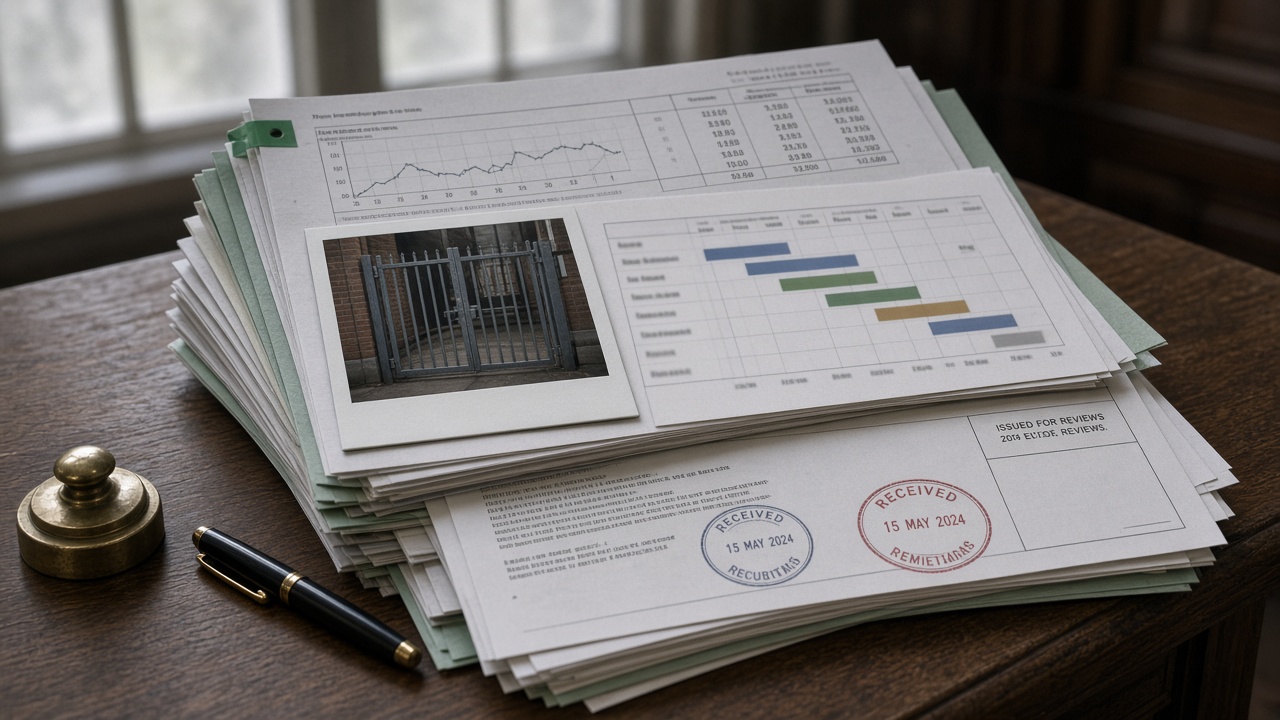
The worst week in a project manager's year is usually the one after the notice of adjudication lands. Not because the argument is weak — people are usually right about what happened on their own job — but because somebody now has to find the paper, which was never kept with a referral in mind. I have watched a quantity surveyor and a document controller spend days rebuilding a fortnight in March out of recovered inboxes, a camera roll and a planner's memory. They got most of it. Most of it is not the same thing as proof.
“Contemporaneous” is the word everyone types into the referral, and it carries a great deal of weight there. On a live job it means something fairly specific: a record built from the issued set, the notices, the programme, the weather and the access facts — dated when the event happened, attributable to somebody whose job it was to write it down, and still findable when the other side asks for the file. Entitlement is the contract's business. Whether the days can be shown is the file's business, and the file gets built long before anybody knows it will be needed.
What the word has to mean
A record counts as contemporaneous when it was made at or near the time of the event, by somebody who was there or whose duty it was to write it down, in a form a later editor cannot quietly rewrite. Time, attribution, fixity. Fail one of the three and what you are holding is a story, however true it happens to be.
Content has to clear the same bar. A diary line reading “wet, could not pour” is beautifully timed and completely useless. A chronology assembled from five inboxes the week before the notice goes out is rich and far too late. You need both halves — a date you can defend, and a fact somebody else can check.
Tie every entry to a place and to the information that was current that day. “Delay on Level 4” is a colour, not a record. Set it against this: Level 4, grid C–F, slab pour held after issue of GA revision C03 at 07:40, gang stood down at 08:15. The second version can be joined to a notice, a programme activity, a weather or access note. The first can only be believed.
Keep the claim out of the daily note, too. Write the facts and let the narrative live in the referral. If the diary is already arguing the case, the other side will read it as advocacy and go hunting for the underlying paper — usually the paper you hoped nobody would ask about.
Why a reconstructed file arrives too late
Statutory adjudication, and most of the contractual versions of it, exists to keep cash moving. The window is measured in weeks. An adjudicator will read the referral and the response; they will not rebuild your job from memory, and they will not wait while you reconstruct a Tuesday in March.
Reconstructed files have a shape anyone who has been near a dispute will recognise. Emails recovered from personal accounts. Minutes recording that “delay discussed”. A programme that stopped being issued at roughly the point the job got difficult. Photographs with no date. A consultant's spreadsheet allocating days after the event. Some of that material earns its place. None of it does the work of a record that existed on the day.
The story is usually accepted. The days are not. In my experience the cut lands in the same place every time: the event is plausible enough, but the effect on the critical path is not shown, or the notice was late, or empty, or nobody can find it.
Build the file as though the referral will be written out of it, because that is what happens. If a document would only surface because a claims specialist asked for it, it is already late.
The issued set: what was current on the day
Delay is rarely “an instruction” or “the weather” in isolation. It is work that could not proceed on the information that was current. If the pour stopped because a revised general arrangement landed while the gang were already on the deck, the record has to name the container, the revision, the time it was issued, who received it, and what the previous revision said. “Revised drawing issued” is a caption.
Keep an issue register a stranger can read: information-container identity, revision, suitability, date and time of issue, recipients. That is the contractual issued set. Then keep the fact that nearly always goes missing — which revision was actually in the gang's hands, on the hut wall, in the pack, on the tablet. The gap between issued and in-hand is itself a delay fact, and it is the one your site supervisor can describe while the register says nothing.
Mark superseded revisions as superseded. Overwriting a file so only the latest revision remains destroys the “as at” picture, and an adjudicator needs what was current then, not what is current now.
Put instructions, early warnings, requests for information and technical queries in the same chain. Each needs an identity, a date, a statement of what changed, and the areas or activities it hit. An instruction that lives only in an email thread has not been issued. One that is issued but never joined to a programme activity is still awkward to use.
Notices that can be dated and found
Most standard forms require notice of delay, of a compensation event, or of a claim, inside a stated period. A late notice is a contractual problem. An on-time notice that names nothing is an evidence problem. Both fail for the same practical reason: neither the other party nor the adjudicator can see what you say happened.
A usable notice goes through the contractual channel rather than a message on somebody's phone. It is dated. It names the event and the start date, the activities or area or trade affected, and the programme activity identities where the accepted programme has them. It states the likely effect as understood at the time, even if that estimate is refined later. And it sits under a stable identity the project can retrieve, not a PDF in somebody's downloads folder.
Keep a notice log: number, clause relied on, date issued, date received if you are the recipient, linked event, linked programme activities, and any later updates. Update the notice as the effect becomes clearer. Do not wait for a perfect quantum — an early, specific first notice is worth more than a complete narrative that missed the window.
If the contract names a form or an address, use it. A well-written letter sent to the wrong place is not notice, and nobody enjoys learning that twice. Record the sending and the receipt, not only the draft.
The programme, planned and actual
The programme is the only place the planned sequence lives. Without it, delay is a feeling. With it, delay becomes a movement of dates on named activities, which an adjudicator can examine.
Hold the baseline or accepted programme — whichever the contract treats as the reference — as an issued container, not as a file on a planner's laptop. Issue updates at the interval the contract requires, and at least weekly once the job is in difficulty. Every update should say what changed and why. An update discussed in a progress meeting and nowhere else has not been issued.
Build the as-built as you go: actual start, actual finish, remaining duration, and the logic that actually happened rather than the logic you planned. Progress photographs, labour returns and plant returns support those dates, provided they are themselves dated and located. A photograph of a still deck proves nothing unless you can say which day it was and which activity it belongs to.
The critical path that matters is the path as it stood at the time of the event, on the programme that was then current. A critical path worked out at claim time, after the later logic has been tidied up, is a reconstruction and reads like one. If the updates stop when the job goes late, the hole in the record sits exactly where the claim will need a week-by-week picture.
One unglamorous detail decides whether any of it joins up: activity identities have to be stable enough for a notice to point at them. If every update renames the pour, the link between notice and programme breaks without anyone noticing.
Weather that is more than a memory
“It rained in November” is not a record of anything. Weather becomes usable when you can show the measurement, the threshold and the effect on a named activity.
Agree the source before you need it: a site gauge, a nominated meteorological station, or whatever the contract specifies. Write the day's figures into the diary — rainfall, wind, temperature — instead of the adjective “wet”. Record the hours or days that stopped a specific operation: a pour, a crane lift, external works, earthworks. Name the threshold you applied. A method statement that stops a pour below a stated temperature is a far better reference than somebody's recollection that it felt cold.
Where the contract allocates weather risk against a historical pattern — a one-in-ten-year event, or a stated allowance — keep the comparison data with the daily note. Hunting for station records after the notice of adjudication is a poor use of a short week; the comparison belongs in the contemporaneous file, not in an exhibit assembled later.
Say what carried on as well. If the crane stopped and the internal fit-out did not, write that down. A weather note implying the whole site went home will be taken apart in the response; one that names the stopped activities survives the same reading.
Access: who could get on, and when
Access delay is common and the worst recorded of the five. Another contractor still in the area. Possession of a plot or a floor arriving late. Restricted hours. A neighbour constraint, a logistics hold, a service nobody isolated, a scaffold not yet handed over, a hoist that was not available. Each is an access fact, and each dissolves into a grumble at the progress meeting unless somebody writes down the dates.
Record who controlled the access, when it was due, when it actually became available, what restriction remained, which activities waited, and what notice you gave. A dated, attributable photograph of a locked gate or an occupied floor helps if it is joined to those sentences. A minute reading “access discussed” beats silence and loses to an access notice.
Do not fold access into weather, or into “site conditions”. Late possession is not rain. A shared loading bay held by another trade is not a drawing revision. Keep the causes distinct so that each effect can be joined to the right clause.
Where access arrives in stages, record the stages. Partial possession that still blocks the critical activity is not access given, and the record should say what was open, what was not, and which activity still could not start.
| Record | What it must show | Common failure |
|---|---|---|
| Issued set | Container identity, revision, suitability, date/time of issue, recipients | "Revised drawing issued" as a captionwith no identity behind it |
| Notice | Dated; names the event, the activities/area hit, the programme activity identities | An on-time notice that names nothing |
| Programme | Baseline, updates showing what changed, as-built dates and actual logic | Updates stop the moment the job goes late |
| Weather | Measurement, threshold, effect on a named activity | "It rained" — no figuresno thresholdno named activity |
| Access | Who controlled it, when due, when available, what restriction, which activities waited | Folded into a vague "site conditions" note |
How the five records lock together
A delay record that survives a short timetable is a chain rather than a pile.
For the day of the event you want to be able to point at five things: the issued set that was current, the notice that named the event, the programme activities that moved, the weather and access facts for those hours, and the as-built progress on those activities. One missing link is where the other party will cut. Five complete records in five systems with five clocks are only marginally better: the adjudicator then has to take your join on trust.
Put the join in the record itself. Give the event a stable identity and repeat it on the notice, the diary, the programme note and the issue. Use the activity identities the accepted programme already carries, and the container identities the issue register carries. Do not invent a parallel numbering system in the week the claim is written; nobody downstream will reconcile it.
Attribution matters as much as the join. A note with nobody's name on it is a rumour. A note that anyone can silently edit is a draft. Prefer issued containers, registers and diaries that show who wrote the line and when, and prefer photographs whose date comes from the file rather than a caption added during the claim.
A weekly habit, not a claim-week scramble
Daily, the raw layer: weather figures, access state, labour and plant on the activities you already know are at risk, and which revision was in hand. That should take a site engineer minutes, not an evening.
On the event: issue the notice the same day, or at least inside the contractual window. Do not wait to see how it plays out. The effect can be updated later. The first notice cannot be back-dated.
Weekly: issue the programme update, walk the notice log, check the issued set against the pack actually on site, and close the obvious holes — a missing receipt, a missing activity identity, a weather adjective with no figure behind it. Monthly, a short delay schedule of open events, days recorded so far, and records still outstanding. Treat it as hygiene on the file, not as the claim.
A claims specialist can analyse a file. Nobody can invent a Tuesday. If the Tuesday is not in the registers, it will not reach the referral in a form that survives the response.
Where this stops
Your contract wins. NEC, FIDIC, JCT and the Scheme for Construction Contracts each come with their own notice machinery and their own allocation of weather, access and change risk, and none of it substitutes for advice from whoever handles a live dispute for you. A clean record does not manufacture an entitlement the clause never gave. It only means that where the entitlement exists, the days can be shown.
ISO 19650 and the common data environment describe how information is issued and made current; they have no view on delay. Use them for the issued set, the contract for the notice, the programme for the path, and the diary for weather and access. Keep the five in one chain.
The practical version fits on a Monday morning. The document controller keeps the issue register honest. The planner issues the update and keeps the activity names stable. The site team write figures instead of adjectives. None of it is interesting work, and it is the difference between arguing from a record and arguing from a recollection.
Read next: Extension of time: what your CDE should be capturing every single day, You won the argument and lost the claim, because you could not prove it, Discovery-ready: structuring project records before the dispute starts.