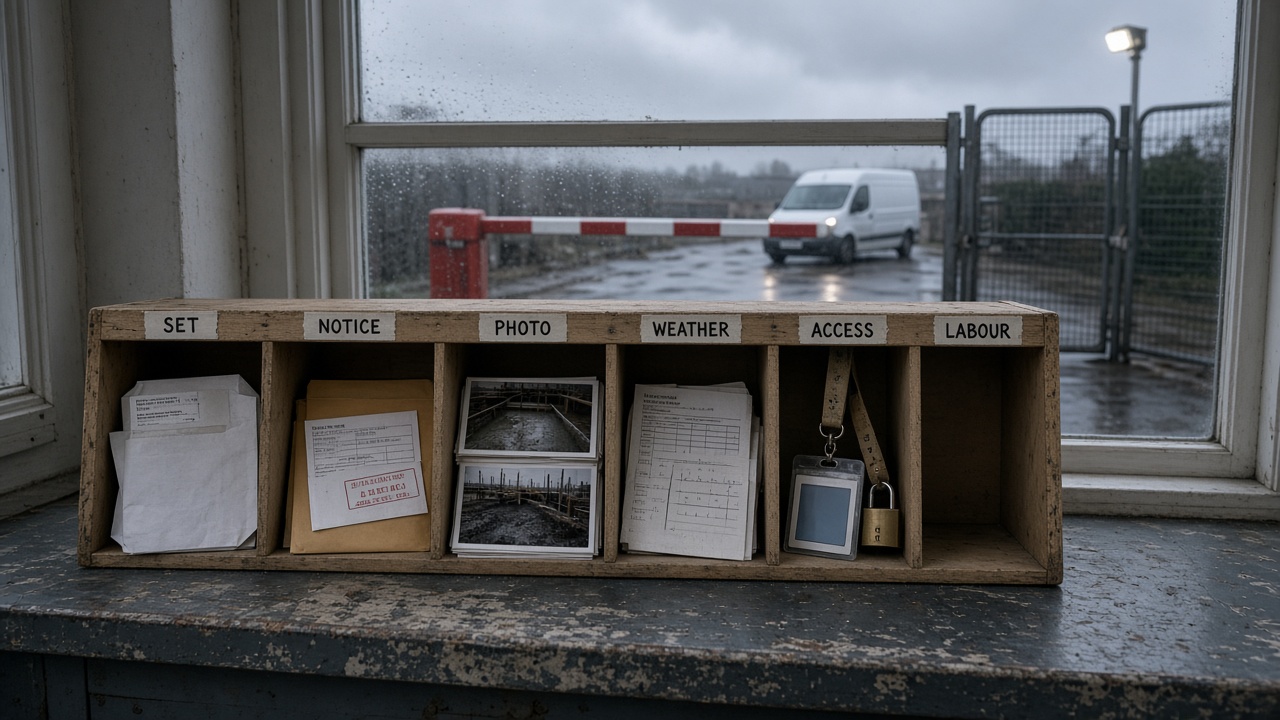
An extension of time is the claim you hope never to file, and hoping is not a strategy for filing one. The record that supports it gets assembled on ordinary Tuesdays: the issued set that was current at 07:00, the notice that left the same afternoon, the photograph of the pour, the weather that stopped it, the gate nobody unlocked, the gang that stood down and went home. If those facts live only in a site diary, a WhatsApp thread and somebody's personal mailbox, what the project owns is not a delay record but a story a planner will have to reconstruct out of other people's memories.
None of what follows is a reading of NEC, JCT or FIDIC. Those texts have owners, and all of them assume a contemporaneous file can be produced when asked. What they do not tell you is what to put in the common data environment before anyone has named a claim.
So: six checks. Time-box them, do them every day the job is live — Saturdays too, if the site is working — and write the findings into the CDE rather than into a sidebar only you can see. A published folder kept immaculately tidy that never received the day's facts is storage, and storage does not argue.
Why the day, and not the month
Contemporaneous means dated, attributable and hard to edit afterwards. A pack assembled the week before a notice of adjudication is none of the three; it is a brief, and it tends to be read as one.
The usual failure is monthly hygiene dressed up as evidence. The drawing register gets reconciled at period end. Photographs come off phones when somebody remembers. Weather is copied from a public station once a commercial query lands. Labour is a payroll extract. Access is a recollection, generally a confident one. Each of those artefacts can be perfectly true and still be useless, because none of them answers the question a delay record exists to answer: what was the state of the works, the information and the site on this calendar day?
Capturing those facts daily does not make a claim, and it does not commit anyone to making one. It turns a later claim, if it ever comes, into a retrieval job rather than an invention job. Most jobs never file at all. The discipline is the same either way, because by the time you know which days mattered, those days have gone.
Do not wait for a compensation event, an architect's instruction or a relevant event to be named by someone else. Name the day. Capture the six facts, and file them where the project still owns them after the people have left.
1. Issued set
Delay is argued against information. If you cannot say which revision was published, to whom, and for what purpose on the day the work stopped or changed, you cannot later argue that the site was working to the wrong sheet — or to the right one.
Every day, before the first pour or fix:
- Record the current published identity for every title the site is installing today: sheet number, revision, suitability, transmittal number, date of issue.
- Record any revision that became current today, and the identity it withdrew. Upload is not issue. Two "current" rows for the same title is a fail.
- Record any instruction that qualified a published container without yet becoming a new revision: hold, omit, invert, proceed in advance. If that sentence exists only in mail, the issued set in the CDE is already wrong.
The aim is reconstruction for a named date, not a folder that hoards every historical file. A weekly register pass is hygiene; the daily issued-set note is what a delay narrative is eventually built from. If the document controller is on leave, the deputy writes the same four facts. An empty day is itself a finding.
2. Notices
Most standard forms expect notice of delay — or of an event that may delay — within a short window, in a stated form, to a named person. Leave the clause to the people who own it. The information question underneath is simpler: did a dated notice leave the project, and can anybody still find it?
Every day:
- List every notice issued today that concerns time, access, information, weather or a stoppage — early warning, delay notice, confirmation of verbal instruction, a request for information that holds the works. Give each one a unique identity, a time, a named recipient, and the issued containers it points at.
- List every notice received today that changes those same facts. Receipt is a project fact; a tick in somebody's mailbox is not, unless the CDE holds the file.
- Mark any event that should have produced a notice and did not. A locked gate, a late revision, a gang stood down, a weather stop — if nobody wrote, record that nobody wrote. Silence can be evidence, but only where you recorded the silence on the day.
Do not invent a clause number you have not opened, and do not wait for commercial to raise the notice. The CDE captures the communication as it existed; the contract administrator can decide afterwards what it amounted to. A notice sitting in a personal inbox is outside the project record.
3. Progress photographs
A photograph is not evidence simply because it is a photograph; it becomes evidence when it is dated, located, and tied to the issued set and the activity it claims to show.
Every day, for the zones that moved or were supposed to move:
- Capture a small set — enough to show the workface, not a gallery. One honest view of the pour, the scaffold, the riser or the unopened gate is worth fifty untitled files off a phone roll.
- File them in the CDE the same day, with date, time, grid or zone, activity, and the current revision of the sheet that zone is building from. A folder called "Site photos" full of camera filenames is a dump, as anyone who has tried to use one months later will tell you.
- Do not crop out the thing that later matters: the standing water, the missing delivery, the empty bay, the plant that never arrived. Photography that only shows progress is advocacy, and the delay record needs the day as it was.
If the only copy lives on a personal device, the project does not have it. When that person moves to the next job, the photographs go with them. Transfer is part of capture, not an afterthought.
4. Weather
Weather is the delay cause everyone believes they can reconstruct afterwards. They cannot. A monthly summary from a city station ten kilometres away says nothing about whether this site could pour, lift or work at height on this morning.
Every day:
- Record on-site conditions at the start of the shift and at any stoppage: rain, wind, temperature, visibility — whatever the works are genuinely sensitive to. Name the instrument or the observer. "Wet" is not a record.
- Record the decision that followed. Work continued, work restricted, work stopped, and which activities. Weather with no effect on the programme is meteorology; weather with a named stand-down belongs in the delay file.
- Keep the source. Site station output goes into the CDE that day. An observer's note gets signed and filed. A screenshot pasted into a weekly report a fortnight later is reconstruction, however honestly it was done.
Leave the exceptional-weather argument for later, and for people with the contract open. The daily file only records what the site experienced and what the site did about it.
5. Access
A gang that cannot reach the work has already lost the day. Access failures are ordinary — a permit not issued, a preceding trade not clear, a delivery parked across the only road, a client possession that overran, a gate that stayed locked — and they evaporate from memory unless somebody writes them down while the van is still sitting outside.
Every day:
- Record planned access against actual access for the zones on today's programme: who was supposed to be where, at what time, under what permit or possession.
- Record every refusal, delay or restriction — the time, the place, who controlled the access, and which issued information or instruction it sat against. "No access" without a door, a time and a name is a complaint.
- Record when access was restored, and whether the same gang could still make use of the day. A two-hour lock-out that leaves six hours of work is a different fact from a day that never started, and the planner will need to know which it was.
Access is not only physical. Information access belongs here too, for the mornings when the published set, the permit or the lifting plan could not be opened at the workface. A CDE that shows a file as published while the cabin could not reach it has recorded an access failure; write it as one.
6. Labour
Labour is the fact commercial teams reconstruct from payroll and then argue about for months. Payroll says who was paid. It says nothing about who stood at a locked gate, who was redeployed to another block, or who was sent home at 10:00.
Every day:
- Record the planned resource against the actual resource for the activities on today's programme: trade, gang size, hours on the planned work. Names if the project already uses them, grades and counts if it does not. Do not invent a timesheet system the site does not run.
- Record idle, redeployed and stood-down labour with a reason that points at one of the other five facts — issued set late, notice unanswered, weather stop, no access, the photograph of the empty bay. Labour with a cause belongs to the delay record; labour without one reads as a cost, and costs get disputed.
- File it in the CDE the same day, as a project-owned note rather than a screenshot of a supervisor's app. If the only labour record is a subcontractor's weekly application, you will be arguing their numbers, in their arithmetic, months from now.
A per cent complete on a dashboard is an opinion about progress. Keep it if the project runs on it, but it will not tell anyone who was on site and what they were able to do.
The daily score sheet
Print this. One row per day. The document controller or the deputy fills it in before they leave, and the project manager does not edit yesterday.
| Capture | What "done" means today | Pass or fail — write the identity |
|---|---|---|
| Issued set | Current revision, issue and any qualifying instruction for every title being installed | |
| Notices | Every time-related notice sent or received, or a dated note that none was required | |
| Progress photographs | Dated, located, tied to zone and revision, in the CDE, not on a phone | |
| Weather | On-site conditions, decision, and source filed | |
| Access | Planned against actual; refusals timed and named | |
| Labour | Planned against actual; idle and stood-down labour given a cause |
A pass is boring, which is rather the point of it. A fail is a missing fact, a personal mailbox, or a photograph that never left a device. Do not average the six rows into a percentage, and carry yesterday's fails forward until somebody closes them. A week of empty rows is not a quiet site. It is a week you cannot later prove.
An hour is enough, once the six facts are already being written down somewhere on site. The work is getting them into the CDE on the day, with identities the project still owns. If it reliably takes longer than that, you are reconstructing rather than capturing — stop, and write down where the hole is.
Where this stops
A checklist is not compliance with anything. ISO 19650, CDM, the Building Safety Act, NEC, FIDIC, JCT, COBie and the project's own BEP each have owners, and none of them will take a score sheet in place of the obligations they set out. Capture discipline does not value a day of delay either; that is work for people reading the contract, with a programme in front of them.
The principal contractor's project manager is the one who can make the six facts a named daily job rather than a document controller's evening habit. Put the score sheet into the site administration duties, fund an hour every day the works are live — Saturdays too — and stop accepting a monthly register pass as the delay file. That hour is real cost, and it is still cheaper than building a brief from phones and mailboxes once someone has named an event. Run tomorrow's six rows before the first pour; if any of them still live on a personal device, that is the hole to close first.
Read next: Building a delay record that survives adjudication, Discovery-ready: structuring project records before the dispute starts, You won the argument and lost the claim, because you could not prove it.