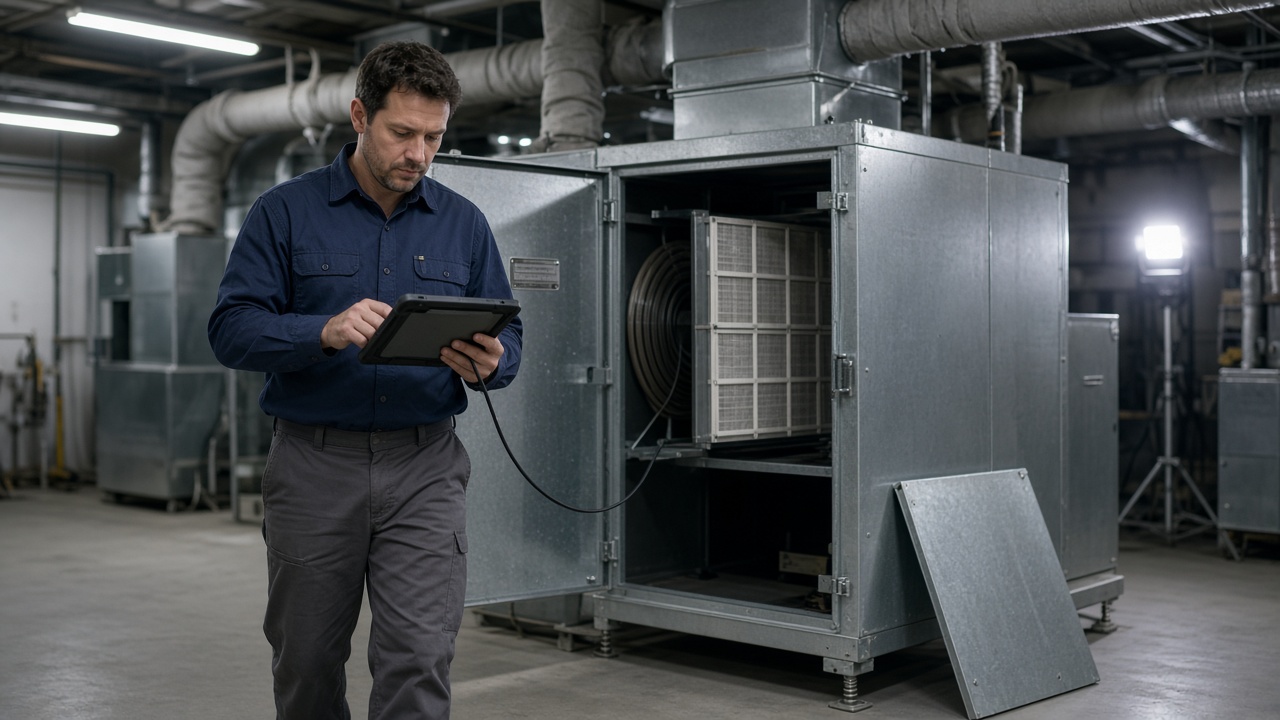
The plant room is warm, the access door is off the air-handling unit and leaning against the casing, and three people are watching a reading settle. The commissioning engineer has the instrument, the commissioning manager has the sheet, and someone from the client side has been asked to witness, standing close enough to actually see the display, which is not always the case. For that hour, everything operations will ever need to know about this unit is in the room: the nameplate is legible with the cover off, the as-found value is on the screen, the as-left setpoint is the one just dialled in, and the witness is a person rather than a line on an attendance list.
Then the panel goes back on, the sheet is folded, and it leaves site in a van.
Eight weeks later, in the fortnight before handover, someone sits with a laptop and a folder of nameplate photographs, deciding whether a serial ends in a B or an 8 and emailing the supplier for a warranty start date. What comes out of that exercise is not the commissioning record. It is folklore with a filename.
"During" means the hour, not the month
Programmes read "during commissioning" as a season — several weeks, ending near practical completion. On the ground it is far narrower: during means while the people who ran the test are still standing on the system.
The hour matters because a handful of facts are only cheap in it. The serial is on a plate you will never see again once the covers are refitted. The as-found reading is on the instrument, not in someone's recollection of it. The as-left setpoint is the one you just wrote, not one inferred from a trend line. The witness can sign a name rather than a memory. And the drawing revision in the tester's hand is, definitionally, the one the test was run against. A nameplate photograph is worth taking, but somebody still has to type the characters into a row and stand behind them.
Same day is the outer limit, and only if the same people are still contactable. By next week the sheet has to be decoded, the setpoint reverse-engineered from a building-management trend, and the witness telephoned and asked, slightly awkwardly, whether they were in the room.
If you cannot say which test ran, on which day, with which as-left values, and who watched it happen, what you hold is a story about commissioning.
After is archaeology
Reconstruction looks industrious. Folders fill up. Spreadsheets appear and get colour-coded. O and M PDFs arrive from suppliers. None of it recovers the hour.
Four things tend to happen, all of them lossy:
- Someone reads a photograph of a nameplate and types what they can see — or what they think they can see — into a register the tester never touched.
- Someone asks a vendor for serials, models and warranty dates the vendor already had on site, because nobody wrote them against the tag while the unit was open.
- As-found and as-left collapse into a single "result", so operations inherit a number with no way of knowing whether it is the factory setting, the failed first pass, or the value left after the last adjustment.
- A witness gets nominated from the attendance sheet for that week rather than from whoever actually stood at the panel.
None of that is negligence. The engineer who took the photograph was doing the sensible thing with what was in their pocket. But be honest about the work: nobody is improving quality, they are excavating. Once the room empties, every field becomes an inference dressed up as a value.
A reconstructed register usually looks complete, because empty cells get filled with the most plausible thing available. Complete and contemporaneous are different tests, and only one holds up when a facilities manager asks where a figure came from.
The register starts at the test, not at handover
Handover is when the project wants the register finished. It started earlier, whether anyone admitted it or not.
The fields a facilities team will actually query are rarely the delivery metadata everyone argues about. They are identity, location, system, manufacturer, model, serial, warranty start, the performance baseline, the as-left setpoint, and the title and revision the test was run against. Most of those are decided — or only knowable — while the test is happening.
| Field | Knowable during the test | Reconstructed after |
|---|---|---|
| Tag and location | On the unit and the drawing in hand | Guessed from a general arrangement |
| Manufacturer, model, serial | On the nameplate, with the cover off | From a photoor a vendor chase |
| As-found / as-left | On the instrument, that hour | Collapsedor pulled from a trend |
| Witness | The person still in the room | An attendance list |
| Warranty start | Tied to the accepted test date | A practical-completion date that may not match the unit |
| Related title and revision | The sheet used to test | "See O and M" |
What the operator wants, two years in, is a set of defensible statements about installed plant they can query without unzipping a folder of scanned PDFs. Written for the first time while the handover pack is assembled, they arrive late in the way a health and safety file compiled as a binder arrives late. The facts existed. The record did not.
It is also why tying inspection and test plans to asset tags from day one matters, and why quality records that never meet a tag end up as fiction in the O and M. Commissioning fuses the two: either the test writes the register, or it gets invented afterwards by people who were not there.
What to write before the cover goes back on
You do not need a new file type. You need a row, written before the panel is refitted, that a second person could defend without ringing the original crew.
Accept a record only if it carries:
- Identity — the asset tag as installed, not the procurement code, and the location an operator would actually use.
- Plant — manufacturer, model, serial. A nameplate photograph sits beside the row as evidence, not in place of it.
- Test — type (pre-commissioning, functional, witnessed acceptance), date and time, as-found, as-left, pass or fail, and anything still open.
- People — tester and witness as names that will still mean something after demobilisation, not role titles on their own.
- Provenance — the title and revision used, and the system the asset belongs to.
If any of those are missing, the hour is not finished. Closing a test without the row is how "after" starts.
The rule most commissioning managers end up enforcing, usually after one bruising handover: no accepted test without a register row, and no row whose serial, as-left values and witness cannot be shown to have been written that day. Anything weaker is a note to self.
Try this on Monday
Pick one system already commissioned, or being commissioned this week — an air-handling unit, a pump set, a fire-alarm loop, a medical-gas outlet. Accept only a record as the answer.
- For each asset on that system, can you show the serial, as-left values and witness without opening a photograph folder or emailing a vendor?
- Were those fields written on the same day as the test, or typed later from memory and pictures?
- Can you tell as-found from as-left, or has the result been collapsed?
- Which title and revision was the test run against — and is that the revision in the issued set?
- If the asset failed the first pass, is the failed hour still findable, or did only the eventual pass survive?
Rows written in the hour mean a register being born. Answers pointing at last fortnight's reconstruction mean a pack facilities will hand back for someone to retype.
What the standards already assume
ISO 19650, COBie, CDM, the Building Safety Act, NEC, FIDIC, JCT and the project-specific commissioning specification all assume a contemporaneous record of what was tested and what was left set. None treats a spreadsheet written in the final fortnight as proof that the hour happened. They will let you file it. They will not let it carry the weight later.
Ten minutes while the cover is still off is the whole bill, and it belongs in the commissioning package rather than in the last-fortnight scramble. The commissioning manager already decides when a test is accepted: refuse to close one whose register row is missing the tag, the serial, the as-found and as-left values, the witness name, and the title and revision in the tester's hand, and write that refusal into the specification before the first unit is offered. Clients who want a queryable register at handover have to price a named person to enter the row before the panel goes back on. Hope is cheaper until December, when facilities hand the pack back for someone who was not in the room to retype.
Read next: Inspection and test plans tied to asset tags from day one, Quality records are handover records. Most teams learn this too late., Progressive handover: validating asset data throughout delivery.