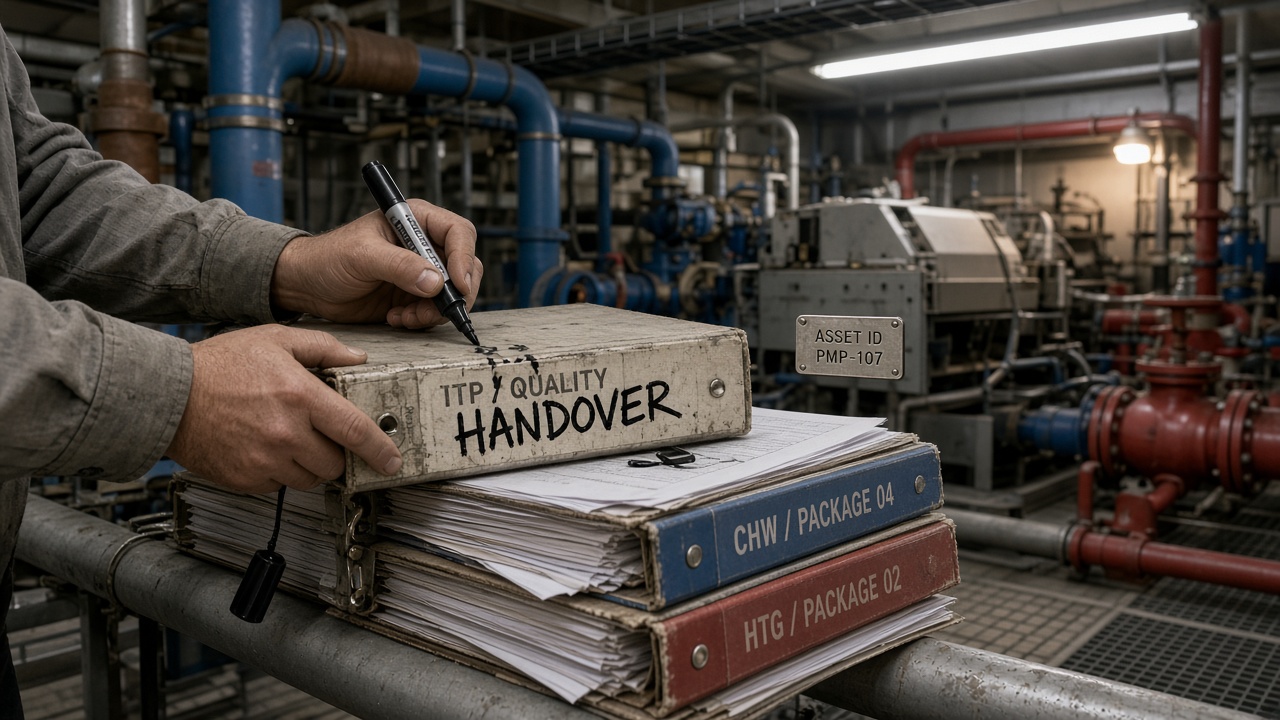
Ask a QA engineer what they produced this year and they can show you: two metres of lever-arch behind the desk, inspection and test plans by package, signed hold points, pressure tests, a non-conformance register that closes. Ask whether any of it will reach the owner and you usually get a pause, then a shrug. On most jobs those folders are not the folders that go into the handover pack. Somebody will build that pack in the last month out of something else entirely.
Which is strange, when you think about what is in them.
We run two calendars. Quality is the inspection, the hold point, the certificate, the non-conformance closed against a package. Handover is a later act with different owners — the operation and maintenance manual, the as-built, the warranty file, the health and safety file, the asset list the operator is supposed to run from. Separate folders, separate meetings. Then the last month arrives, somebody is asked to assemble a pack, and the two seasons collapse into one object. The collapse is expensive, and it is avoidable.
The same facts, a different reader
A quality record is contemporaneous evidence that work met a specified hold point: what was inspected, where, against which requirement, with what result, on whose authority. An inspection and test plan, a signed inspection, a materials certificate, a pressure test, a commissioning sheet, a closed non-conformance — those are quality records when they are captured at the time rather than written up afterwards.
A handover record is what the receiving party needs in order to accept, operate, maintain, certify and later alter the works. Operation and maintenance manuals, as-built drawings, warranties, spares lists, training records, residual hazards, asset identifiers the facilities team can query. Those are handover records when somebody who was never on the job can read them.
The hinge is identity rather than sequence, because the second object is made out of the first. An O and M that cannot point at the test that proved the installed item is fiction on headed paper. A warranty that cannot find the serial number, the inspection that accepted the install and the certificate that sat beside it is a brochure. An as-built redrawn from memory in the final fortnight is not the inspection that recorded what was actually built. And if the inspection and test plan never met an asset tag, what the owner receives is a list of names, not a building.
We talk about handover as though it were a new piece of authorship. It is closer to readdressing. The reader changes — from the supervisor and the inspector to the operator and the maintainer — while the facts stay where they are. Where the facts were never bound to the thing that will be operated, there is nothing to readdress, and what happens instead is compilation.
What has to be on the sheet
For the identity to hold, a quality record has to survive a short list of questions asked long after everybody has left.
- What was inspected or tested?
- Where, and against which asset, location or system identifier?
- Against which specified requirement or hold point?
- What was the result, and who had authority to accept it?
- What evidence sat beside the result — photograph, certificate, reading, redline?
- Can those answers be retrieved from project custody, grouped by the identifier the operator will use?
A checklist that is true of a package, a floor or a week, and silent on the asset, is a serviceable quality record for delivery. It is not yet a handover record, and the conversion will not happen later as a typing exercise. The identifier has to be on the record when the record is made, or the reconstruction will invent a building the inspections never saw.
This is why "we have the inspections" and "we have the handover" are not the same sentence, however alike they sound in a progress meeting. Volume of quality paperwork is ordinary. Binding that paperwork to the thing that will be operated is the part most jobs skip, largely because delivery never asks for it. Delivery asks whether the hold point passed. The owner asks which unit, which serial, which residual risk, which maintenance action, and asks it eighteen months later. Those are the same inspection if the tag was on the sheet. They are two different archives if it was not.
Why the last month cannot fix it
Completion is when the receiving party finally asks the owner's questions, and by then the people who could have answered from memory are demobilising. The trade holding certificates in a mailbox has gone. Photographs sit on phones. Serial numbers were written on a cardboard sleeve that went in a skip in March. Commissioning sheets are filed by system, inspections by package, and the asset list is a spreadsheet somebody started in week eighty. None of the three joins to either of the others.
The compilation that follows looks like work, and it is work, but it is reconstruction, not recovery. Folders named Final, packs named Handover, as-built archives assembled from whatever still opened. You can copy a passed inspection easily enough. You cannot invent the asset tag it never carried, the certificate that never entered project custody, or the hold point that was signed against a zone instead of a unit.
Late learning has a shape to it. The project believed quality and handover were sequenced — do the quality, then do the handover — and that belief is a calendar comfort which hides the identity until the calendar has run out. You can relabel the folder. You cannot relabel the inspection.
In England the health and safety file, the golden thread on higher-risk buildings and the ordinary employer's information requirements all assume the same hinge: a record already bound to the place and the thing. None of them tells you how to manufacture that binding out of a crate of unmarked sheets. ISO 19650 and COBie assume it too, as do the usual contract families. What they all leave to the project is the only part that matters on a Tuesday morning — whether the identifier is on the sheet before it is signed.
Four cupboards and no key
On a mid-size job the pattern is ordinary rather than dramatic, which is why it survives.
Quality keeps inspection and test plans by package. Site closes inspections against locations that made sense to the gang that week. Document control keeps certificates in a published folder that is tidy and untagged. Commissioning keeps sheets by system. Soft landings, if anybody named them, sit in a separate meeting. Facilities, if they were invited at all, asked early for a structured asset list and were told it would come at the end.
For months this looks like competence: each team can show you its own cupboard, and each cupboard is in order. Then somebody is asked to assemble the handover pack. The first discovery is that the cupboards share no key. The second is that snagging has quietly become a second register — a late list of things that failed to become records the first time. The third is that the O and M will have to be written as prose, because the inspections cannot be queried by asset.
The labour that follows gets billed as completion, or as document control, or as a consultant, and where it is not billed it is absorbed as unpaid evenings by people who did not cause it. Colleagues who left in the spring are rung up and asked which plant item was on which sheet. Attachments no longer open. What lands with the owner is a compilation, and an owner cannot operate from a compilation, so they rebuild the register from scratch. Six months into occupation their FM team is still opening ceiling voids to find assets that appear on no list at all.
The inspections happened. Nobody took the identity.
One asset, one hour
You do not need a consultant for the diagnosis. You need an hour and one asset.
- Pick something installed that will still need maintenance in two years — a plant item, a life-safety device, a façade unit, a switchboard.
- Produce the quality records that accepted it: the inspection or test, the certificate, the hold-point sign-off, the photograph or reading that sat beside the result.
- Confirm those records carry the identifier the operator will use — asset tag, serial, location code — and not merely a package name or a gridline that made sense on the Tuesday.
- Produce them from project custody, not a trade mailbox, a phone or somebody's downloads folder.
- Ask whether a stranger — a facilities supervisor, a document controller who started this week, an owner's information manager mid data drop review — could get from the asset to the records and back again without a guided tour.
Whatever you cannot produce in that hour is not a filing gap. It is a handover record that was never made, and recreating it in the last month costs more than binding the identifier would have cost at the time, without ever becoming contemporaneous.
Stop accepting sheets that cannot name the asset
The fix is unglamorous and mostly clerical, which is why it keeps losing to more interesting problems. It also needs somebody with authority over the QA templates, because a QA engineer cannot impose it alone.
- Appointing parties and clients: require the operator's identifier on the quality record itself, not in a separate register to be reconciled later. Put the asset identification convention in the employer's or asset information requirements, say who issues it and from what date, and ask at tender how inspections will be bound to it — a more useful question than asking whether a bidder can produce COBie.
- Principal contractors: change the templates. An identifier field that cannot be left blank on the inspection sheet, the certificate transmittal and the commissioning record does more for a handover pack than any amount of close-out planning. Then give the QA engineer explicit authority to return an untagged sheet, and back that decision the first time a subcontractor escalates, because that escalation decides whether the rule is real.
- Delivery teams: run the hour test on the package closing this month rather than the one that closed last year, and take the missing joins to the progress meeting as open items with names against them, not as a note in a quality report.
None of this is free. Tagging before the first inspection costs a walk and somebody's ownership of the register; templates cost a change-control cycle; a supply chain asked to comply after award will price the change, and is entitled to. Set against the last-month compilation and the owner's rebuild that follows it the bill is small, but it is a real bill and it belongs in a tender rather than in somebody's evenings. Put it there on the next job. On this one, start with the sheet being signed tomorrow morning.
Read next: Snagging lists are where projects go to die, Inspection and test plans tied to asset tags from day one, Turning the health and safety file into a live asset instead of a binder.