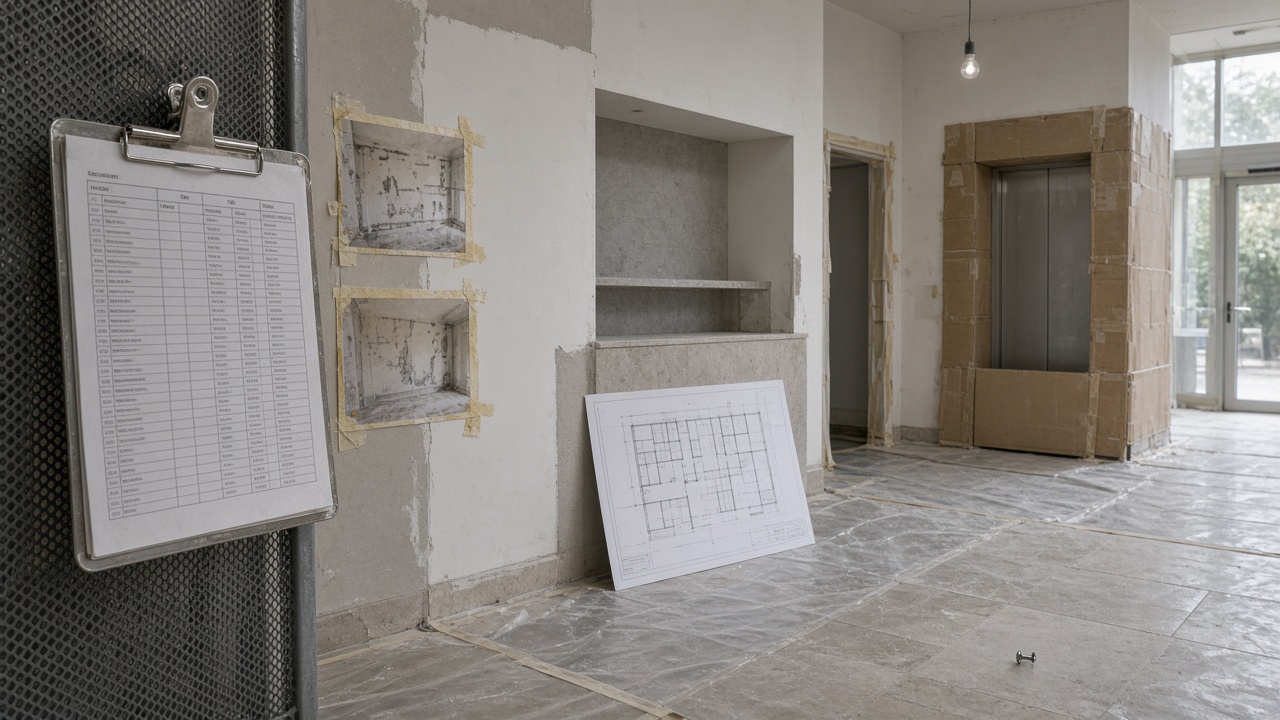
The day before handover, a client's representative walks the building with a tablet in one hand and a printed list in the other. Three hundred and some rows. Half of them have a photograph attached that was taken five weeks ago, when the protection was still on the floor and the room had a different door number. The painter left on Friday. The person who wrote item 18 is on another job in another city, and nobody in the lift lobby can say whether the scuff in the picture is the scuff in front of them or the one round the corner.
Everyone in that lobby knows the artefact. It might be a spreadsheet, a clipboard table, an export from a walk-round app, or a shared album with numbers in the file names. The building is up. The trades are leaving. Completion is supposed to be a date. What the project has is a list.
What the list actually is
The list is meant to be diligence. Folders have names, inspection and test plans were signed, somebody walked with a tablet, the plotter still sings. In that version of events, opening the list is the completion meeting and painting a row green is close-out.
A green cell is a statement about the register. Completion is a statement about the job, and the two come apart almost immediately.
Most snagging lists are a second register. First-fix records, inspections and test plans, if they existed, already happened against packages, hold points and — if anyone was organised — asset tags. The list gets invented later, once occupation, sectional completion or practical completion is in the diary. Into one table go scratches, missing sealant, incomplete fire-stopping, a valve without a tag, a missing O and M sheet and a client preference about ironmongery. The table has a Status column, which is not the same thing as a workflow.
Late snagging spreadsheets and walk-round exports are real enough; anyone who has handed over a building has met one. The problem is structural rather than moral. The artefact on which completion is asked to finish has been built so that it cannot finish cleanly.
Completion stalls on the register, not on the floor
Completion is a gate. Contracts dress it differently — practical completion, taking over, sectional completion, occupation — but the information act underneath is the same. Someone has to say the works are complete enough for the next legal state, and someone has to say what remains.
The list is hired to be that remainder, which is why projects go to die here rather than in the pour or the clash report or the last RFI. Those failures delay the building. The snagging list delays the end of the building. Retention sits on it. The completion certificate waits on it. The handover pack is told to wait until snags are closed. Trades demobilise against it. Afterwards, the dispute is never whether the frame was poured; it is whether item 18 was the same door as the photograph, who owned it, and whether the issued drawing even showed the ironmongery that somebody later called a defect.
A register can only close a gate if it can finish as a record, and finishing as a record needs three dull properties. Each item has an owner who can still act. Each photograph still identifies the thing it claims to show. Each defect is pinned to the issued construction information — a sheet, a revision, a location the installer can find — rather than to a corridor nickname and a crop.
Typical lists have none of the three.
Nobody owns item 18
"Found" is a verb that flatters the walk-round. A mark was seen, a row was written, a photograph was taken. What has not happened is the decision: which package makes it good, whether it is a defect against the issued set or a change the client is describing late, whether the trade that could fix it is still on site, and whether the item is a snag at all.
Unowned items do not stay unowned for long, though. They go local. One supervisor knows the painter will come back. The commercial file still shows the room as complete. The client's representative has the same observation in a different spreadsheet under a different number. The trade that left on Friday has no row at all.
Ownership on a typical list is a name in a column, and the name is often "contractor", "finishes", the person who walked, or nothing. That is a mailing list rather than an assignment. Ownership at completion, if the word is to carry weight, means the authority either to change the built state or to record, with a date and a person against it, that the issued information was correct and the comment is a change, a preference, or damage that happened after the walk. If the register cannot name that person — and name them while they still have labour on site — what you have is a catalogue of remarks.
The list also mixes remarks that do not share an owner. A missing fire-stopping seal is a quality item against an issued detail. A requested upgrade of ironmongery is a variation wearing a snag number. A missing as-built drawing is a records item. A stain on a carpet that was protected until last week is damage. One column headed Owner cannot hold those four authorities, and projects pretend otherwise because one column is what a walk-round produces.
Once the trade has demobilised the column becomes archaeology. You can still type a name; you cannot get a person. Completion then depends on a residual gang, a goodwill visit, or a commercial negotiation that has very little to do with what was originally observed. The item did not die on the floor. It died when it lost an owner.
The photographs are already out of date
The photograph is how the list claims to be evidence. A walk-round without pictures is hearsay; a walk-round with pictures is a record. Most of the pictures are wrong by the time the completion meeting opens them.
The supersession is ordinary rather than dramatic. The first walk photographs a scuffed door. A painter attends, or does not. A second walk photographs a different scuff, or the same door once protection came off, or the adjacent leaf that looks identical in a crop. The row still carries one image, or three, or a folder of files called IMG_1841. Nobody can say which image is the observation, which is progress, and which is close-out — and the close-out picture, where it exists, is usually another crop of a similar wall.
You cannot supersede a crop. The phone keeps no register. Forwarding strips whatever date and location the file once carried, and a shared album is not a revision history. What remains is a picture of a surface, which is exactly what you need to recognise a room on the day and exactly what you should not treat as a stable identifier a month later.
Then the list does something quiet with time. The photograph is treated as contemporaneous because it is attached to the row, but attachment is not contemporaneity. The wall has moved on; the item has not. Closing a row against a superseded picture is how projects sign off defects that are still there, and how they reopen defects that are not. Both are completion failures. One leaves work in the building, the other leaves an argument in the register.
There is a duller second supersession. The photograph was taken against a room that later changed identity — a number on a door, a partition that moved, a hotel key plan revised after the walk. The picture still looks like a door. The issued set no longer agrees which door it is. Evidence that cannot name its object is not evidence. It is a file.
Nothing is pinned to the issued drawings
This is the failure the other two sit on.
A snag that is not pinned to the issued set is not located. "Level 3 corridor", "apartment 12 bathroom", "as photo", "north stair — paint" are things a person can walk towards on the day. They are not an identity the project can reopen in six weeks. They name no sheet number, no revision, no grid, no room code matching the issued key plan, no asset tag, and no issued instruction the work was supposed to meet.
Without the pin, three things become impossible.
You cannot tell a defect from a change. If the issued drawing never showed the closer, the missing closer is a gap in the information published for construction rather than a snag. The list will call it a snag anyway, because the walk-round saw an absence, and completing a building against absences that were never issued is how projects invent remaining work.
You cannot tell this item from the next one that looks like it. Two scuffs, two valves, two doors on a floor of repeating rooms: the photograph was meant to distinguish them and the photograph is a crop; the pin was meant to distinguish them and there is no pin. Close-out becomes a matter of who sounds most confident.
You cannot withdraw the observation when the issued set changes. A revised finishing schedule, a late architect's instruction, a substituted ironmongery pack — the list still holds the old remark, because there is no container to mark superseded. The unofficial set in the trailer is the same failure in paper form. The snagging list is that failure at the end of the job.
ISO 19650's states are unromantic about this. A comment offered on a walk is not published construction information. A photograph in a phone is not an information container. A spreadsheet row is not a transmittal. Projects that skip those distinctions still hand over keys; they simply cannot say which issued revision the remaining work was judged against, or whether the remaining work was in the issued set at all.
A pin costs attention rather than software, and it comes down to one sentence the list should be able to answer on demand: this item, on this issued sheet, at this revision, at this location, observed on this date. A list that cannot say that is a walk-round that was typed up.
How you end up with two quality records
The sequence is ordinary enough that it barely varies between jobs.
A completion date sits in the programme. The floor looks finished enough to walk. Someone — client, supervisor, clerk of works, a visiting manager — walks with a phone. Remarks are spoken faster than they can be identified. The issued set is in the cabin, or behind a login, or on a plot that is not in anybody's hand, and the walk does not stop to open it.
That afternoon a spreadsheet appears. The columns are Owner, Location, Description, Photo, Status. Photographs are dumped into a folder or pasted into cells. Location is a corridor name, Owner is a trade category, Status is Open. The official quality records, if they exist, are not consulted, because the list is faster and looks more current for having arrived later.
Trades are then asked to work through the list. Some items are locally obvious and get done. Some cannot be found. Some are not theirs. Some are changes. A second walk adds rows, by which point the first walk's photographs are a week old. A few rows go green because somebody is sure. A few get duplicated under new numbers because nobody can match the picture to the door.
By the completion meeting the project has two quality stories. The ITPs and inspection sheets say the packages were accepted. The snagging list says the building is not finished. Neither story can see the other, and the unofficial one wins because it is the artefact in the room. Completion becomes a negotiation about a register that was never designed to finish.
Nobody in that sequence has been careless. The inspector inspected. The walker walked. Document control still holds an issued set. The decorator attended the items they could recognise. Each step is locally reasonable; the chain is what dies.
Why the list never empties
Emptying was never the job the list was hired to do.
It was hired to prove that a walk happened. That proof is useful in a progress slide, a client report, and a sentence about remaining works being managed. It is cheap compared with the work that follows: assigning while labour is still on site, pinning each remark to an issued container, replacing photographs when the wall changes, withdrawing items that were never defects, and refusing to let a client preference sit on a completion register.
The count also protects the people who would otherwise have to decide. A three-figure list is an alibi — nobody can be blamed for item 186. Twenty owned defects, each pinned to a revision, each with a photograph that still matches, is a management object with names on it. Projects tend to prefer the alibi, and I have yet to meet a team that would say so out loud.
The third reason is informational rather than moral. Close-out crosses systems the list never enters. The observation lives in a phone. The decision lives in a meeting. The repair, if it happens, lives in a gang's day. The issued set lives in a register the walk never opened. Until those are one record, "closed" has nowhere to be true.
That is not an argument for another product. It explains why lists accumulate at the end. When the official quality record cannot be trusted to finish, people keep a late local copy of what they think remains. The cabin folder at first fix and the snagging spreadsheet at completion are the same failure at two different dates.
The meeting that calls it complete
The completion meeting is where the industry pretends the workflow lives.
A meeting can do real work. It can throw out remarks that were never defects. It can force a package to speak before it leaves the site. What it cannot do, by sitting, is close a register with no owners, no live photographs and no pins. A meeting that tries to go through the list is a viewing of output.
What it usually produces is a bargain: these items are completion, those are defects liability, this handful will be monitored. None of those sentences has an issued revision, a withdrawn observation, or a named recipient who still has labour available. They are the list in prose.
If the meeting ends and the published set is unchanged, and the rows are the same rows in softer words, nothing has completed. Practical completion granted against that bargain is a legal act riding an unfinished record. Practical completion withheld against it is the same unfinished record with more time attached. Either way the project is living on the artefact.
Doing it differently on the next handover
None of this is fixed by walking harder, and the week before handover is far too late to start. The decisions belong at tender and at appointment, which means the client, the employer's agent and the principal contractor own them.
Open the completion register before the floor looks finished, inside whatever system already holds the inspection records, rather than as a fresh spreadsheet on a laptop. Split the single Owner column into the four authorities that actually exist — quality defect, variation, records item, damage — and route each to the person who can decide it. Require an owner who still has labour on site, with a date by which the decision is made, and accept that this means assigning during the busiest fortnight of the job when nobody has the time. Someone has to be given the time.
Make the pin a condition of raising an item: sheet number, revision, room code from the issued key plan or asset tag. If the walker cannot name those, the row is a query, and queries go to the design team rather than onto a trade's list. Photograph again at close-out and keep both images against the row, with the original treated as a recognition aid rather than proof of identity.
Then the contractual half, because the rest will not hold without it. Write the practical completion criteria down before the walk, so the gate is not negotiated on the artefact in the room. Let the employer's agent reject a snagging list that cannot answer the pin, and say so in the appointment. Expect the honest register to be far shorter than the comforting one, and expect somebody senior to find that alarming the first time it happens; a list of twenty real defects with names against them is harder to look at than three hundred rows nobody can be blamed for.
It costs time in the wrong month and a system that quality records and snags share, which is a licence and a setup argument rather than a revolution. The alternative is what the client's representative is holding on the day before handover.
Read next: Monthly Register — November 2025, Quality records are handover records. Most teams learn this too late., Inspection and test plans tied to asset tags from day one.