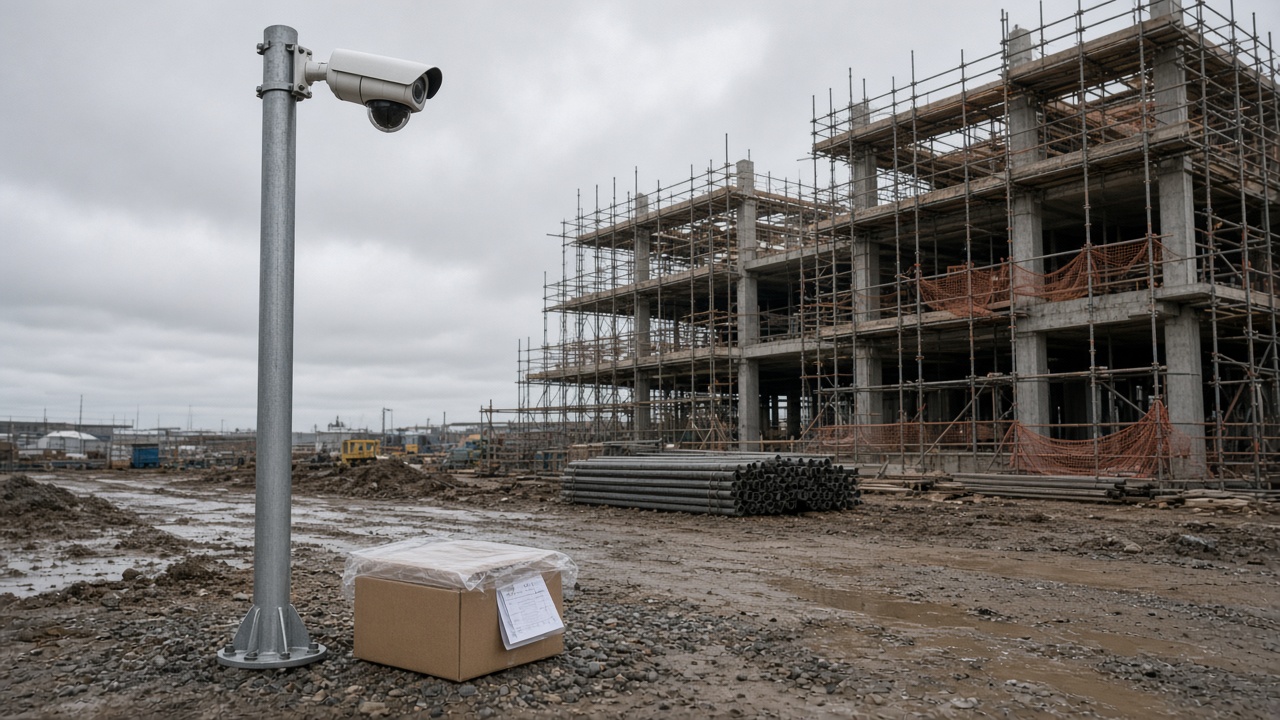
There is a camera on a pole at the corner of the compound and a second still shrink-wrapped by the welfare unit, waiting for a telehandler. The demo that sold them was thirty seconds long: a worker walks into frame bare-headed, a red box appears, an alert lands on a phone. It is a good demo. It is also close to the easiest thing the technology does.
What a camera is worth as a safety control on a live job can be answered partly from the published record rather than from the reel. Three sources are available and they do not flatter each other: what peer-reviewed detectors report on named datasets, what Great Britain's RIDDOR figures say actually kills people, and what UK data-protection law already prices as surveillance. Take all three as they stood in spring 2025.
It is only fair to say what would change my mind. A multi-site study that attributes a statistically significant fall in RIDDOR events to vision, having controlled for the other things happening at the same time — edge protection, competence, permit discipline — and that publishes the false-negative rate the site was prepared to act on. That study is not in the record. Until it arrives, cost the miss rather than the demo.
What it catches
The literature is crowded and most of it is about the same two objects. Hard hats and high-visibility vests are large, high-contrast and easy to photograph, which is why they dominate the datasets.
Nath, Behzadan and Paal, in Automation in Construction (2020), trained three YOLO-based pipelines on Pictor-v3 — about 1,500 annotated images and about 4,700 worker instances, crowd-sourced and web-mined — to ask whether a worker was wearing a hat, a vest, or both. Their best single-network approach reported 72.3 per cent mean average precision at about 11 frames per second on a laptop, and a faster variant managed 13 frames per second at 63.1 per cent mAP. Those numbers describe a detector on that test set. They say nothing about injuries, and the authors did not pretend otherwise.
Fang, Ding, Luo and Love, in the same journal in 2018, split the job in two: Faster R-CNN to find the worker, then a second network to find a safety harness. On a closed set of photographs from projects in Wuhan they reported 99 per cent precision and 95 per cent recall for the worker, and 80 per cent precision with 98 per cent recall for the harness. High recall on the harness means very few missed straps in that album. It does not mean the edge was protected, the lanyard clipped, or the person authorised to be up there in the first place.
By late 2024 the open benchmark had grown considerably. Ahmad and Rahimi's SH17 dataset, published in the Journal of Safety Science and Resilience, offers 8,099 images and 75,994 instances across 17 classes: person, head, face, glasses, mask, face-guard, ear, earmuffs, hands, gloves, foot, shoes, vest, tools, helmet, medical suit, safety suit. Their best model, YOLOv9-e, reached 70.9 per cent mAP at a 50 per cent overlap threshold and 48.7 per cent across the stricter 50–95 band. Worth dwelling on the composition: helmets account for only 927 of those instances, roughly 1.2 per cent of the set, and almost 40,000 annotations occupy less than one per cent of the image. The detector is being asked to see small things.
There is a sibling application that most safety pitches skip past — workers and heavy equipment in the same frame, for progress and plant monitoring (Fang, Ding, Zhong, Love and Luo, Advanced Engineering Informatics, 2018). The output is still a bounding box. Drawing boxes is not the hard part. What the box is permitted to decide is.
| Study | Dataset | Scale | Best model | Reported accuracy |
|---|---|---|---|---|
| Nath, Behzadan & Paal (2020) | Pictor-v3 | ~1,500 images, ~4,700 worker instances | YOLO-based, single-network | 72.3% mAP at 11 fps (faster variant: 63.1% at 13 fps) |
| Fang, Ding, Luo & Love (2018) | Wuhan site photographs | Closed set, not published as a count | Faster R-CNN + CNN | 99%/95% precision/recall (worker); 80%/98% (harness) |
| Ahmad & Rahimi (2024) | SH17 | 8,099 images, 75,994 instances, 17 classes | YOLOv9-e | 70.9% mAP@50; 48.7% mAP@50–95 |
| Cross-domain test | SH17-trained YOLOv9-e run on public Pictor-PPE (3 classes) | — | Same weights | 58.8% mAP — helmets frequently scored as heads |
So the papers support something real, narrow and entirely visual. In good light, with a lens that can resolve the object, current detectors will flag a missing helmet, a missing vest, sometimes a missing harness, a person in a plant envelope, a body crossing a line someone drew on a still. I would rather have that than not have it. It is a long way short of a safe system of work.
Where it falls over
The first problem is domain shift, and you will find it in the method sections rather than the marketing. SH17 was scraped from Pexels. Those images are licensed, diverse and well lit. They are not a fortnight of rain on a British frame, a night pour, or a lens with a film of dust on it since the last dry spell. When Ahmad and Rahimi ran the same YOLOv9-e weights on the public Pictor-PPE images — only three classes, worker, hat, vest — mean average precision fell to 58.8 per cent, and helmets were frequently scored as heads. Reviews of construction vision, from Fang and colleagues in Automation in Construction in 2020 through to the 2024 survey literature, keep listing the same failure modes: occlusion, motion blur, poor lighting, visual clutter, and datasets too small or too clean to compare. Zhafran and colleagues, working with laboratory images, had already noted accuracy dropping with distance and lighting. A stock-photo mAP is not a site mAP.
The second problem is the object the camera was never going to see. HSE's Work-related fatal injuries in Great Britain, 2024, published on 3 July 2024, recorded 138 worker deaths in 2023/24, provisionally, of which 51 were in construction — four more than the year before, against a five-year average of 42. Across all industries, falls from a height accounted for 50 deaths, 36 per cent of the total; being struck by a moving vehicle for 25; being struck by a moving object for 20. Those three categories together were about 70 per cent of worker deaths. A helmet detector does not install edge protection. A vest detector does not separate people from plant. A harness detector, even at 98 per cent recall on a research set, has no idea whether the line was clipped, whether the scaffold was inspected that morning, or whether the man on the roof appeared on the permit.
The third problem is everything that is not a pixel. CDM 2015 assumes pre-construction information, a construction-phase plan that is still live, and a health and safety file somebody can produce on request. A camera assembles none of that. It cannot close a permit, name a duty-holder, or record residual design risk against an issued revision. It has no view on competence, and no view on why the helmet came off. Purpose limitation cuts in the same direction: the Information Commissioner's Office is explicit that you must not monitor workers "just in case", and that audio, wearables and facial recognition for unique identification raise the legal bar — the last of those being special-category biometric data under Article 9 of the UK GDPR. The ICO's own construction example is conventional CCTV alongside guards, with prominent signage stating that the purpose is safety and security. That is surveillance with a declared purpose, which is a different thing from a claim that the model read the method statement.
And a detection nobody owns ends up as a line on a dashboard, which any supervisor holding the phone will tell you is not the same as a control.
What it costs
The visible invoice is the mast. UK hire price lists in 2024–25 advertised rapid-deployment CCTV towers from the low hundreds of pounds a week at the recording-and-monitoring end, with higher-specification or "analytics" units quoted above that. Those figures disagree with one another about what is included — monitoring hours, relocation, solar, audio challenge — and they are security products in any case. Treat them as a floor on hardware and connectivity, not as a safety business case.
The rest of the bill never appears on the hire sheet.
Data. Somebody has to label the site you actually have. SH17 needed four annotators plus review to mark 76,000 instances on stock photographs. A live camera looking at your trades, your PPE colours and your weather is a new dataset. The cross-domain drop from 70.9 to 58.8 per cent mAP is the published price of skipping that work.
Review. At 11 to 13 frames per second, one camera generates more events than a supervisor can honestly close. False positives are labour: someone dismisses the foliage, the vest draped over a chair, the helmet scored as a head. False negatives are liability, because the system said clear. There is no peer-reviewed sterling figure for that labour on a UK site, and the absence is the useful finding. If you cannot say how many alerts were actioned, by whom, and which RIDDOR category they were aimed at, you have no basis for pricing the system.
Law. Images of people are personal data before they are a safety metric. The ICO expects a documented lawful basis — usually legitimate interests rather than consent — a necessity and proportionality argument, and, where processing is likely to result in high risk, which includes systematic monitoring of staff, a data-protection impact assessment. You consult the workforce, fix the purpose, restrict the field of view, set a retention period, store footage so it can actually be produced, and answer subject-access requests including the redaction of third parties. Facial recognition for unique identification needs an Article 9 condition. Audio should be rare. A contractor already running CCTV for security has not, by that fact alone, authorised an analytics layer that scores identifiable workers for PPE all day; changing the purpose is new processing, and new processing costs time.
Opportunity. HSE's series does not show that more cameras shift the fatal categories that dominate construction. Edge protection, exclusion zones and a construction-phase plan that is genuinely the document the site is working to this week are controls with a mechanism behind them. Money spent detecting a bare head in good light, on a job where permits get closed retrospectively, has gone to the visible object. The expensive one is outside the frame.
What the record will and will not carry
None of this proves that a platform, a mandate or a model will improve an outcome by itself, and none of it says the cameras should come down. The papers show that mid-70s mAP on hats and vests is achievable on their own datasets in good conditions, and that the number falls when the camera or the domain changes. The regulator shows that construction still kills people through falls, vehicles and moving objects, and that those deaths are counted every year. The ICO shows what the footage legally is.
The principal contractor who writes the construction-phase plan should hold the next tower until three things are written down: who owns an alert — who dismisses it, who stops the work — a data-protection impact assessment for systematic monitoring of staff, and a business case that cites the test set, the RIDDOR year and the lawful basis. Those cost site-specific labelling, the labour of closing false positives, and a workforce consultation; they are not the hire rate on the mast. Put whatever money remains on the controls that have a mechanism — edge protection, exclusion zones, a plan the site is working to this week. If the case cannot survive that, leave the shrink-wrapped camera in its carton.
Read next: Near-miss data: collecting it so it predicts something, Monthly Register — May 2025, CDM 2015, ten years on: what the regulations assume about information.