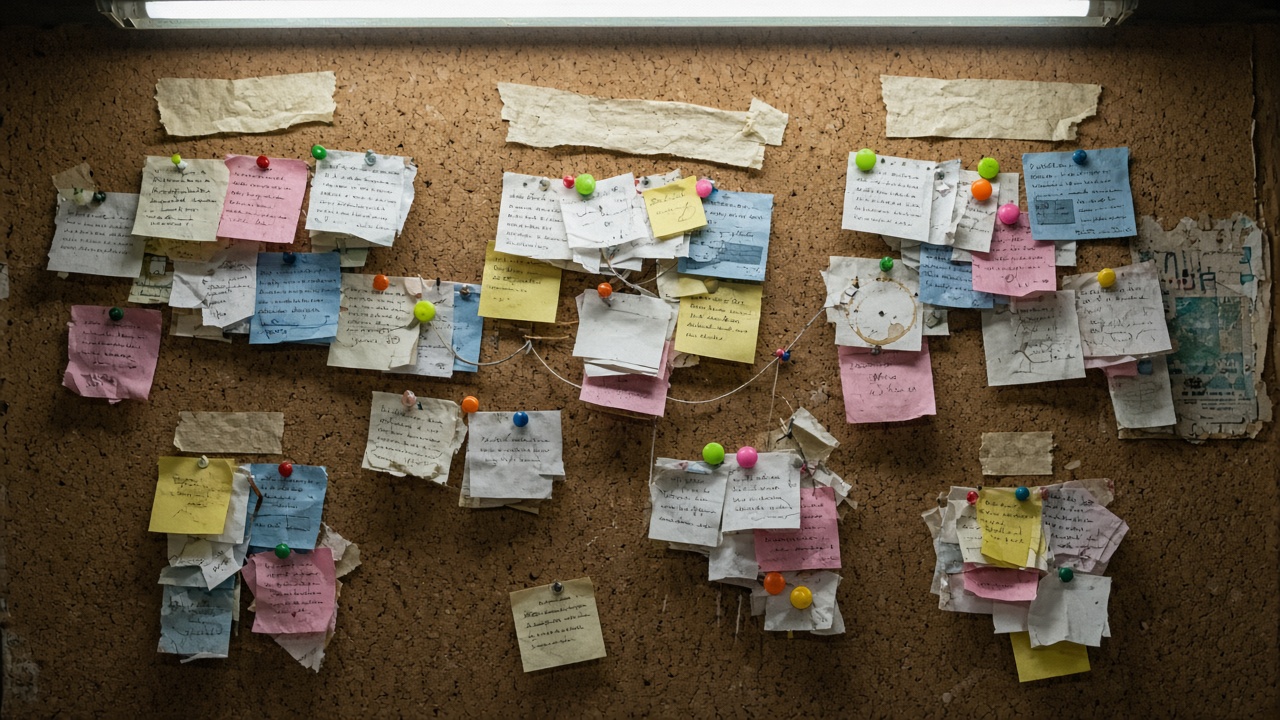
Walking back to the cabin, a labourer decides whether to write the card. A pallet shifted on the forks, nobody was underneath it, and the shift ends in twenty minutes. The form is in a plastic wallet by the door; the app wants a login he has forgotten, and his last card came back as a toolbox talk about paying attention. The calculation is rational, and the answer is usually no.
Everything else about near-miss data depends on what he decides. The slogan is well known — collect leading indicators, do not wait for harm — and what most sites collect instead is a monthly total. That total then gets read as a score: high means a strong reporting culture, or an unsafe site, depending on who is chairing. Neither reading predicts anything. What predicts something is a cluster you can see forming and act on before the same energy finds a person.
Two things have to work, in this order. The culture, or you get fiction. The fields, or an honest report cannot be found again next week.
What a monthly total cannot tell you
A leading indicator arrives before the outcome you care about, and a near miss qualifies: energy was released, or a control was missing, and nobody was hurt. The value lies not in the event itself but in the next person being able to see the same conditions forming.
Counting cannot do that work. Forty-seven reports this month tells you that forty-seven forms were filed. It does not tell you whether they were the same edge, the same service drawing, the same night shift, or seven copies of “housekeeping” written on a Friday to satisfy a quota. Lagging indicators — injuries, dangerous occurrences, enforcement — have the mirror-image problem: they are gratifyingly specific and arrive far too late.
Treat the monthly total as a hygiene check on the system: are reports arriving at all? What you are building is a record you can group.
Take the accident triangle off the cabin wall too, or at least stop presenting its ratios as a forecast of this job. Those figures are a century old and still contested — a story about accidents in general, not a measurement anybody took here. If you want a ratio, wait until you have enough of your own clusters to derive one. Until then, you have a log.
The culture that produces any reports at all
You cannot analyse a report nobody wrote, which makes the first design problem a human one rather than a database one: will a labourer, a banksman or a visiting inspector still write the card after seeing what became of last month's?
Three habits kill the feed.
Punishment. Treat a near miss as a disciplinary event — particularly one that names a supervisor's gang, a missing permit or a drawing that was simply wrong — and the next one becomes a conversation in the canteen instead of a card. Named reporting beats anonymous, because you can close the loop. It collapses the moment the name is read as a charge sheet.
Quota. “Two cards per gang per week” reliably produces cards. It produces them late on Friday, in one handwriting, about trailing leads the weekly inspection had already picked up. Volume targets teach people that the form is a performance. If you want a target, make it the time taken to close a real cluster.
Silence afterwards. People will put up with a short form. They will not put up with a form that vanishes. When the reporter never hears what changed — a drawing revision, a barrier, a permit condition, a toolbox talk that cited the actual sheet — the lesson is that reporting is theatre.
The test is ordinary: ask last week's reporter, by name, what happened after they wrote the card. A supervisor who thanks them at the time, protects them through the investigation and comes back with one specific change will get the next card. A safety manager who publishes a league table of most reports filed will get a vanity log.
Distinguish three things on the form itself, or people will mash them together:
- an observation is a condition (unguarded edge, unsigned permit, wrong revision on the hut wall)
- a near miss is an event without harm (the load swung, the cable was live, the person stopped at the edge)
- an incident is harm, or a dangerous occurrence that the law already knows how to classify
Mix them and the leading-indicator count inflates while the events that actually carried energy disappear inside it. Share the fields; keep the type distinct.
Fields that let a record predict
An honest paragraph in a notebook is still a poster if nobody can find the next one like it. The minimum record is not an essay. It is a small set of facts that survive a query.
Require these. Allow a photo and a sentence. Do not require a novel.
- 01WhenWhat “good” looks likeDatetimeshiftWhat fails“Last week”“night”
- 02WhereWhat “good” looks likePlotlevelgrid or zoneWhat fails“On site”“Level 3-ish”
- 03EventWhat “good” looks likeWhat occurredin one sentenceWhat fails“Unsafe behaviour”“near miss”
- 04Energy / almostWhat “good” looks likeWhat would have hurt someone (fallstrikeserviceplantcollapse)What failsA risk-matrix colour with no noun
- 05ActivityWhat “good” looks likeWhat the work wasWhat fails“General duties”
- 06Trade and employerWhat “good” looks likeWho was exposednot who filedWhat failsA blankor only the principal contractor
- 07Issued setWhat “good” looks likeDrawing or instruction identity and revisionRAMS or permit if one governed the taskWhat fails“The drawings”“as briefed”
- 08Intended controlWhat “good” looks likeWhat should have been thereand whether it wasWhat fails“PPE” as a slogan
- 09Immediate actionWhat “good” looks likeWhat stopped it getting worseWhat failsEmpty
- 10Owner to closeWhat “good” looks likeDesignsiteor supply chain — a named roleWhat fails“H&S” as a dumping ground
- 11Close-outWhat “good” looks likeWhat changedon which containerby whenWhat fails“Discussed in meeting”
The issued-set row is the one most forms skip and the one that turns a pile of cards into something worth reading. A load that swung because the lifting plan was last week's is a different problem from a load that swung because the current revision put a tower crane over a public footpath. A service strike that almost happened on C02 of the drainage layout is a design and coordination fact. The same event with no revision recorded is a story about a trench.
You do not need a location pin to start. A grid and a level that match the site set will do. You do not need a risk score either; you need a noun for the energy and a name for the control.
Free text is fine for the sentence. Controlled lists are required for type, energy, trade, zone and close-out state. All free text and you will never cluster. All dropdowns of slogans and you will never learn.
Query the week, not the year
Prediction on a live job is a weekly habit rather than a research project. Ask the same four questions of whatever arrived.
- Same place. Two or more records on one grid, one shaft, one roof edge, one haul road. The place is trying to tell you something the weekly inspection is walking past.
- Same sheet. Two or more records that cite the same drawing or instruction revision — or that cannot cite one, which is itself a cluster about the unofficial set.
- Same trade and activity. Night-shift services. Saturday concrete. A single subcontractor's unloading bay. Those are planning facts, not character facts.
- Same failed control. Permit not issued, barrier removed, exclusion zone not held, wrong status on the hut print. If the control is missing in three places, stop retraining individuals and change the control.
Then act on a cluster the way you would act on a drawing comment: change the issued information, the method or the physical arrangement, and write that change back onto the records that prompted it. A record sitting open with nobody's name against it has stopped being a leading indicator.
If you have one report and no cluster, close it anyway. A single event can be plenty when the energy is high. Nobody needs a trend before moving a barrier that was already absent.
A Monday check
Take last month's cards, or last month's export, and score the system rather than the people.
- Can a reporter finish the form in the hut, in gloves, in a few minutes, without a unique login they have forgotten?
- Take five records at random. Do at least four of them name a place more precise than the site, a trade, and an energy?
- How many name a drawing or instruction revision, or honestly say that none was in force?
- Ask two reporters what changed after they filed. If both shrug, the culture is a poster.
- Can you group last month by zone, by revision, and by failed control without rereading every paragraph?
- For each group of two or more, is there a dated change to a drawing, a RAMS, a permit condition, or a physical control — and is that change written on the records?
If (1) or (4) fails, fix the culture and the friction before you add a single field. If (2), (3) or (5) fail, you have a log. If (6) fails, you have a queryable log that predicts nothing, because nothing in the work changed.
Limits worth stating
None of this replaces the framework around it. CDM 2015, RIDDOR, the Building Safety Act where it applies, and the project's own safety-management system each have owners, and HSE's guidance on investigating incidents and on managing for health and safety is what decides whether an investigation was adequate on a given job. A near-miss form does not classify a RIDDOR event and does not stand in for an investigation.
Nor will any of it forecast a unique event. Near-miss records are no substitute for competence, supervision or a current issued set. What they will do, if you let them, is show where the same conditions keep repeating.
The changes that make that possible are small, and they are not free. Adding an issued-set field means reprinting the card, changing the form in whatever system you use, and — the harder part — persuading supervisors that a report naming a wrong revision is a good report rather than an accusation. Grouping last month by zone and by failed control takes someone an hour or two every week, indefinitely. Give that hour to a named person or it will not happen.
Principal contractors own the form, the grouping and the close-out. Clients and appointing parties own the thing that actually shifts behaviour, which is what gets asked for at the monthly review. Ask for the count and you will receive the count for the life of the job. Ask instead for the clusters found this month, the change made against each one, and the drawing, RAMS or permit condition that change was written onto — then be prepared to hear that a cluster pointed at the design rather than at the labourer who wrote the card. That is the review question worth changing, and the cost of changing it is a willingness to sit with the less flattering answer.
Read next: Designing out risk: making the design risk register traceable to the model, Computer vision on site: what it catches, what it misses, what it costs, CDM 2015, ten years on: what the regulations assume about information.