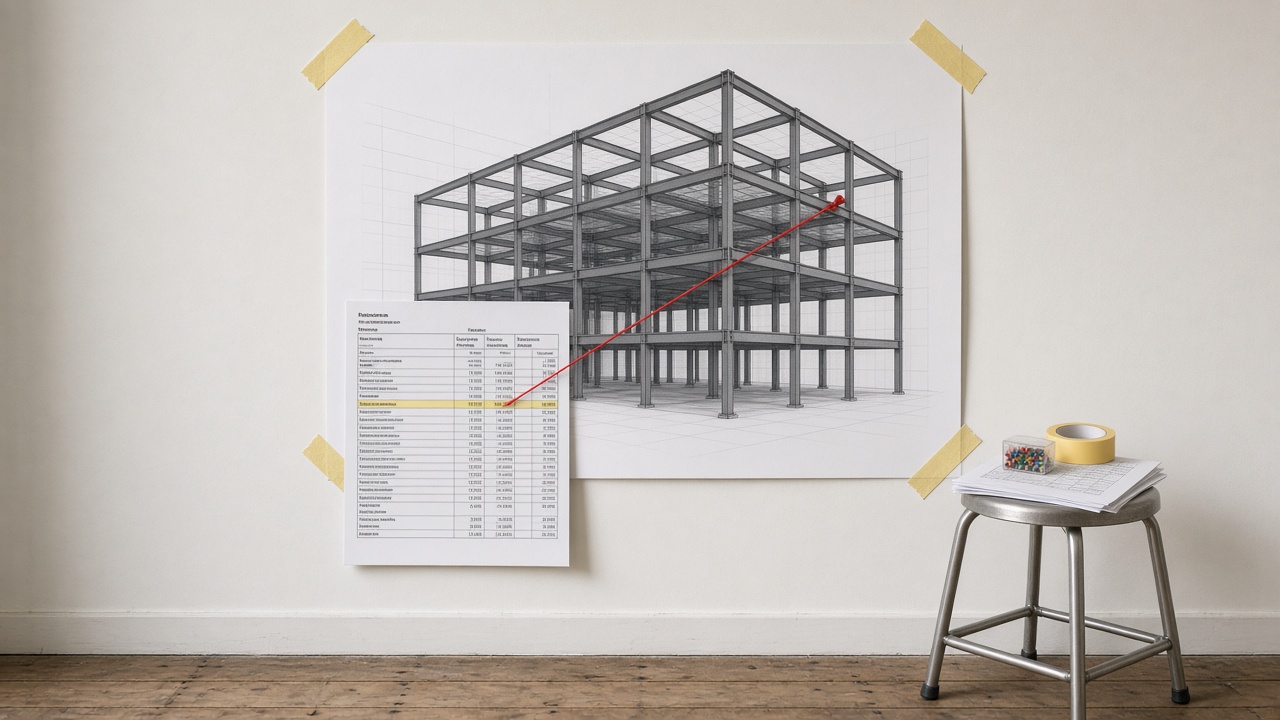
Somewhere in most design offices there is a register row that reads: falls from height, mitigate, residual amber, owner design team. It has been amber since February. The hazard behind it is a roof edge at level seven — or a riser opening, or a plant item that will eventually have to come out through a finished lobby — but you would not learn that from the row, and nor would the contractor who has to price it.
Change the status to designed out and the cell turns green. The edge is still open.
What stops that happening is dull and mechanical: every live row points at something a stranger could retrieve, a model object or an issued sheet, with number, revision and identity, so that the decision sits on the thing it actually concerns. Where nobody can make the pointer, what you have is a note about a hazard rather than a hazard anybody has dealt with.
The row that could belong to any job
Most registers are precise about probability and vague about location.
The typical row: falls from height; services congestion; manual handling of plant; temporary instability during erection. Category, safety. Owner, the design team. Status, mitigate. Residual, amber. The mitigation reads “guarding to be confirmed”, or “coordinate in the federated model”. No drawing number. No revision. No object, no storey, no grid, no room. Copy that row into any other job in the office and it would be just as true there.
Which is exactly why it survives. Nothing in the model has to change for it to stay accurate, so it passes every design review on its way through, then travels into the pre-construction information and the health and safety file as a generic residual — “care on roofs” — that a contractor cannot price and a supervisor cannot brief on a Tuesday morning.
CDM 2015 asks designers to eliminate hazards so far as is reasonably practicable, and to reduce what cannot be eliminated. The regulation assumes what remains can be pointed at. It does not assume a worksheet. A principal designer who cannot walk from a residual row to a sheet or an object is coordinating a list rather than a design.
The test takes ten minutes. Hand the register to a colleague who did not write it and ask them to find the thing each row is about. If they have to come back and ask the author, that row has nothing behind it.
Point at an object, or at an issued sheet
A comment in a cell saying “see architectural model” is not a pointer, because nobody can follow it. What a pointer does is get somebody else, later, to the thing itself.
Two targets will do, and both is better.
A model object, or a typed set of them, with an identity that holds. The roof edge still waiting for a parapet. The void nobody closed. The plant item whose replacement route runs through a finished lobby. The object has a type, a location, and an identifier that survives export. “The federated model” is not an object. “External wall, type W-EXT-04, grid C/4, level 07” is.
An issued drawing, with title, number, revision and stated purpose or suitability. The sheet is what site is entitled to rely on, so if the residual will be built from a plot, the row has to name that plot the way a register names any current identity. “Roof plan” will not get anyone there. “The roof sheet, C02, issued for construction” will.
Rows that point only at the model go dark the first time somebody works from paper in the hut. Rows that point only at a sheet go stale the first time the model moves and the sheet has not yet been reissued. Rows that point at neither are the ones this whole exercise is about.
Neither pointer maintains itself, either. Delete the object and the risk does not close; supersede the sheet and the reference does not follow. What traceability buys you is a prompt to look again at the right rows, which is more than most registers manage and rather less than a hyperlink implies.
Designed out means something changed
“Designed out” is a claim about geometry, specification or sequence, not a dropdown.
If the risk was a fall at an unprotected edge, designing it out means the edge is not unprotected on the object that will be issued: a parapet, a walkway, an opening moved, or an erection sequence that never creates the edge at all. The register records the decision, the date, and what changed. Whatever residual is left points at what is left.
If the risk was a duct crossing an escape stair, designing it out means the two no longer share a volume on the issued coordination set. Close the row because a Thursday meeting agreed to resolve it in the next drop and the hazard stays exactly where it was, believed closed, for however many months it takes the next drop not to arrive.
Where elimination is not on, the residual still needs somewhere to live. Pre-construction information and the health and safety file should inherit the pointer along with the wording. “Residual risk: roof maintenance” tells the eventual duty-holder nothing at all. “Residual risk: roof sheet C02; western edge at grid D, level 07; access by mobile platform from the west elevation; no fixed ladder” is something a supervisor can actually brief.
A row marked designed out with no before-and-after object is how a project congratulates itself for editing a cell.
Three things the pointer has to survive
A revision. C02 supersedes C01. The risk travels to C02, or closes because the object changed, or becomes a residual against the new identity. A pointer still reading C01 a fortnight after C02 went out is a small private version of the unofficial set in the trailer.
A model drop. Objects get split, merged, remapped, renumbered. If the only key you held was last Tuesday's internal code, the row has already come loose. Hold a type, a location and an identifier, and when an identifier breaks, treat it as something to review rather than something to leave alone.
A change of duty-holder. Novation, a new package, a contractor's design portion. Whoever wrote “the design team” in the owner column has left a vacancy, and the pointer now has to resolve for an incoming author who sat in none of the meetings. If it lives only in a personal workbook on somebody's laptop, it will not.
Those three events are the reason the register cannot sit quietly in a spreadsheet next to the model. The model and the issued set already have owners, states and supersede rules. Either the risk rows join that traffic, or they are the thing nobody updates when the traffic moves.
| Event | What happens to the pointer | If it fails |
|---|---|---|
| A revision | C02 supersedes C01; the risk travels to C02 or closes against it | Pointer still reads C01 — a privateunofficial version of the risk register |
| A model drop | Objects split, merge, remap or renumber | The row has already come loose from the thing it concerned |
| A change of duty-holder | Novation, a new package, a contractor's design portion | The pointer must resolve for someone who sat in none of the meetings |
Something to try on Monday
Take the register as it is. Resist tidying it first, because the mess is the data. Then work the live rows.
- For each open row, write the pointer: model object (type, location, identifier), issued drawing (number, revision, purpose), or both. If you can fill neither column, park the row rather than scoring it.
- For each pointed row, retrieve the object or the sheet without asking the author. If retrieval needs a meeting, what you have is a comment.
- For each row marked designed out, name what changed on the object or the sheet, and the revision the change went out on.
- For each residual, carry the same pointer into the pre-construction information or the health and safety file extract. A residual that cannot travel with its pointer arrives on site as a poster.
- List the rows that need reviewing before the next design meeting because a sheet was superseded or an object deleted this week. An empty list, in a week when the model moved, tells you something.
Five rows will show you the pattern. You do not need a new taxonomy, or a workshop about one. You need to know which rows have nothing behind them, and to get the live decisions attached to the objects they concern.
What the standards assume
CDM still assumes a residual can be pointed at, and the principal designer is the one who can make that true. Before the next design review, park every live row that cannot name a model object or an issued sheet, and refuse "designed out" unless the author can show what changed on that identity and which revision carried it. Carry the same pointer into the pre-construction information. An hour on the live rows, plus the awkward conversation with the engineer who treats the register as a file document, is the cost; a residual the contractor cannot price is the alternative. Five rows are enough to see which version of the design somebody else can actually retrieve.
Read next: Toolbox talks that link back to a drawing revision, Near-miss data: collecting it so it predicts something, CDM 2015, ten years on: what the regulations assume about information.