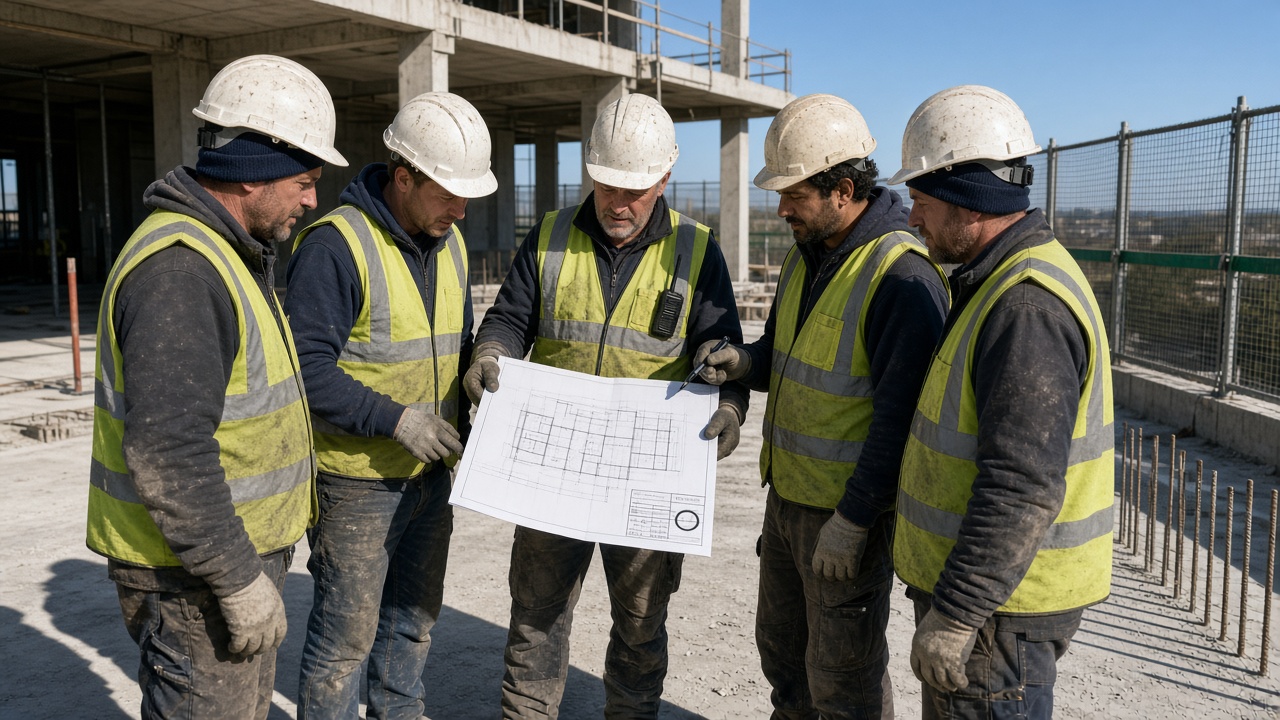
Seven in the morning, a cold slab, nine trades in a huddle where the wind comes across the deck. The supervisor gets through it in four minutes: the hazards, the exclusion zone round the leading edge, the crane sequence, the fact that the floor below is now occupied. Then the closing line, the one almost everybody uses. Work to the drawings. The attendance sheet goes round, gloves come off to sign it, and the form is in the folder by nine.
If somebody cuts an opening in the wrong place a month later, that folder will prove the gang was briefed. It will not prove what they were briefed on.
The talk is already happening, run by someone who knows the work. What is missing is treating the issued identity of the sheet as part of the briefing rather than as something the document controller looks after somewhere else.
Which drawings, though
“The drawings” is a location rather than an instruction. Depending on who is listening it means the common data environment, the rack in the hut, the A1 taped to the plywood by the stair core, or the crop that came through on a messaging thread after yesterday’s coordination call. Those are four different objects and they can disagree about the same sheet number. A gang told to work to the drawings will work to whichever one is already in somebody’s hand.
A revision is an issued identity: this title, this series, this purpose of issue, this supersede. C02 is a sentence about what the site is allowed to rely on. “Latest” is not a sentence; it is a guess about who last plotted, last forwarded, or last drew on a print with a marker.
None of which means the briefing should become a document-control lecture. Most talks cover one activity on one area, and that activity sits on a handful of sheets that already carry numbers and revisions in the title block. Saying them out loud costs about thirty seconds. Arguing afterwards about what the gang “must have known” costs a good deal more than that.
What citing a revision sounds like
Short enough to survive a radio and a gloved hand.
Not: “Services are live on level four, work to the latest drawings.”
Instead: “Today’s work is the level-four corridor penetration package. The issued sheets are M-4102 at C03 and S-2281 at C02, issued Friday for construction. C02 on S-2281 moved the opening 300 millimetres east. The hut print of C01 is dead. If you still have it, it gets marked superseded before we start.”
The hazards still get said. The exclusion zone still gets said. What has been added is the container identity, the revision, the purpose of issue, the change that matters, and the withdrawal of the previous print — five facts, one breath longer.
If the supervisor cannot produce those facts without opening an inbox, the talk is not ready. Fetch the register before the gathering rather than during it.
A crop on a phone will not do the job either, because a crop has no title block and no revision box. Hold the published sheet, or a plot of it, with the title block visible, and point at the revision. The gang should be able to walk to the rack afterwards and find the same identity — or discover that the rack is wrong, which is also worth knowing before ten o’clock.
A Monday method
Run this on the next talk already in the diary. Nobody wants another meeting.
-
Name the activity, then the sheets. Write the work, the drawing numbers and the revisions on the board or the attendance sheet before anyone signs. If you cannot fill those three fields, stop and fetch the register. Briefing from a memory of what was issued last week is how a superseded sheet keeps its authority.
-
Open the issued identity, not a crop. Show the title block. Read the revision and the purpose or suitability as they appear on the container. If the plot stamp and the title block disagree, you have found a defect, which is a better outcome than a fluent briefing on the wrong sheet.
-
Say the delta. Nobody needs the coordination history. They need the change that will place today’s work: the opening that moved, the restraint that was added, the note that appeared in the margin. If nothing material has changed since the last talk on this activity, say so — and still cite the revision. An unchanged C02 is still C02.
-
Withdraw the previous print in the same breath. Issue without withdrawal is how two revisions stay live at once. If C01 is still on the wall, the talk that cited C02 has not finished. Mark it, collect it or replace it before the gang walks.
-
Record the citation, not only the attendance. The signed sheet should carry the numbers and revisions that were read out, the date of the issued set, and who held the talk. A list of names under “toolbox talk — services” records a ritual. The same list under “M-4102 C03, S-2281 C02” records an instruction.
-
Reconcile the hut before the shift starts. After the signatures, walk to the rack. Does the print match the citation? If it does not, the talk has documented one issued set while the workface holds another. Fix the print rather than filing the form and hoping.
Six steps, and roughly ten extra minutes when the register is in order. Longer when it is not, and the length of that delay is itself the finding.
What the record has to hold
A later claim, a near-miss review or a principal contractor’s audit will not ask whether the gang had a briefing. It will ask what they were told to build from.
The contemporaneous file should answer four questions without anyone having to reconstruct the morning:
- Which activity was briefed, on which date, by whom?
- Which information containers were cited — number, revision, purpose?
- What change was named as material?
- What previous print was withdrawn, and where did it go?
If those answers live only in the supervisor’s memory, the project has a talk and no record of it. If they live on a form that says “drawings as issued”, it has signatures under a slogan.
Keep the form boring. Three or four lines on the attendance sheet you already print will do, and a photograph of the title block attached to the record beats a paragraph of prose. CDM 2015 and the Building Safety Act own the duty to cooperate and to provide the right information at the right time; neither specifies the wording of a briefing at ten past seven. Both assume somebody can say which issued identity the workface is using.
The people who can make this normal are not the supervisors — they are already doing the difficult part, in the cold, before most of the office is awake. It is whoever owns the template and whoever audits it. Add three cells to the standard attendance sheet: sheet number, revision, purpose of issue. Tell supervisors that a talk with those cells blank comes back, the way a blank signature box would. Then put the drawing register somewhere reachable from a phone at ten to seven without a login nobody remembers, because if the citation costs five minutes of fighting a portal, the citation will not happen. Principal contractors can write it into the subcontract briefing standard; clients can ask to see six months of talks and test whether the revisions cited were current on the dates they were read out. The cost is a printing change, a couple of hours of induction, and an awkward fortnight while half the forms come back incomplete. Against one argument about who told a gang to cut where, that is a cheap line in the safety budget.
Read next: Monthly Register — April 2025, Designing out risk: making the design risk register traceable to the model, CDM 2015, ten years on: what the regulations assume about information.