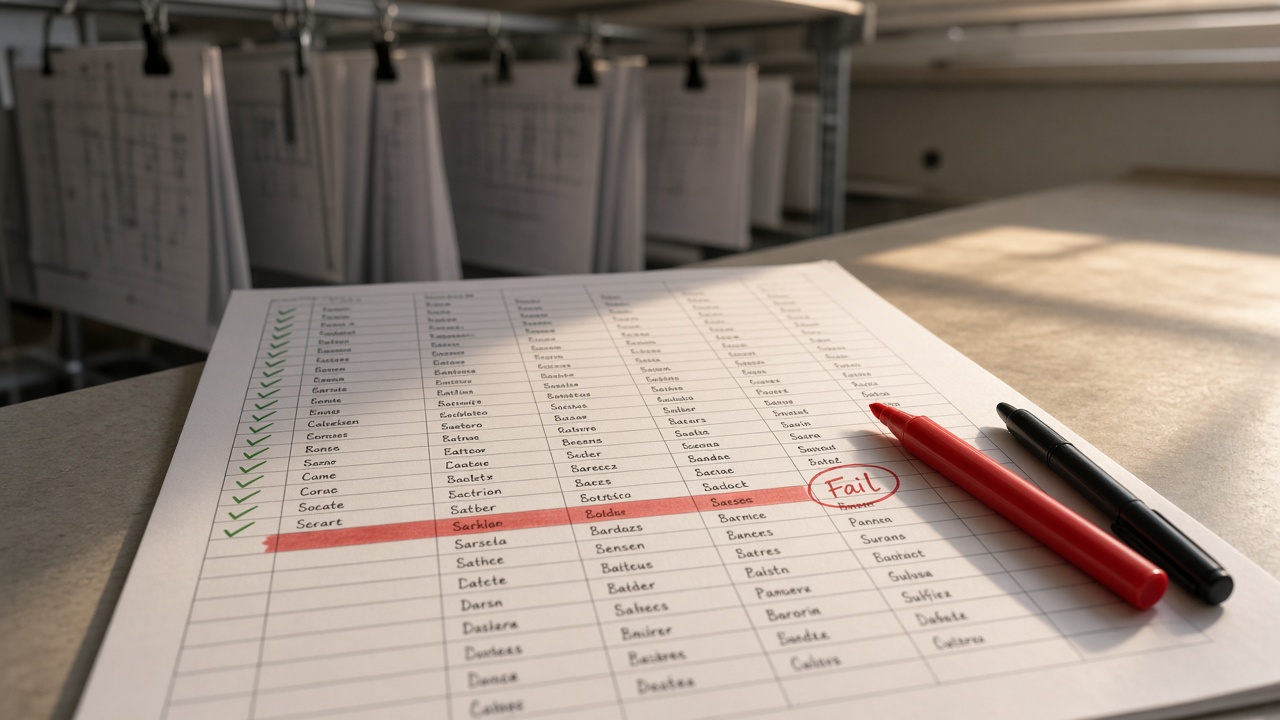
Half four on a Friday and the register prints clean: every row green, one current revision per title, nothing obviously owed. Then site rings to ask whether the Rev C taped to the plywood is the sheet they should be setting out from, and it turns out Rev D went to a shared mailbox on Wednesday, addressed to nobody in particular. The register was not lying. It was describing a different building from the one being built.
Closing that gap is what weekly hygiene is for, and four things do most of the work: superseded revisions genuinely marked, transmittals genuinely numbered, plotter copies genuinely collected, and suitability codes that can still stop a plot.
So print the checks and time-box them. One live package, forty-five to ninety minutes, every week the job is building from paper or PDF — not at close-out, not when an audit is announced. Findings go in the register or a dated note beside it, as sheet numbers rather than adjectives.
How to run it
Pick the packages the site is installing this week — a floor of architectural GAs, a structural issue for a pour, a coordinated MEP set for one zone. Not the archive. And do not "clean" the common data environment the night before, or you will spend the hour auditing your own tidying.
Name the standard or BEP you are testing against, including the status-code list it publishes. If nobody can produce that list, write it down; you have a finding before you start.
Then walk the four checks in order, because they stack. Supersede first: two live-looking revisions of the same title poison every check that follows. Transmittals second, since a current row with no issue behind it is a well-organised shelf. The plotter third, because the copy at the workface is the one that gets built. Suitability last — a current, transmitted, plotted sheet that anybody may use for any purpose is not controlled in any sense that survives a question.
Aged placeholders ride along on the same pass. A row that promised a deliverable and has sat empty through two issue cycles is rot. Chase it or close it; leaving it looking owed helps nobody who inherits the register.
1. Supersede
A folder containing Rev A, Rev B and Rev C is a folder. Control is being able to say which identity is current, who still holds the previous one, and whether they may use it.
For each title in this week's live package:
- Confirm there is exactly one current revision. Two "current" rows for the same sheet number is a fail, even if one is "about to be withdrawn."
- Confirm the previous revision is marked superseded in the register — not only sitting in an older column, not only living under a filename suffix.
- Confirm a withdrawal fact: collected print, stamped copy, recorded return, or a named instruction that the previous identity is dead. A status change in the CDE with no mark on the artefact is how two revisions stay live.
- Confirm the superseded file remains findable as history. Deleting it is not hygiene, and hiding it so nobody can reconstruct last Tuesday is how a claim file ends up empty.
The characteristic miss is the late revision. The register updates on Thursday; the hut finds out the week after, or doesn't. ISO 19650's published state exists precisely because dropping a file into a folder is a different act from withdrawing the instruction it replaces. If you cannot point at the withdrawn identity, nothing has been superseded — something has been added.
Write down the sheet numbers that failed. "Mostly fine" is a mood.
2. Missing transmittals
A green issued cell is a colour. Issue is a numbered act with recipients you can name.
For every revision published since last Monday — and for any older current row still carrying no issue record — reconstruct four facts from the system of record rather than from memory:
- unique transmittal number and date
- named recipients, not "the contractor" or "the package"
- exact containers and revisions
- purpose, or the action requested
A gap in any of the four is a missing transmittal. So is an upload with no number, a zip to a mailbox with no named installer, and a pack of thirty sheets that never says which one changed — that last gets filed unread, which comes to the same thing.
Then the fifth fact most registers skip: is there dated evidence of receipt at the installing company, not merely at the first mailbox in the chain? Issue without receipt is how the register can be entirely correct and the pour still wrong. You will not close that cascade in one sitting. You do have to see the hole.
Do this for the week's issues rather than for one tidy pack you are proud of. An immaculate cover sheet proves you can do it when watched; a week of numbered issues proves a habit.
3. Plotter copies
The plotter has no idea what it superseded. It produces a fresh sheet, warm and convincing, and leaves the previous run lying about looking issued.
Walk the places the live set actually lives:
- the plotter output tray and the reject pile beside it
- the cabin wall, the plywood at the workface, the rack treated as "the drawings"
- the rolled set in the supervisor's bag, and the unmarked print taped inside a cabinet door
Any unmarked previous revision of a current title is a finding. So is any print whose revision cannot be read at arm's length, and any sheet whose title-block number disagrees with the register identity. Collect, stamp, or replace. Leaving it because everyone knows which one is real is how a superseded drawing keeps its authority another fortnight.
This is the rest of supersede rather than a site inspection in fancy dress. The register can show Rev C as current and be telling the truth; the A1 on the trestle is telling a truth as well.
If you cannot get to the hut this week, ring whoever runs the plotter and ask what happened to last week's run. Write the answer down. A shrug is a finding.
4. Suitability
A suitability code is a claim about permitted use, not a badge in a filename. ISO 19650-1:2018 clause 12.1 asks for a status on each container so the recipient can see what the file is for, and by extension what it is not for.
Take ten containers that left work in progress this week, or all of them if the package is smaller. For each:
- Does the status sit on the agreed list in the information standard or BEP?
- Does it match the CDE state? S0 in Published, or an A-code still checked out to the author, is a contradiction the system will happily store and an adjudicator will not.
- Does the title block match the metadata? A plot that says S2 while the library says A4 is two instructions.
- Can the file be downloaded or plotted regardless of the letter? If it can, the code is decoration.
Then the test that matters. Find one recorded case, this week or last, where a code stopped something: a refused plot, a held transmittal, a request for a new revision because the sheet to hand had only been shared for comment. If nobody can find one, the codes are ornament with a standard's number attached. The longer vocabulary sits in the suitability-codes note.
The weekly score sheet
Print it, one row per check. The document controller fills it in; the project manager does not quietly improve it afterwards.
| Check | This week's sample | Pass | Fail — write the titles |
|---|---|---|---|
| Supersede | Every current title in the live package | One current revision; previous marked and withdrawn | |
| Missing transmittals | Every revision published since last Monday | Number, date, named recipients, containers, purpose | |
| Plotter copies | Tray, hut wall, workface rack | No unmarked previous revision of a current title | |
| Suitability | Ten containers that left WIP | List, state, title block, and at least one refused use in the recent record | |
| Aged placeholders | Rows older than two issue cycles | Chased or closed |
A pass is boring, which is the point. A fail is a sheet number. Resist averaging the five rows into a percentage: it invents precision the hour does not have, and the percentage is what gets quoted back at you. Carry fails forward until they close.
Limits
An hour with a highlighter is not a certification, whatever anyone tells a client. ISO 19650, CDM, the Building Safety Act, NEC, FIDIC, JCT, COBie and the project's own BEP all have owners, and none of them delegate anything to a Friday pass. What the pass tells you is whether what those texts assume — that somebody can say which container is current and what it may be used for — still holds this week.
It has honest blind spots. It samples, so it misses the package you did not pick. It tests the register against the site, not the design against the brief. And it depends on a document controller being allowed to record a fail without someone senior asking them to soften the wording, which is usually the first thing to go.
Hand the sheet to whoever has to refuse a plot on Tuesday. Doing it weekly is not about tidiness; it is so they can say no with a dated record behind them.
Read next: Metadata is the product: why your folder structure is a liability, The document controller is your highest-leverage hire, Anatomy of building from a superseded drawing.