Tuesday, ten o’clock, eleven people and a screen share. Viewpoints play in the order the detection tool exported them. Somebody says that one has been there a while. Somebody else says leave it with me. An hour later the minutes read “to be coordinated” against nine items and “action: all” against three, and next Tuesday the same fly-through starts again with the new clashes that arrived because nothing in the issued set moved.
Nobody in that room is doing a bad job. What is missing is an output. A coordination meeting that ends in decisions is designed the way a transmittal is designed: every item names an issued identity, a conflict, a person who owns it and the next issued state. Those four facts get written while people are still in the room, or the week has not changed anything except its date.
Whoever chairs the hour — BIM coordinator, lead designer, sometimes the document controller sitting in because the register will have to carry the result — can fix this on their own. It does not wait on a software vendor, a better federation or a consultant. The method is the same on a job running Navisworks and a job running a marked-up A1 and a red pen.
The record is the product
Most coordination hours are designed as a tour. Someone shares a screen, the pictures go past, people nod, and the minutes record attendance.
Chairing harder will not fix that. The agenda was a list of pictures rather than a list of objects that had to change state, and no amount of facilitation turns one into the other. A transmittal that does not name containers, revisions, recipients and purpose has not issued anything. A meeting that does not name containers, revisions, owners and the next issue has not coordinated anything.
The issued set is the only surface the meeting is entitled to decide against. A clash found in last week’s work in progress, a screenshot from a messaging thread, or a model nobody published carries no authority — it is a rumour with geometry. Close those outside the room, or park them on a separate WIP-only list that cannot authorise a drawing change. Mixing them into the live set is how a decision ends up written against a model nobody was allowed to build from.
Freeze the issued set before anyone sits down
Do this the afternoon before, not in the first ten minutes while people hunt for the link.
- Name the current issued identities for the zone you will discuss — model containers and the drawings that claim to match them. Sheet number, revision, suitability, date of issue. If two “current” rows exist for the same title, stop. You do not have a meeting; you have a register problem, and the drawing-register hygiene pass is the prior job.
- Confirm the clash tests were run against that set, and not against a federation assembled from unchecked-out files. Write the test date and the file list on the pack cover. A report that cannot name its inputs is a renderer with a count. The longer argument is twelve thousand clashes and zero closures.
- Split hard clashes — two solids in the same space on the issued models — from soft clashes, clearance misses and “to review.” Soft items may be parked. Hard items on the issued set may not be walked past.
- Pre-close anything that does not need a room: duplicates, accepted tolerances already in the BEP, items already assigned with an open due date. Publish that list. The hour is for the residue that needs a named person to choose.
Someone will arrive with an unofficial crop, a model on a memory stick, or the version they were using in the hut. Treat it as an exhibit rather than as the set. Either it matches a named issued identity or it waits. Two live sets in one room produce two live decisions, and the site will pick the print already on the wall.
Send a pack, not a deck
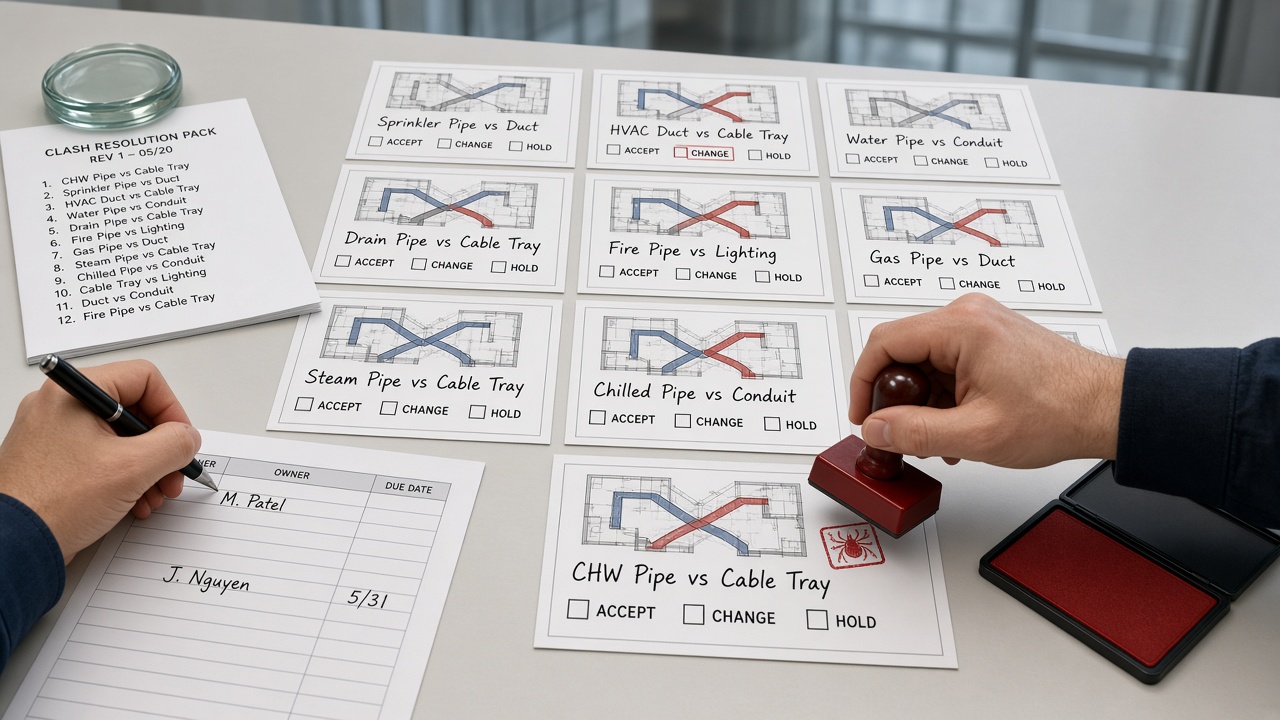
Issue the pack at least a working day before. It is a short cover plus a numbered list of information objects that have to change state.
Each row needs, before the meeting:
- clash or decision identifier
- the issued containers it sits on (model and, if a drawing already exists, the sheet)
- one-sentence conflict
- proposed close: accept as-is / change model X / change drawing Y / hold pending a named survey or instruction
- suggested owner
A viewpoint can sit behind the row. It must not be the row. People who received only a video of last week’s fly-through cannot prepare a decision; they can watch again, which is not the same thing.
Cap the live list. Twelve to twenty hard items is a meeting. Two hundred viewpoints is a film. If the detection run produced thousands, either the filter failed or the models were never in a state to accept, and the hour should not be punished for a gate you skipped. Model quality gates belong before the invitation, not as the first agenda item.
In the room: one object, one decision
Open the issued-set cover and read the container list aloud. If anyone disagrees that this is the live set, that disagreement is item zero — resolve it or adjourn, because coordinating against an unsigned set turns the minutes into fiction.
Then take the residue in order. Five spoken facts per item, written down while people are still present:
- Identity. “This is clash 184 on structural model C03 and MEP model C02, zone B2 plant.” Not “this one.”
- Conflict. One sentence. Two services, one slab opening, a beam that moved after the duct was issued. If you cannot say it without the viewpoint, the viewpoint is doing the thinking, and nobody remembers a camera angle on Thursday.
- Decision. Use a closed vocabulary. Accept as-is, and write the tolerance. Change a named model. Change a named drawing. Hold, pending a named survey, client instruction or missing container. “To be coordinated” is not in the vocabulary. Neither is “action: all.”
- Owner and due issue. One firm, one person, one next revision or transmittal date. A discipline name without a person is a parking space.
- Binding. Which issued identity the decision will appear on, and what happens to the clash row when that identity is published — closed, accepted, or carried with a reason.
Put those five on a shared log the document controller can file. Do not wait for formal minutes on Friday; Friday minutes are a second meeting, and the people who decided will not be at it.
Resist the fly-through. If an item needs a model walk to see the conflict, walk it. If the walk is a way of not deciding, stop it. And when the list is finished, stop — empty agenda time is not a licence to open a few more viewpoints. That is how the tour comes back.
Language that can be issued
Minutes that cannot be turned into a transmittal were entertainment. Test each decision against this sentence:
On [date], [named person] at [firm] decided that [clash or conflict] on [container + revision] shall be [accept / change / hold]. The next issued identity that must show the result is [container + due revision or date]. Until that identity is published, the previous issued set remains the instruction.
If you cannot fill the brackets, you do not have a decision. You have a mood.
That same sentence is what the register and the clash log have to be able to show next week. A closed clash whose model never moved, and whose drawing never superseded, is not closed. It is hidden. And a decision whose owner cannot be named in the supply chain has not been assigned to anybody.
Start with last week’s closures
Item one is the due list, before anyone opens a new detection run.
For each decision from the last hour: is the promised identity now issued? Does the clash row show closed, accepted, or carried with a written reason? If the model moved in WIP but was never published, the decision is late. If the drawing superseded but the model did not, you have two instructions again. Write the miss down rather than averaging it into good progress.
Carry fails forward until they close. A series that resets the slideshow every Tuesday is theatre with a recurring invite, and the clash-detection argument is the same habit at portfolio scale: detection without closure is a count.
If nothing from last week landed on the issued set, do not open new clashes. The meeting has a delivery problem rather than a geometry problem, and saying so out loud is the only thing that will shift it. Adjourn early if you must. An honest forty minutes beats a two-hour film of items nobody will issue.
Score sheet
Print this. The chair fills the left columns before the hour. The document controller fills the right column in the room. The project manager does not edit it afterwards.
| Check | Before the hour | Pass in the room | Fail — write the identities |
|---|---|---|---|
| Issued set frozen | Named current models and drawings, one revision each | Room agrees this is the live set | |
| Tests match the set | Clash run dated against those containers | No WIP-only items on the live list | |
| Pack, not deck | Numbered objects with proposed close and owner | People arrived having read the residue | |
| Closed vocabulary | Accept / change / hold only | No “to be coordinated,” no “action: all” | |
| Written while present | Log the document controller can file | Five facts per item before the next viewpoint | |
| Last week’s due list | Promised identities and clash rows | Closed, accepted, or carried with a reason |
A pass is boring. A fail is a container ID. Resist turning the six rows into a percentage, which invents a dashboard the hour does not have.
What the score sheet cannot do
A template is not a certification. ISO 19650, CDM, the Building Safety Act, NEC, FIDIC, JCT, COBie and the project’s own BEP each have owners, and each says something about who is entitled to decide what. The hour described here sits underneath those texts rather than in place of them.
Three changes make the difference, and only one of them is free. Move the preparation into the afternoon before — frozen set, numbered residue, pre-closes — and accept that it costs the chair two or three hours a week that nobody has budgeted. Ask for that time rather than quietly absorbing it. Put a document controller in the room with the authority to write the log as it is spoken, which means paying for the seat and letting them interrupt a senior engineer mid-sentence to get a container ID. Then get the appointing party to say, in the exchange information requirements, that coordination closes on issued containers with due revisions named, so the discipline is a contractual expectation rather than your personal preference.
If only one of the three is winnable this quarter, make it the last. Once someone senior has agreed in writing that a meeting which changes no issued identity has not finished, the other two stop being favours you have to ask for.
Read next: Monthly Register — June 2025, Model quality gates: what to check before you accept a delivery, Clash detection found twelve thousand issues. Nobody fixed any of them..