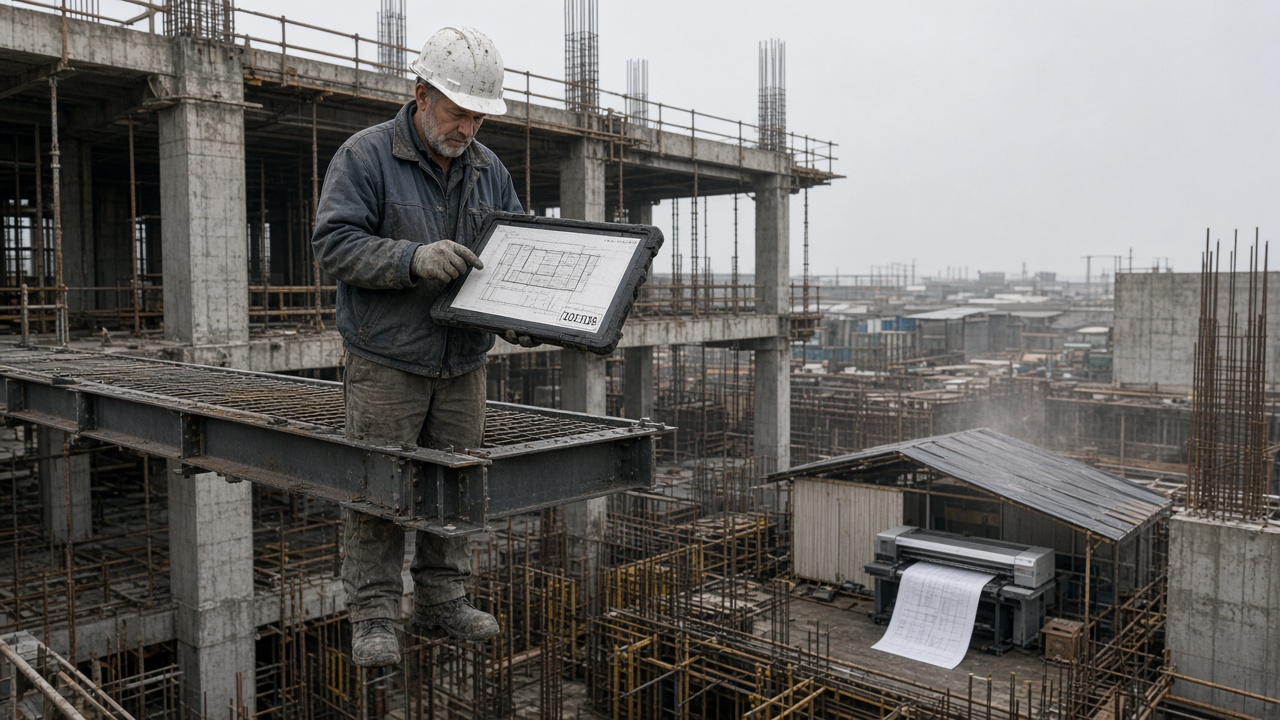
Somebody hands a superintendent a tablet at twenty past six and explains that the new assistant is on there now. It is the fourth application on that device. One holds the model, one takes snags, one wants a daily diary that duplicates the one already typed in the site office, and now this. Concrete arrives at half seven. He will give the new thing roughly ninety seconds and a gloved thumb, and if it cannot tell him whether the sheet in his hand is still the live one, it will join the other three on the second screen he never swipes to.
That is the room in which field AI is actually judged, and it bears very little resemblance to the way it is sold. The industry's preferred picture is a montage: drones over a clean slab, glasses painting the model onto a pour, a twin that answers in the first person, an assistant that "knows the project". Those sentences photograph beautifully. None of them is a morning.
A morning is a sequence of retrievals under conditions the montage does not admit exist. Which revision is live for this grid. Whether the RFI holding that detail was answered, and whether the answer was actually issued. Whether last week's sheet was ever taken off the hut wall. Whether the permit still covers the work. Software that cannot answer one of those from the issued set has not earned a place on the job. It has earned a demonstration.
And there is a trap underneath. The office keeps a system that claims to be the record; site keeps a set it genuinely builds from; the two do not share an identity. Field AI that ignores that split will simply write a third record — an opinion in a chat log that neither the common data environment nor the cabin will own.
Four different claims wearing one glow
The jobsite-of-the-future reel bundles four unrelated things and lets the audience assume they arrive together.
The first is capture: a camera, a scan, a drone that produces a picture of what is there. Useful, and not a decision. A photograph of a slab tells you nothing about the drawing the slab was meant to match. Progress imagery has a place; it is not a copilot.
The second is vision: software that flags a missing helmet, or a person inside a plant envelope. Published detectors manage some of that in decent light, on a fixed view, with a tolerable false-positive rate. What they cannot see is a closed permit, a withdrawn revision or a duty-holder. Spotting a pixel and owning a control are not the same undertaking.
The third is generation: a paragraph that drafts a method statement, a daily report, a reply to a trade. Generation is now close to free. Reliance is not. A generated sentence nobody will put their name to has not produced a contemporaneous record; it has produced a second unofficial set with better grammar.
The fourth is agency: software that coordinates, closes things out, issues. An agent can propose. It cannot issue, because issue creates reliance and reliance needs a human who can be asked why. Blur that line and you have not helped the superintendent — you have moved the liability onto a timestamp.
The reel needs all four at once because that is what fits into ninety seconds on a trade-show screen. A live job needs one answer, from the published set, before the gang is booked. Treat the montage as the product and field AI ends up as a mascot: visible in the bid, unopened at ten past seven.
What "copilot" would have to mean out here
Copilot is a borrowed word. In an office it means a sidebar that drafts. On a job it would have to mean something considerably stricter: a second pair of hands on the retrieval the superintendent is already doing, rather than a second opinion about the job.
The person who holds the pour decision — superintendent, site manager, whatever the job calls them — does not have a research afternoon. They have a clock, and the clock is the reason the unofficial set exists at all. A portal, a four-hundred-page PDF and a naming convention designed for a desktop all lose to it. Any assistant that assumes a login, a signal and a clean screen has already failed in the basement, in the core, and anywhere the site shares one weak mast.
Sharing the morning means answering from the same identity the office believes it published. Current revision of this sheet number. Open RFIs still sitting on that revision. Whether the previous one was superseded, and whether anybody collected it. Whether the container is published or merely shared. Those are not conversational turns; they are facts a register is supposed to hold already. Answer from last week's crop, from a model that was never issued, or from a paragraph the software wrote itself, and you are not sharing the morning — you are competing with the hut set. The hut set wins, because it can be held.
Narrow means knowing what was issued
Narrowness here is a condition rather than a design preference: an answer is only allowed to be relied upon when its scope is tight enough to check.
Being issued-set-aware means the software knows the difference between a file that exists and a container that was released: these revisions, this purpose, this list of recipients, this moment. It knows shared and published are different states. It treats a suitability code as a statement about permitted use. It treats a transmittal as evidence that an issue occurred, and not as evidence that anything arrived at the workface — and it does not pretend otherwise when asked.
The genuinely useful machine-learning job on drawings was never a chatbot. It was reading a title block, checking the revision against the register, and finding the sheet that somehow never got superseded. What earns a superintendent's time is the next inch of that work, not a new category: retrieve the current identity, retrieve the open question still attached to it, surface the withdrawal that never happened, then stop.
Dull, obviously. It is also the only dullness a claim will later respect. Nobody, months after the pour, will ask whether the assistant was fluent. They will ask which revision was live, who held it, and whether the answer that changed the detail exists in a file anyone can produce.
How these things die
A mascot is software the office can screenshot and site can ignore. Four ways that happens, all of them common.
It dies if it needs a third record. A chat history that is neither the common data environment nor the cabin set is a new unofficial folder with a nicer voice, and the split was expensive enough with two.
It dies if it cannot survive the conditions that created the hut set in the first place. Offline is not an edge case on a job with a basement. Sunlight is not a theme. Gloves are not user error. An assistant that only behaves on a clean tablet in the cabin is an office tool wearing a hard hat.
It dies if it generates what it should have retrieved. A confident "the current revision is probably C" is worse than silence, because silence sends the superintendent back to the register and a wrong letter sends him to the workface.
It dies fastest as a mandate. Telling site to use the assistant because the bid promised AI produces attendance without reliance, which is how most pilots end. If the person who owns the pour will not open it unprompted, it has not earned anything yet — however much the office likes the reel.
The test is a clock
On an ordinary morning, can the person who owns the workface name the current issued set for the work in front of them, and does the assistant agree with the published container, or honestly say that it cannot tell? If it agrees, and it is quicker than walking to the hut folder, it will get used without anybody being asked. If it cannot, the folder stays. There is no culture problem in that sentence anywhere.
A future that still has a plotter
The useful version of this is not a cleaner montage. It is an ordinary Tuesday with weather, a plan rack and somebody who wants a drawing in his hand before the pour. What changes is not the kit; it is whether the answer in that hand and the answer in the published container can be shown to be the same container — or shown to have diverged — while there is still time to do something about it. The plotter will still sing. The unofficial set will still try to write itself whenever issue and withdrawal come apart.
So if you are the one being asked to fund a pilot next quarter, set the entry price accordingly. Pick one package. Give whoever is selling a live project's register and ask their tool to name the current revision of six sheets and the open RFIs sitting on them, offline, on the device your supervisors already carry — then walk to the hut and check the answers against the wall. Buy nothing that generates a revision letter it cannot trace to a container. Write the offline requirement into the specification rather than the wish list, and accept that it will cost more than a browser tab. Principal contractors and their digital leads are the ones who can insist on that test, and the honest part is that most of the reel will fail it, which is the point of running it before the money moves rather than after.
Read next: Onboarding a subcontractor to your CDE: the first ten days, You won the argument and lost the claim, because you could not prove it, The site team has the truth. The office has the system. Neither talks..