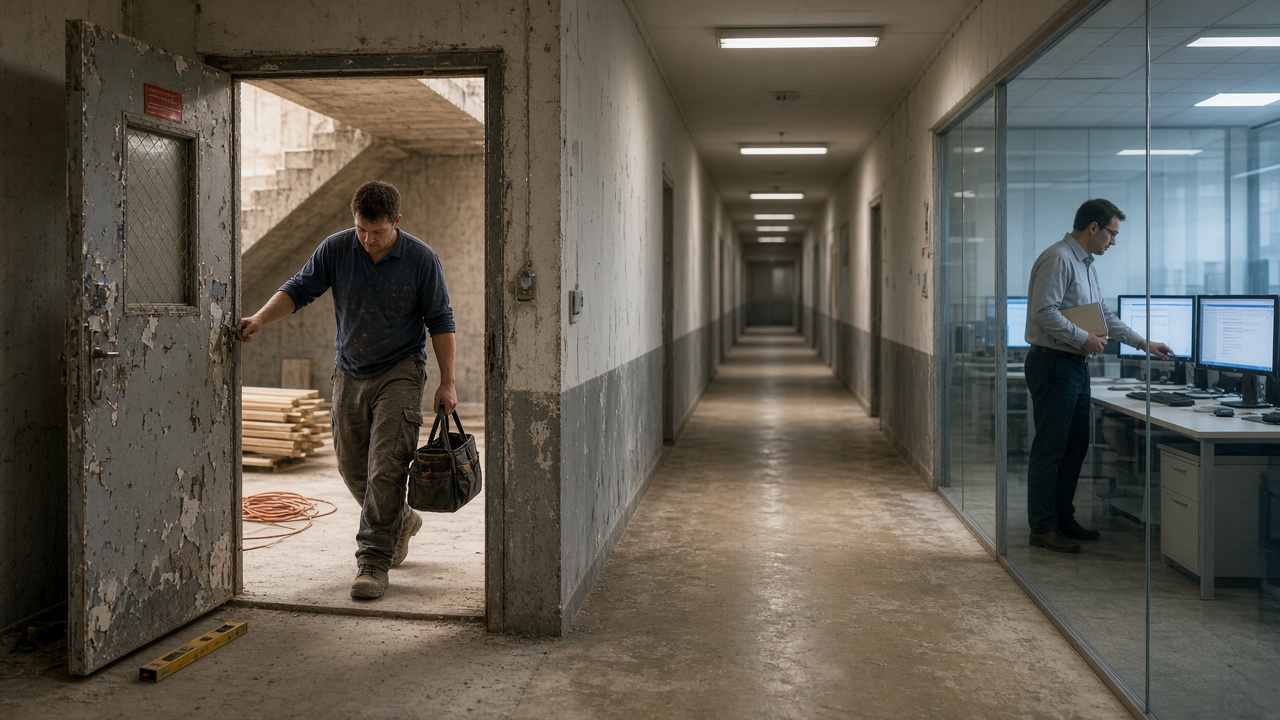
Most construction companies have a door somewhere that separates two kinds of hours. On one side: boots, a tool bag, a radio, a slab that has to be finished before the concrete goes off. On the other: a programme, a cost report, a drawing register, an inbox of queries nobody has answered since Thursday. The labour-exposure research published since general-purpose language and vision models arrived — Eloundou and colleagues' "GPTs are GPTs" is the most cited example — has been sorting occupations by how much of their working time those models can already cover, and the two sides of that door do not land in the same place. Construction comes out near the bottom. Office and other knowledge work comes out near the top.
That finding travels well in our industry, usually as reassurance. It is worth being careful about what was actually measured, because the reassurance does not survive the method section.
Start with what would change the picture. If a published ranking appeared — one with a method you could argue with — in which construction’s ordinary hours looked as AI-covered as the hours of clerks, analysts and software writers, the sceptical reading here would be finished. That ranking is not the ordinary record. Until it is, the pattern is the story, and the pattern describes the current wave of models rather than a forecast of 2040 or a count of seats sold to contractors.
One habit before we go further. Most AECO numbers arrive without a denominator. Documentation volume without incident rates. “Thirty per cent of lifecycle data lost” without the moment of loss. Automation percentages without a definition of non-physical work. Exposure scores without a task list. Read the method. If there is no method, you are reading a brochure.
What these studies actually measure
An exposure study is a matching exercise rather than a site diary.
An occupation gets broken into tasks — write, retrieve, calculate, speak, lift, cut, set out, pour, inspect, drive. Those tasks are scored against what current models can already do, or against a list of abilities the models are assumed to hold. Out comes a ranking: which jobs have a large share of hours that overlap with the model, and which do not.
The object is overlap, not adoption. A high score does not mean the job has already been automated, and a low score does not mean nobody on that job has ever opened a chat window. It means that, given the task list as published and the models as they stood when the paper was written, this occupation’s hours look more or less covered.
On a building site that distinction does real work. A superintendent can paste last week’s minutes into a model at half seven and still spend the rest of the day walking a slab. The minutes were exposed. The walk was not. Research that puts construction near the bottom is describing that mix; it is not measuring whether the trailer has a licence.
The same papers are describing current models — language and image systems that live on a screen, not a general robot that ties rebar in the rain. Anything that collapses those two objects into a single “AI” score has stopped measuring and started captioning, which is the same category error you find in funding headlines: a big bucket with no method for the numerator.
Why the trades sit low
The ranking stops being mysterious the moment you look at what the hours consist of.
Knowledge occupations — writing, analysis, software, administration, the professional services that live in documents and meetings — sit high because the product is a file, a slide, a cell, a clause, and the model already speaks that language. Coverage is high because the labour and the model share a medium.
Construction labour is presence. Weather, access, materials, other people’s bodies, a drawing that has to be true on a slab poured yesterday. Current models do not pour. They do not isolate a live service, and they will not hold a line and a level in a crosswind. Take the physical hours out of the occupation and there is not much occupation left, which is why agriculture and food service tend to sit near construction in the same tables.
Here is the part the industry label hides. A construction firm contains both kinds of hours. The estimator pricing a package, the planner rebuilding a programme out of a pile of commitments, the document controller chasing a supersession, the quantity surveyor working through a folder of RFIs — measured honestly, those hours look a great deal more like the office ranking than the trade ranking. Score “construction” as an industry average and the split disappears into one low number. Everybody who works in a contractor’s regional office already knows the split is there. They spend Tuesdays on the wrong side of it.
The comfort people take from it
Put the low score in front of a leadership team and a particular sentence tends to follow within a minute: the models are coming for the office, not the hoist. Construction is different. We are the industry that cannot be replaced, so we are the industry that need not change. It gets a good murmur from a conference floor, and it is doing something the research does not support.
It treats exposure as a threat index. A shield would mean construction keeps its productivity path while everyone else is compressed, and no exposure paper claims that. What they claim is narrower: the current tools do not cover these hours. Uncovered hours are not protected hours. They are hours this wave was not built to help.
The consolation also flattens the firm. The person most comforted by “construction is safe” is rarely the person tying steel. They are in the trailer, or three floors up in a regional office, doing exactly the hours the ranking would have pushed nearer the top had the label on their contract said clerk or analyst. If the method does not say whose hours were counted, the comfort is a caption.
A position, not a shield
A low score on observed AI coverage describes the work. It also describes a position in a market that is already allocating attention, capital and product towards the occupations current models can touch, and position has three faces.
The productivity dividend of this wave accrues where the overlap is. Office sectors can, in principle, do more file-work with the same hours, or the same file-work with fewer. Construction’s ordinary hours are not in that overlap, so a low score tells you who is in the wave and who is standing beside it. Standing beside it is a location, not a strategy.
The tools then follow the ranking, because vendors build for hours they can already cover. A buyer in a high-exposure occupation can demonstrate value inside a week. A buyer in construction has a use that still has to survive contact with a slab, a permit board and a drawing superseded on Monday. The pilot that dies is this same fact in a different tense: the model was pointed at a folder because the folder was the part of the job that looked like office work, and the hours that actually build the building were never in the trial.
Capital follows the photogenic overlap too. Last year’s construction-AI money showed the mix plainly enough — a large technology bucket, a thin genuine-AI slice, and that slice concentrating in robotics and hardware rather than in the information workflow. Exposure research and funding prints are separate tables, but they rhyme. Where an occupation looks uncovered by language models, money that still wants to say “construction AI” buys a machine. Where it looks covered, the money buys a seat. The register in the cabin appears in neither pile.
A position is something you can occupy badly. You can read the ranking as permission to leave the unofficial set in the trailer, because AI is not for us. You can read it as permission to buy a copilot for the office slice and tell the board the firm has been transformed. Both readings spend the same low score, and neither changes who holds the issued set.
The useful cut runs inside the firm
Site hours are the hours these papers put at the bottom: presence, materials, plant, waiting on another trade. A language model will not draft them. Computer vision can watch a gate or a hard hat without becoming the trade. Robotics can mark a line without becoming the gang. Claiming otherwise is a brochure.
Trailer and office hours are the ones the same method would have scored higher had it labelled them knowledge work: finding the issued revision, reconciling a register, writing a query, checking a clause, assembling a programme from commitments made in three different meetings. Those hours are exposed, in the narrow sense the studies use. They are also, awkwardly, the hours construction already fails at with no model involved — the unofficial PDF set, the second set of records kept by someone who no longer trusts the first, the claim that dies for want of a contemporaneous file.
Low industry coverage can therefore be true and still mislead. The average is pulled down by the site, while the information problem lives in the hours that look like office work and are still run as though they were not. A model pointed at last Thursday’s export is reading the exposed slice and missing the issued set entirely.
None of the ISO 19650 states become optional because a ranking came out low. Work in progress is still not Shared, Shared is still not Published, and a chat window does not issue anything to anybody. Exposure describes task overlap. Issue describes who was allowed to build.
What the ranking does not prove
It does not prove construction jobs are safe or that office jobs are finished. It proves that current models overlap more with document labour than with site labour, and that a low industry score is what that overlap looks like once you average the two together.
It does not prove a particular table or a headcount forecast. The hole is in the method section of whoever published the ranking: which task list, which model year, whether “construction” meant the trade or the firm, and whether the office slice inside a contractor was counted as construction or as clerical work. Cite the pattern, and leave the hole where the data stops.
It does not prove that software, a mandate or a model will save an outcome on its own. A high-exposure occupation can still run a shambolic register. A low-exposure one can still lose the issued set. Coverage is not custody.
So if the ranking has landed on your desk, do something with it other than quote it. Count the exposed hours inside your own business first — estimating, planning, document control, commercial, bid work — and ask how many of them go on working out which revision was live on a given date, who actually received it, and whether the one before it was ever withdrawn. That figure is usually worse than anyone expects and it is the honest baseline. Then point any tool you buy at the issued containers rather than a folder export, and refuse to run a trial that cannot name the person who owns a wrong output. At tender, ask a vendor to work against your live CDE states, not a curated demo set; the ones who can will say so in the room. Be straight with the board about the bill, because the licence is the cheap part. Getting the states honest enough for a model to read is months of unglamorous work by people you already employ and cannot spare, and it will look like nothing on a slide. It is also the only version of this that survives the next wave, whenever a paper finally arrives showing site hours as covered as office ones.
Read next: Where the money actually went in construction AI last year, Construction AI pilots mostly die. Here is the pattern., The site team has the truth. The office has the system. Neither talks..