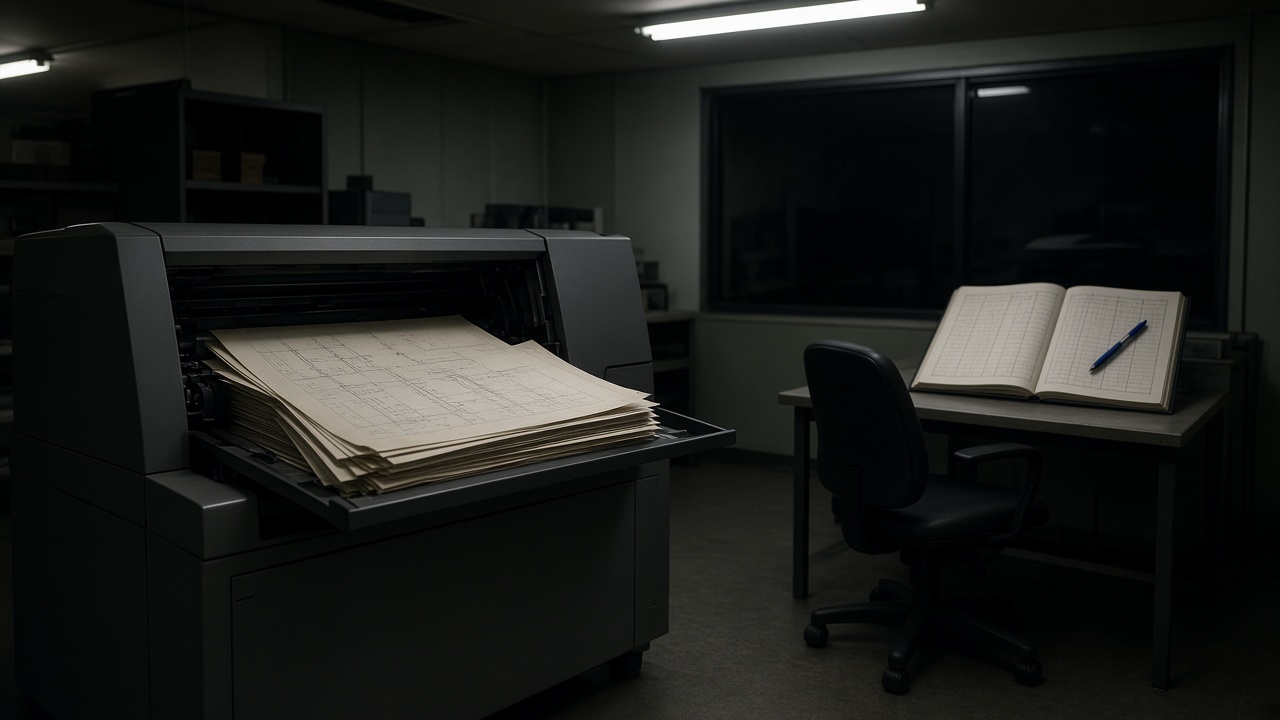
Somewhere on your project, probably on a Friday afternoon, a document controller is opening PDFs one at a time and squinting at the bottom right-hand corner: a transmittal batch on one screen, the register on the other, a column of revision letters going in by hand. They are not being slow. There is no other way to find out whether the register still describes the drawings the project actually holds.
Ask the industry about AI and you get a tour instead. A model that writes a method statement. A twin that answers questions. A dashboard that “knows the project.” Those sentences photograph well, and not one of them is the job on the second monitor — which is the job that pays first.
If a machine cannot read a title block honestly, it has no business generating a paragraph about the project.
Reconciliation is a reading job
A drawing register is a list of current sentences. Each row says: this title, this number, this revision, this purpose or suitability, this date of issue. Reconciliation is the act of checking that those sentences still describe the artefacts the project is holding.
It is not a dashboard refresh, and it is not “the CDE is up to date.” It is a comparison between three objects that routinely disagree:
- The title block printed on the sheet.
- The register row that claims to describe that sheet.
- The supersede state — whether the previous revision has left the live set, or is still sitting in a rack looking issued.
When the three agree, document control is boring. When they do not, the unofficial set in the trailer writes itself: the site plots whichever sheet is easiest to hold, and the claim, months later, asks which identity was live on the pour date. Manual reconciliation is how projects pretend they will be able to answer.
The work stays manual for unromantic reasons. Title blocks are inconsistent. Scanned PDFs come in crooked. Revision letters sit in different corners. A “C02” in the filename is not the same fact as a “C02” in the block. A human being opens each file because nobody has yet trusted a machine to read the one line on the drawing that carries a legal identity.
That is a reading problem rather than a generation problem.
The title block is the identity
A title block is not decoration around the plan. It is what makes a sheet an issued container rather than a picture of geometry.
Number. Title. Revision. Date. Originator. Status or suitability, if the office remembered. Sometimes a plot stamp. Sometimes nothing but a handwritten letter in a box that has been photocopied twice.
Everything else on the sheet can be cropped, screenshotted and sent on WhatsApp. The title block is what those crops destroy. Without it you cannot say which revision you are looking at, what it superseded, or whether it was ever issued at all.
Reading every drawing, in this narrow sense, means reading that corner first. Not describing the grid. Not guessing at a clash. Extracting the identity the register is supposed to already know, and writing down where the two disagree.
Revision is a letter the sheet has to own
Revision control is not a folder containing Rev A, Rev B and Rev C. A revision is the issued identity the site may rely on. The letter in the title block is part of that identity; the letter in the filename is a rumour; the letter in the register is a claim.
Manual reconciliation exists because those three drift apart. Someone issued C03 and the register was updated from the transmittal rather than from the sheet. Someone exported a PDF whose filename still says C02. Someone plotted last week's identity and taped it to the hut wall. Someone saved FINAL_v3 while the block still says P04. The controller's job is to notice. The project's later job, if they miss it, is to reconstruct what the work was actually built from.
A machine that reads every title block does not invent a new revision scheme. It asks a smaller question: for this sheet number, what revision does the artefact itself declare, and does the register agree?
Dull question. It is also the question a claim will ask. The ISO 19650 published state, the P/C/A series and the suitability codes all assume the identity on the sheet is knowable. They do not assume a chatbot; they assume a contemporaneous file.
Where the machine and the register disagree, a human still decides. Reading is not issuing. The end of manual reconciliation is not the end of judgement — it is the end of using one person's eyesight as the only instrument capable of seeing ten thousand title blocks.
Supersede is the line the register keeps missing
Supersede is the moment the previous revision leaves the live issued set. C02 does not vanish when C03 arrives; it is retired. The register should show C03 as current, the archive should still hold C02, and the plot rack should not.
This is where manual reconciliation fails quietly, even on jobs that type every new letter correctly. The new identity gets entered. The old identity is not marked. The print is never collected, and the hut set goes on looking issued because nobody treated withdrawal as part of issue.
A tool that reads every drawing is only useful here if it can see both sides of that act — find the current title-block revision, and the earlier sheets still declaring themselves live in the current pack. A register listing C03 while a scan of C02 sits unmarked in the "current" folder has not been reconciled. It is a list that has not yet met the artefacts.
The unofficial set in the trailer is usually this failure with furniture round it. The easy explanation is that somebody on site is careless. The record, where one survives, says supersede was typed into a cell and never executed on paper.
Reading has to come before generating
Every larger AI claim in construction rests on the issued set being a known object. Retrieval over the project record, a model drafting an RFI response, a strategy about automating the non-physical hours — if nobody can say which revision was live on the pour date, all of it is confidently summarising a pile.
Reading title blocks does not photograph like a platform. It does not replace a document controller, write a BEP, or know the project. It does one thing the industry already concedes it cannot do at scale: compare the identity on every sheet with the identity the register claims, and surface the supersede that never happened. Whoever owns that comparison owns a fact a coordination meeting can argue with. Without it, a document system can only tell you what it holds, which was never the hard question.
If you would rather test this than debate it, the trial is small. Take a transmittal batch somebody has already reconciled by hand, scans and all, and have the tool pull number, revision and status from the block on every sheet with no help from the filename. Then read the disagreements against the register rather than counting them. A fair share will turn out to be the register's fault, and that is the finding worth paying for.
Set the bar on the awkward sheets, because anything can read a clean vector title block: the photocopy of a photocopy, the handwritten letter in a box, the sheet scanned sideways at eleven at night. Insist the output covers the other half of the act — which earlier identities are still sitting in the live pack. A tool that only confirms the newest revision has automated the easy direction.
Push for it through the information manager, with a client willing to write it into the information requirements at appointment rather than in year two. Be honest about the bill. The first pass costs time rather than licence money: once the disagreements surface, somebody has to correct the register, chase the prints and mark the retirements, and that lands on the same document controller already stuck at the second monitor on a Friday. The machine only finds the gap. Closing it stays with the person who has to sign the register.
Read next: Monthly Register — March 2025, CDM 2015, ten years on: what the regulations assume about information, Anatomy of building from a superseded drawing.