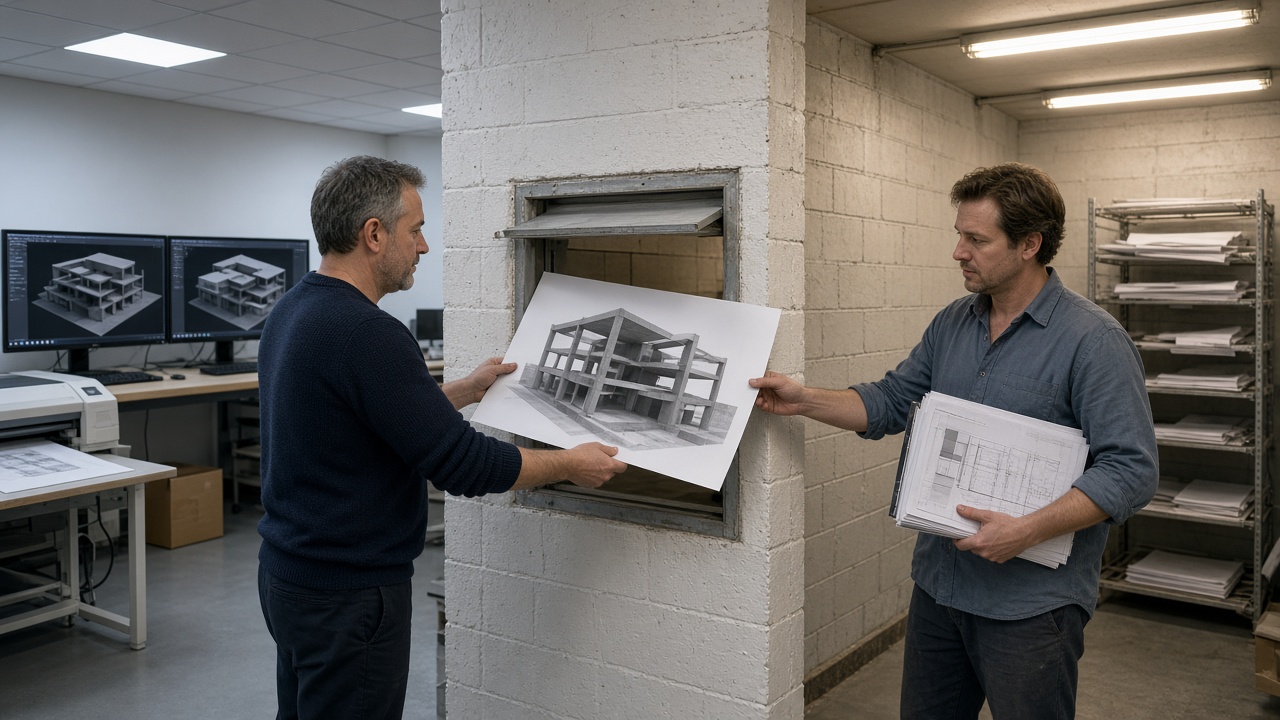
A site engineer opening the first construction package will sometimes discover that the design assumed a different sequence from the one the programme is now asking the gang to follow. The plant room was coordinated around a box that was never the specified unit. A services route that looked set-out in the federation was only ever a proof that a route existed. The sheets in the trailer and the model on the stick do not agree about which of those facts is current. Nobody in the kick-off meeting lied. The files crossed the appointment boundary, and three claims that were true — or at least agreed — while the information was still being authored died in the transfer: how developed the objects actually are, what the container may be used for, and what has been issued for construction.
The model changes hands. The assumptions do not travel with it. The files can be identical. The authorised use is not.
Coordination did not fail because people stopped talking. It failed because a change of use was treated as a file copy.
The handoff is a change of use, not a file copy
What the industry calls the design-to-construction handoff is several different events wearing one name. A work-stage gate. A change of lead appointed party. Novation. A folder renamed Issued. A federation exported and attached to an email that says “latest model”. A kick-off meeting at which someone presents a fly-through and the room treats the fly-through as the set.
ISO 19650’s language is unromantic about this. Work in progress is not shared. Shared is not published. Published is not whatever happens to sit in a directory the contractor can open. A container that crosses the appointment boundary without a recorded state, a recorded status and a recorded purpose has not been handed over. It has been copied.
The copy is what makes the later argument expensive. Everyone can prove they had the files. Nobody can prove what those files were for on the day a trade first used them.
LOD is a claim about development, not a licence to build
Level of development — LOD 200, 300, 350, 400 in the AIA / BIMForum sense — is a statement about how far an element has been thought through for a stated purpose. It is not a promise that the object can be procured, fabricated or installed. The UK and the ISO 19650 family have spent a decade trying to retire the number as a magic word and replace it with level of information need: enough to decide, not everything the authoring tool can store. Most BEPs still write LOD 300 and then stop.
That number dies at the handoff in a specific way. In design, LOD 300 meant: the geometry is coordinated enough for others to design against. After the handoff, the same solid is read as: this is the thing. Placeholders look like products. Generic families look like specified plant. A clearance envelope looks like a duct. An indicative route looks like set-out. The authoring tool shades it like a building, so the receiving team treats it like a building.
The characteristic failures are mechanical.
The family was a stand-in. The air-handling unit in the model has a box, a connection point and a name. The contractor prices the box. The specified unit, when it arrives, does not fit the plant room that was coordinated around the stand-in.
The geometry was a coordination proxy. Services were modelled to prove a route existed, not to give a dimension the installer can build. The clash view is clean because the proxies do not collide. The site still has to invent the set-out.
LOD and the sheet disagree. The model was taken to a higher development level than the issued 2D. Or the reverse: the sheets were revised for construction and the model was left at the coordination grade. The contractor inherits both and picks the one that is easiest to hold.
A BEP that lists LOD targets by stage and never writes, on the container, what this object is not yet good for, has specified a mood rather than a development claim. The receiving party will fill the silence with the most optimistic reading, because that is the reading that lets the programme start.
Suitability is the sentence that gets stripped
A suitability code is a claim about permitted use. S1 is suitable for coordination. S2 is suitable for information. S3 is suitable for review and comment. An A code, once the project’s information standard has defined the number, is published purpose — and even then “published” is not, by itself, “build this”.
Those sentences are true while the container sits in the environment that displays them. They die the moment the file leaves that wrapper.
The pattern is ordinary. A coordinator exports the federation. The email says latest. The ZIP has no status. Someone plots a sheet from an S1 model because the gang is arriving and the issued set is late. A shop drawing issued S2 for information is forwarded without the letter. Months later the claim file contains the PDF and not the code. The argument is no longer “was it coordinated?” It is “what was this file for, on that date?”
Handoff makes the misuse structural rather than accidental. Design teams live in Shared. They are used to S1 models that other designers may design against and must not buy from. Construction teams live in a different permission: they have a programme, a buy, and a workface that needs a plot this morning. If the handoff process cannot refuse a container whose status still says coordination or review, you have not transferred construction information. You have transferred a file and hoped the recipient would keep reading a letter that is no longer attached.
State and status have to agree, or neither is a fact. An S1 model sitting in a folder named Issued for Construction is a coordination model wearing a costume. An A-code sheet that the originator can still edit without a new revision is Shared with better stationery. The handoff is where those contradictions stop being a document-control inconvenience and start being the instruction the site is entitled to trust.
The issued set is a third object
The federated model is not the issued set. The issued 2D is not the issued set either, if it was never authorised, never sent to the people who will use it, and is no longer current when they use it.
An issued set is three conditions held at once: construction information that has been authorised for that use, transmitted to the named recipients, and still current at the moment of use. Fail any one and someone will build the wrong thing with a straight spirit level. The rework that follows is coded as a site problem because the wall is on the site.
At the design-to-construction handoff the three conditions come apart in predictable ways.
The model moved. The set did not. Coordination closed a clash in the federation. The meeting minute says agreed. The construction drawings were not revised. The site builds the set, because that is what issued means. A green cell in a clash register is not a wall.
“IFC” means two different things in the same sentence. Industry Foundation Classes is a schema. Issued for construction is a purpose. A contractor who is handed an IFC export and told it is the IFC set has been given a pun, not an instruction. Ask which meaning was in the email. Write the answer down.
Latest is not issued. The CDE holds a newer revision than the transmittal the package received. Or the architect’s package is published and the services models are still S1. The kick-off slide shows a complete building. The issued set is a partial building plus a promise.
Receipt is not the workface. The main contractor’s document control has the pack. The trade that will place the work does not. The subcontract may say the main contractor must cascade. The slab does not read the subcontract.
The unofficial set in the trailer is not insubordination. It is what you build when the official handoff cannot answer, in time, which revision of which container is authorised for this use today.
Why a meeting cannot repair a dead assumption
A coordination meeting after the contractor has already bought from the model is archaeology. You can reconstruct what the LOD number was supposed to mean. You can find the suitability code in the metadata. You can produce the transmittal. You cannot put the stand-in family back in the box, or un-order the unit that does not fit, or un-pour the slab that was set out from a coordination proxy.
The meeting that would have helped sat earlier, and it had a narrower job: refuse the handoff until the three claims are written on the containers, not only in the BEP. What is this object developed for? What use does this status permit? Which construction issue was current that morning, and who actually held it? If those three cannot be answered from the container itself, you are not ready to change appointments. You are ready to copy files.
Clash detection that produces a twelve-thousand-row report and no closures is the same failure in a different costume. Detection is not a handoff. A closed issue is not an issued revision. The industry argument is that a renderer with a count is not coordination. Even a coordinated model is not construction information until the assumptions survive the change of hands.
A test a document controller can run on Monday
You do not need a consultant to see whether the assumptions died.
- Open the BEP or information standard. Write down the LOD or level-of-information-need rule it actually publishes, and whether that rule is attached to containers or only to a stage table. If there is no rule, that is the result.
- Pick ten containers that crossed from design into a construction use last month — a model, a sheet, a schedule. For each: what development claim was declared; what suitability sat on the container on the day a trade first used it; which construction issue, held by which recipients, was current that morning?
- Ask the person who plots for site whether they can see the suitability code on the artefact they print. A shrug is a finding.
- Find one recorded case where a handoff was refused because the model was still S1, the LOD claim was missing, or the issued set and the federation disagreed. If you cannot find one, the handoff is a copy.
The longer method, with scores, is the ninety-day information maturity audit. That audit scores the same three claims at the appointment boundary.
ISO 19650, the UK National Annex, CDM, the Building Safety Act, NEC, FIDIC, JCT, COBie, and the Gulf mandates each have owners. They assume the three claims travel with the file. They do not sit in the trailer on a Monday morning and refuse a copy that is still wearing a coordination letter.
The person who can refuse is the lead appointed party taking over construction — or the client who signs the appointment — and the cost of refusing is a programme argument, not a software licence. Hold the handoff until development purpose, suitability and the current construction issue are written on the containers themselves, not only in a BEP stage table. Give a document controller a recorded right to send an S1 model or a stand-in family back across the boundary. That delay is real, and it is cheaper than un-ordering the unit that does not fit or breaking out a slab set out from a proxy. Run the four checks above before the next work-stage gate. If you cannot find a single refused handoff in the file, you do not yet have a handoff process. You have a copy routine, and the site engineer will keep discovering the sequence the hard way.
Read next: Clash detection found twelve thousand issues. Nobody fixed any of them., Level of information need: specifying enough, not everything, IFC, native files and the interoperability tax.