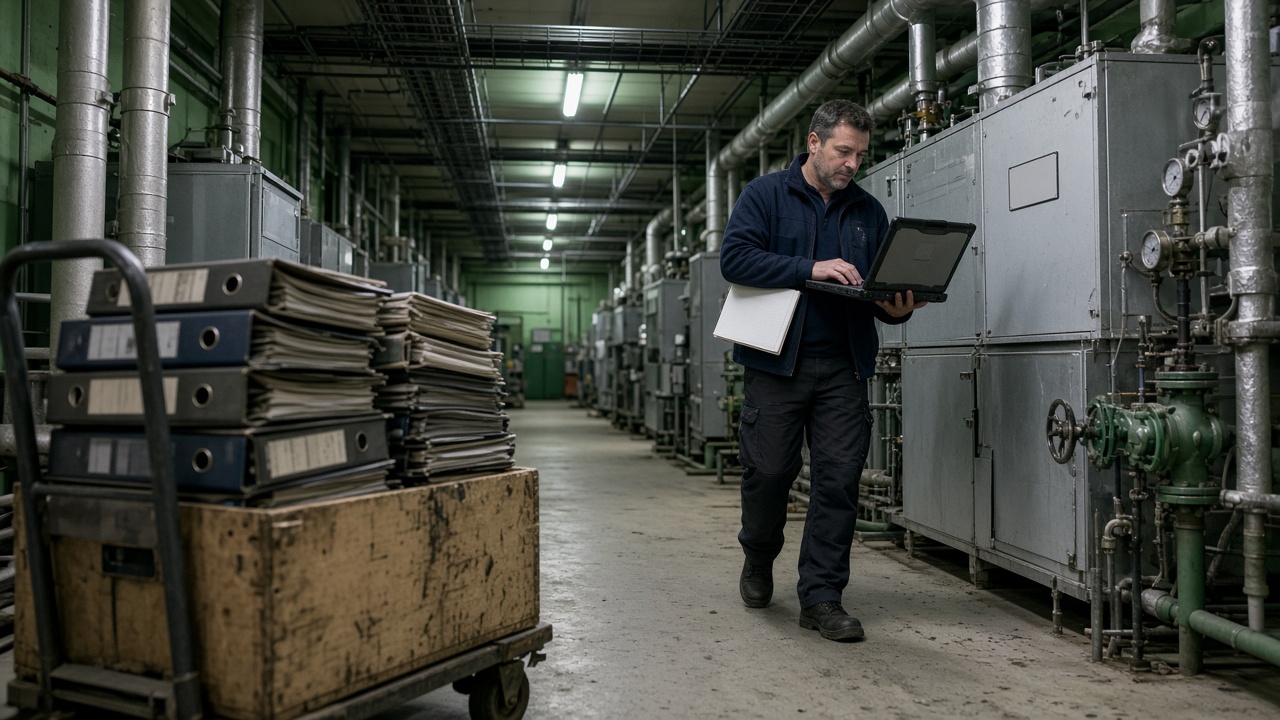
The crate arrives on a Friday. Ring-bound O&Ms, a COBie workbook with a schema name on the tab, an export from the common data environment, minutes from a soft-landings meeting that everyone still calls useful. Someone in the project office has already said the register will be loaded into the computerised maintenance management system during mobilisation. The facilities lead who has to live with the building walks past the crate, opens a laptop on a valve cabinet, and starts typing names from the plates in front of her.
She is not being awkward. She has done this before.
What left the project cannot be queried as assets once it sits in the maintenance system. Names will not join. Locations will not map. Tags will not match the plates. The manual will not open from the row. Any one of those is enough to send someone back into the plant room with a camera. All four usually arrive together. The rebuild is not a taste for typing, and it is not a cultural refusal to use what the project delivered. It is what operators do when the pack fails the trip.
The trip, not the dump
Handover is treated as a completeness ceremony. A receipt is signed. A ZIP is copied to a share. A COBie file opens in Excel. The plant looks finished. From that position any later rebuild looks like fussiness: facilities prefer their own codes, or the CMMS is picky, or mobilisation always includes a data-cleansing line and everyone knew that.
The dump is what left the project. The trip is whether a stranger to the job can, from the receiving system, find a maintainable thing, say where it sits in the estate hierarchy, match it to the nameplate on the unit, and open the manual that belongs to that instance. If any of those four joins fail, you have a souvenir of a register, not a register you can run work orders against.
ISO 19650 is unromantic about the cut. Project information is what delivery needed in order to design and build. Asset information is what the appointing party needs in order to operate. A CMMS is the query surface operations will live in — work orders, statutory inspections, spares, warranties, isolation — not a second archive of whatever the project still had on disk. Rows that cannot support those queries get discarded, whether or not they looked complete on a Friday afternoon.
Names that will not join
Delivery names things for the people who built them. Package, grid, drawing, type family, a coordinator’s abbreviation, a contractor’s internal code. Facilities name things for the people who will still be there in ten years, across an estate that already has a taxonomy. The CMMS will not accept a row it cannot place in that taxonomy. If the import cannot map “AHU-L3-01” onto the functional-location scheme the operator already uses for every other building, the row is a string with a fan somewhere behind it.
The collisions are dull and fatal. Two units share a name because each trade numbered from one. A type name is used as an instance name, so fifty identical fans become one row or fifty unjoinable rows. Spaces were named by gridline in the model, by room data sheet at handover, and by landlord demise in the estate. Someone cleaned up the export for the owner and stripped the only identifier that still joined the inspection to the object. Friendly names feel like service. They are usually how identity is lost.
A CMMS is pedantic because work orders are pedantic. If the technician cannot search the name they will say on the radio, the name is wrong. If two names point at one thing, the history splits. If one name points at two things, the history lies. Facilities do not rebuild because they dislike the contractor’s labels. They rebuild because those labels will not survive contact with the estate’s existing register, and a wrong join is more expensive than a blank.
A Name column in a spreadsheet tells you almost nothing. What matters is whether that string is the string operations will query, unique in the receiving system, and still true of the object in the room. If it is only true of the project, the trip already failed.
Locations that will not map
Delivery locates things in construction space: grid, level, zone, a plant-room note on a drawing, a system the coordinator used to clash. The CMMS locates things in an operational hierarchy: estate, building, floor, functional location, the system the maintainer isolates, sometimes a tenant demise. Those are two maps, not two labels for the same fact.
What arrives from handover is often a designed location that was never updated when the unit moved a bay, or a floor name that does not match the wayfinding the occupants were given, or a space code that died when document control renamed the file. The model knew a storey. The operator needs to know which riser, which landlord cupboard, which side of a fire door, which circuit feeds the board. A grid reference that got a duct through a beam will not get a technician to the isolator at two in the morning.
Location also fails by being too rich and too poor at once. Geometry that nobody will walk is kept. The as-installed bay is blank. A federation labelled “as-built” still points at the designed object. Redlines sat on a phone. The substitution lived in a mailbox. The CMMS cannot store a screenshot of a clash as a functional location.
Facilities walk the plant because location, for operations, is verified by standing in front of the thing. They will not raise a statutory inspection against a gridline. They will raise it against a place their own people can find without ringing someone who has already demobilised. If the handover cannot produce that place, the location field will be typed again from the floor.
Tags that are missing
A register row without a unique tag reads like a brochure. A tag that exists only in the model, or only on a drawing, or only in a photograph folder, is still not a key the technician can read. The CMMS needs a string that is true in two places at once: on the nameplate or label in the room, and in the row the work order will carry. If those two strings do not match, the asset has been described, not handed over.
Missing tags are the ordinary case, not the scandal. Temporary construction marks were never replaced. Serial numbers were written on a cardboard sleeve that went in a skip. The nameplate is painted over, or it is in a language the importer did not expect, or it sits on a face you cannot see without a platform. The COBie component row has a blank. The inspection closed against a package, not an instance. Two identical units have no way to tell them apart except “the left one”, which is not a key.
When tags are present they often still fail the trip. The project’s tag is not the estate’s tag. The barcode on the crate is not the barcode the CMMS licence expects. The identifier was unique inside one work package and collides across the building. Someone printed labels in the last fortnight from a spreadsheet that was already a reconstruction.
This is why the rebuild starts with a walk-down and a camera. The facilities lead is not gathering atmosphere. She is manufacturing the join the project never wrote: this physical object, this serial, this label, this row. Until that join exists, every other field is decoration. You can import a thousand rows. You cannot maintain an unlabelled machine.
O&M that cannot be queried
Operation and maintenance information usually exists. It exists as a crate of binders, a folder of PDFs named by volume, a vendor portal login that expires, a ZIP inside a ZIP, a health and safety file that cannot find the residual on the object. Existence is not the test. The test is whether the CMMS row can retrieve the manual, the certificate, the warranty start, the recommended spare and the isolation note for this unit, without a person who packed the crate.
Unqueryable O&M is a pointer failure. The document is bound to a system name, a trade, a week, or nothing — not to the instance. Search by tag returns nothing. Search by manufacturer returns a four-hundred-page compilation in which the relevant page is not bookmarked. The warranty lives in a package manager’s inbox. The commissioning sheet that accepted the unit was filed by programme, not by asset. A technician with a work order cannot wait for a guided tour.
A CMMS that stores “see O&M folder” in a notes field has received a hint. Facilities rebuild the register so that the extract, the data sheet, the certificate they will actually use sits on the row they will actually search. That labour is billed as mobilisation, as onboarding, as “structuring the handover”. It is the project’s missing pointer, paid for a second time.
If you want to know whether O&M survived the trip, do not ask whether the crate arrived. Ask whether five maintainable assets can produce their own manuals from the maintenance system after the people who packed the crate have gone. If the answer is a share path, the documents failed the trip.
What the rebuild actually is
The rebuild is a third model — neither the project information model nor the asset information model the standards assumed. It is the register operations invent because the trip failed.
The method is always the same, and it is labour-heavy. Someone walks the plant. They photograph nameplates. They invent or apply codes that match the estate convention. They type locations the night staff will understand. They attach whatever documents they can still find, and they leave blanks where the warranty or the certificate never entered custody. They do this first for the assets that will generate work orders — life safety, lifts, water, the plant that fails loudly — and they may never finish the rest. The unfinished remainder is then described as a data-quality backlog, as if quality were the original problem.
None of this proves that facilities teams are better at information management than the project. It proves that the query they must answer is different, and that the pack was never shaped for that query. Delivery kept what it needed to build and to get paid. It dropped what it did not need for either. The CMMS will not run on the remainder.
The twelve-month wait owners complain about is this labour. The circulated slogan that a share of lifecycle data is “lost at handover” is the same labour, described as a percentage. The data was not incinerated. It failed to become something the maintenance system could query. Reconstruction is where the year goes.
Why the pattern repeats
The pattern is structural. It is not one careless contractor and not one awkward CMMS.
Nobody is paid for the conversion. Delivery is paid to complete. Operations is paid to operate what they receive. The space between those invoices is unowned. When a thing has no invoice, it is performed as an export. An export is a lossy conversion: suitability dies, transmittal history dies, the link from the test sheet to the tag dies unless someone already wrote that link as a field. Loading the residue into a maintenance system does not restore the joins.
The receiving system is also not innocent. Estate taxonomies are real, and they are older than the project. A new building that cannot speak the operator’s language will be translated by hand. That translation is the condition of being maintainable inside an organisation that already runs a hundred other assets, not optional polish on a finished register.
A late schema dump does not fix the trip. A workbook generated in the last fortnight from photographs and vendor emails is already a rebuild wearing a standard’s name. Importing it does not transfer the project information model. It transfers a reconstruction, then asks the CMMS to treat the reconstruction as source. Facilities who refuse that import are not being difficult. They are declining to put a second-hand guess underneath every future work order.
What would falsify this on a given job is simple. Take a sample of assets that will still need maintenance in two years. From the CMMS, without a guided tour and without emailing a leaver, produce the operational name, the functional location, a tag that matches the nameplate, and the O&M or certificate bound to that instance. If you can do that, the register was not rebuilt from scratch. If you cannot, the walk-down is already scheduled, whether or not anyone has booked it.
The appointing party is the one who can stop paying for this twice. Name the conversion as a priced activity before practical completion — object types the operator will query, fields the CMMS will import, a trial load that can fail — rather than a mobilisation line after the contractor has demobilised. Put the receiving operator in the room while the installer is still on site, and make acceptance of a sample of rows a condition of sectional completion, not a favour asked of facilities in week three. That costs appointment time and a check someone has to run; it costs less than a year of re-survey. Until that activity has an owner and an invoice, the crate will keep arriving on a Friday and the laptop will keep opening on the valve cabinet.
Read next: The digital twin nobody updates, Where ISO 55000 and ISO 19650 meet, and where they collide, Connecting a CDE to a CMMS without a two-year integration project.