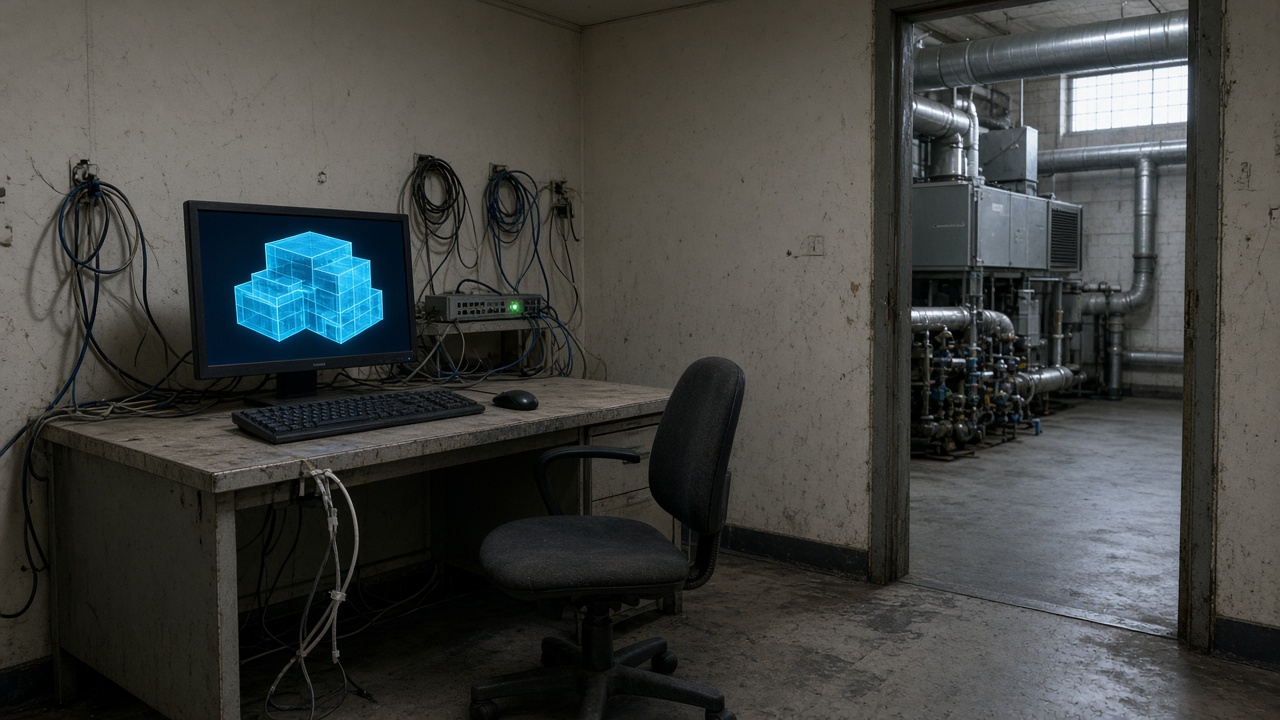
Somewhere there is an estates director approving a renewal invoice for a viewer licence that three people have logged into since occupation, two of them to show it to a visitor. She knows the model is out of date. She also knows that the board was shown a fly-through of it in the final month of the job, that the word twin appears in the appointment, and that cancelling the licence would look like an admission. So the invoice gets signed, again, and the file sits in a folder named Digital Twin while her maintenance team works off a spreadsheet somebody built from nameplate photographs in the first eight weeks.
That spreadsheet is the real asset register. Everyone involved knows it. Nobody has written it down anywhere the board would see.
The promise the bid borrowed
Call something a digital twin in a bid and you have borrowed a definition the project will not staff.
The United Kingdom's Gemini Principles, published by the Centre for Digital Built Britain in 2018, were unusually plain about this. A digital twin, in that framing, is a realistic digital representation of assets, processes or systems that is dynamically updated from multiple sources. The load-bearing word there is not digital but updated. Strip out the updating and what remains is a model of a moment. The industry kept the noun and quietly dropped the verb.
After practical completion the convenient assumption is that the owner already bought the living record, because the BEP said digital twin, the last progress slide showed a coloured federation, and someone was on BIM. Soft landings, if the words were used at all, lived in a separate meeting with a separate attendance list. The plotter has stopped by then. The model looks finished for the same reason the building looks finished.
That assumption suits nearly everyone in the room. Delivery can point at a published container and close out. The owner can point at a screenshot and tell the board they have a twin. Facilities, who were invited to one workshop at stage two and never given a row they could price, inherit a file they did not ask for and a query they cannot run. A twin that is only true on handover day is a souvenir of delivery, and nobody maintaining plant needs a souvenir. They need to know what is installed this week.
What actually arrives
Strip away the conference language and look at the artefact. What gets handed over as the twin is usually one of four things, and none of them updates itself.
A federated design or construction model, renamed “as-built” in the last fortnight. It coordinated ducts against beams, which was worth doing. What it holds is types rather than instances, designed duties rather than installed ones, and a suitability that was written for construction issue rather than for an asset register.
A walkthrough or a viewer scene. Genuinely useful in a client meeting. No help at all to a maintainer who needs the isolation point, the filter type, the warranty end date or the certificate that accepted the unit.
A dashboard that was live while the information manager still had a login. Sensors that were never connected, or were connected to a demonstration loop, or were connected properly and then orphaned when the contractor's site network came down. A tile still reads “real time” because changing the label was nobody's task.
A COBie sheet or spreadsheet register generated once, from photographs and vendor emails, so the handover pack would contain a file that opened in Excel. That is a reconstruction wearing a standard's name.
ISO 19650 already had a less glamorous term for the receiving object: an asset information model. An AIM is what the operator queries. A twin, in the Gemini sense, is an AIM that is still being fed. Stop the feed and you do not end up with a cheaper twin — you end up with a project information model wearing a new label, or a render with a licence attached. The industry prefers the word twin because it photographs well. It has been slower to warm to the appointment that would keep the photograph honest.
Freeze is what the commercial structure produces
None of this is carelessness. The freeze is the predictable output of how the work is bought.
Delivery is paid to complete. The information manager's appointment usually ends with the project. The BIM coordinator demobilises. The document controller who knew which container was which has gone to the next job. The contractor's viewer seats lapse. The designer's as-built obligation, where one existed, was a redline of their own model rather than a standing instruction to maintain a counterpart. Soft landings, if funded, bought meetings rather than authorship of a weekly update.
On the day of practical completion the model is as close to the works as it will ever be, and that is still not very close. Substitutions sit in emails. Serials sit on cardboard sleeves in a skip. Commissioning values sit on sheets that were never bound to the object they describe. The as-built federation still shows the designed air-handling unit, in the designed location, at the designed duty, while the installed unit is a different manufacturer with a different duty and a different tag. On its best day the twin is already late.
Then the building starts changing the way occupied buildings change. A filter type is swapped for what the wholesaler had. A valve is isolated and left isolated. A tenant fit-out moves a terminal. A defect is accepted as is. A warranty claim replaces a board. A permit-to-work quietly changes an isolation philosophy. None of those events has a route into the model that was shown at handover, because the route was never a clause in anything. It was a slide.
Nobody owns the update
The useful word in the title is nobody.
Ownership is not a platform. It is a person, on a live appointment, with the authority to accept a change into the model operations query and an invoice that does not stop at practical completion. Without that person the twin has no parent, and objects without parents do not get updated — they get archived, then ignored, then renewed annually out of embarrassment.
The roles dissolve in a familiar sequence. The appointing party believed they bought a twin when they bought BIM and a viewer, and never named who keeps it, who may change it, or what current is supposed to mean ninety days after occupation. The lead appointed party delivered a project information model, because finishing was the job; maintaining an operational model is a different job and it was not in the activity schedule. The information manager coordinated containers until the last issue and their appointment did not survive the defects period, let alone year two.
Facilities, if they have been mobilised at all, are running a computerised maintenance management system, a helpdesk and a stack of work orders on paper or in portable documents. They were hired to keep the plant running, not to maintain a federation. The first time the twin cannot answer which unit this is, what is on it and when it was last touched, they stop opening it. Meanwhile the vendor of the viewer will renew a seat quite happily. A seat is a login, not an owner.
When a thing has no invoice it has no owner, and when it has no owner the last published state becomes the permanent state. Every role can show its own cupboard — the common data environment archive, the operation-and-maintenance crate, the maintenance system, the health and safety file — and be entirely in order, while the counterpart the bid called a twin has nobody responsible for it. Construction (Design and Management) duties, the golden thread on higher-risk buildings in England, and ISO 55000's demand for asset-management information all assume a receiving object that will still be honest next year. None of them funds the person who edits it when the plant changes.
What an update would have to be
Updating, if the word is to mean anything after occupation, means a recorded change to the object operations query, carrying a date, a person and a reason, bound to the identifier the maintainer actually uses. A fresh render does not count. The geometry may well not need to move. The fields that change are duller than geometry and much more expensive to lose.
Identity first: the tag on the unit, the serial, the location code. If a replacement arrives and the model still shows the old serial, the model is now lying to whoever opens it next.
As-installed fact — what was placed, substituted or omitted after the last model issue. Delivery's as-built is usually a hope expressed in the past tense. Occupation's as-is is a weekly event.
The alphanumerical fields a maintainer needs: filter type, belt size, isolation point, cause-and-effect, warranty end, inspection interval, refrigerant, duty as left. A beautifully authored family with those fields empty is a screenshot.
Documents bound to the object: the certificate, the last test, the permit that isolated it, the vendor letter that changed the service interval. A twin that cannot point at the sheet is a walkthrough.
Relationships — which damper sits in which system, which circuit feeds which board. Fit-out works and defect acceptance break relationships that a coordination model never had to live with in the first place.
Residual hazard and access: what later maintenance will need a platform for, what cannot be isolated, what a following contractor must be told. A frozen twin forgets the residual in the same week its author leaves.
A change that exists only in the maintenance system, or only in a work-order comment, or only in a fitter's head, does not update the twin; it only shows that the twin has stopped being the record. Two records begin diverging on the first unanswered work order, and after a quarter the expensive one is the unofficial one: the register facilities typed from nameplates because they needed something true to work from.
Why operations stop opening it
Facilities are not being awkward when they ignore the viewer. They are being rational.
A model that cannot be trusted at the point of work is worse than no model, because it sends a technician confidently to the wrong unit, quotes a duty that was never installed, and hides a substitution behind a family that still looks official. The cost of a wrong walk lands immediately and visibly. The cost of opening a federation nobody has touched since practical completion is a guess, and on a Tuesday with four call-outs outstanding the guess is do not bother.
So operations rebuild. They photograph nameplates, type a register, extend the maintenance system, and treat the handover pack as a crate to be mined rather than a model to be continued. That is the third model that keeps appearing at the cut between project and asset information: a reconstruction billed as mobilisation. The owner paid for a twin; the operator pays again for a list they can search. The original file stays in the folder called Digital Twin, which is how a project lies to itself with a directory name.
The unofficial set in the site trailer was the same failure during construction. When the official record cannot be trusted in time, people keep a local copy of what they believe is true. After occupation, the local copy is the asset register and the frozen twin is the official set nobody uses.
The shape it takes
The pattern is recognisable enough that most information managers and facilities leads can finish the description themselves.
A mid-size job promises a digital twin in the BEP or the final-stage report. A federation is published, a viewer is demonstrated, a dashboard is screenshotted for the board. Practical completion is certified and the delivery team demobilises. Ninety days later the model has taken not a single as-installed or maintenance event. A year later nobody can name the person who would have accepted one, and the annual licence has been renewed twice.
If your job has a named owner, a standing invoice and a feed from the events that change the asset — work orders, substitutions, tests, fit-out — then this is not your problem. You have an asset information model that is being kept, which is rarer than the slides imply and the only object that has earned the word twin.
A Monday ownership test
You do not need a consultant to find out whether the freeze has already happened.
- Name the person — a role on an appointment that still exists — who will accept a change into the model operations query. Not the vendor. Not “facilities” as a department. A name. If the answer is the information manager who left at practical completion, the twin has no parent.
- Produce the last update that was not a delivery issue: a substitution, a serial, a filter change, a tenant move, a test value. Date it. If the last change is the handover publish, the twin froze on schedule.
- Pick five assets that will still need maintaining in two years. From the twin, produce the identity as installed, the bound certificate and the last intervention. Time-box it to an hour. A guided tour of the archive is a fail, and so is a maintenance register that disagrees with the model.
- Ask who is paid, this quarter, to fill a blank when those five change. A shrug is the finding. “We will cleanse the data later” is the freeze, scheduled.
- Ask what happens if the model and the plant disagree. If nothing in the appointment allows anyone to reject the twin for being untrue, there is no living counterpart to reject.
Five assets is enough. The point is not to complete a digital twin strategy in an afternoon; it is to find out whether anybody owns the verb.
What to change, and who can change it
Two people can act on this, and they are both on the client side.
If you are procuring the work, stop accepting the word twin as a deliverable and buy the update instead. Write the update event into the scope as a priced item — who accepts a substitution, a serial, a commissioning value, a fit-out change, within how many days of it happening — and name the role in the appointment rather than the software. Make the appointment run past the defects period, because that is where most of the change lands. Ask, at tender, what a bidder's update process looked like on a building they handed over three years ago, and listen for whether they can describe a person or only a platform.
If you have already inherited a frozen model, the honest first move is to stop pretending. Decide which object is your register — most likely the spreadsheet your team built, and there is no shame in that — and put the effort into making that one trustworthy and bound to tags. Then price what it would cost to bring the model back into line, get the number in front of whoever signs the maintenance budget, and let them choose between paying it and formally retiring the twin. A cancelled licence and an honest spreadsheet beat a renewed licence and a fiction. Neither route is free: keeping a model current needs a standing fee and someone's diary time every month, and reconciling one that has drifted for two years costs more than the original data ever would have. What it should not cost is another five years of renewals on a file nobody opens.
Read next: Why facilities teams rebuild the asset register from scratch, From PIM to AIM: the transition nobody owns, Operational digital twins: which ones actually pay back.