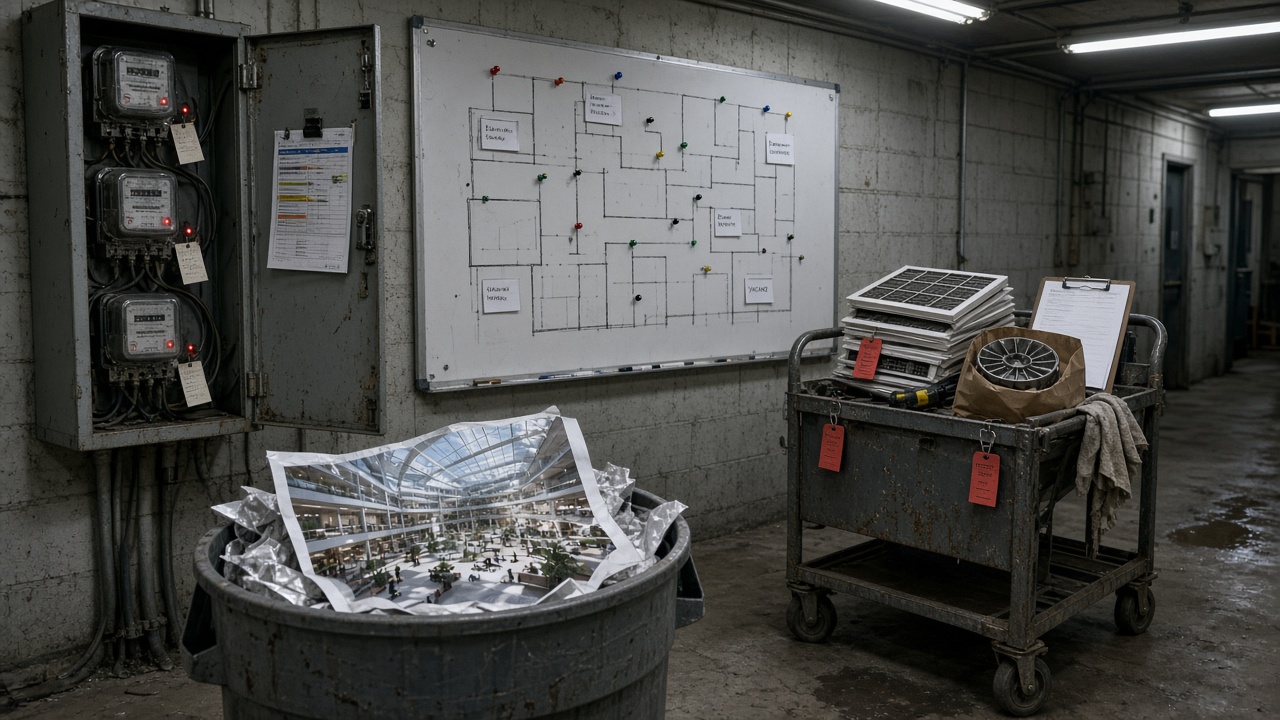
Somewhere this quarter a head of estates is watching a slowly rotating model of one of their own buildings and being asked to find the money to keep it alive. The risers are colour-coded. A tile in the corner counts something in real time. Everyone agrees it looks impressive, and nobody in the room can say which decision it is going to change on Tuesday.
That is the argument worth having. Not whether an owner can buy something called a digital twin — plainly they can — but which operational uses give back cash or labour, and which spend a model and hand over a slide. The comparison is energy, space and maintenance on one side, and visualisation on the other: the fly-through, the federated leftover from delivery, the render in the board pack. The window is occupation, after practical completion, once facilities have either inherited the record or quietly rebuilt it.
Most numbers in this corner of the industry arrive without a denominator. Documentation volume without incident rates. “Thirty per cent of lifecycle data lost” without the moment of loss. Twin savings without the action that produced them. So before anything else, read the method. If there is no method, you are reading a brochure.
What a twin has to change before it counts
An operational twin is a living representation of an occupied asset that somebody can query in order to change how the building is run. That is a good deal narrower than the word on a conference slide. A federated delivery model does not qualify. Neither does a photogrammetric mesh, nor a dashboard that restates last month’s meter readings in a prettier room — unless a person used the restatement to alter a setpoint, a lease or a maintenance action.
Payback has a denominator too. Standing the twin up costs money. Keeping it true costs somebody’s week, every week, indefinitely. The return has to show on the operations side: a lower energy invoice, a floor you stop paying to hold, a planned job that no longer needs a van, a failure nobody had to attend at two in the morning. If the only return is that the model still exists, you have measured storage.
Capability lists are what hide this. Real time. 3D. IoT. AI. Every one of those words can be true of a system that has never changed a Tuesday. The useful questions are narrower and less comfortable: which decision is the twin allowed to alter, who owns the exception when it is wrong, and has the old path — the unofficial spreadsheet, the night walk, the assumed occupancy — actually been withdrawn. They are the same three absences that kill most AI pilots: nothing pinned to a living record, nobody owning it, no production workflow. Count the decisions rather than the objects in the viewer.
Energy: the invoice turns up anyway
Energy usually pays first, for the unglamorous reason that the cash object already arrives every month with a date on it.
The waste is nearly always waste that already has a meter behind it. Plant running in an occupied regime overnight. Heating and cooling fighting each other on the same floor. Setpoints that drifted from the commissioned values within a fortnight of the delivery team demobilising. Occupancy schedules written for a brief rather than for the Tuesday when half the floor is at home. The performance-gap literature has been describing buildings that do not run as designed for years, and Soft Landings named the aftercare window in which those facts are still cheap to correct. None of that needs a new percentage bolted to it. It needs a comparison — what the meters say against what the expected regime said — and an energy manager who is allowed to change the regime and keep it changed.
The twin doing that work is rarely the impressive one. Live consumption against a named expected state. A list of exceptions somebody in controls or energy is authorised to close. A record of what was changed — this setpoint, this schedule, this valve — so the saving survives the next season and the next contractor. The cash is avoided kilowatt-hours, avoided gas, avoided plant hours. The labour saving is not walking the building at night hunting waste the invoice had already implied.
The version that does not pay is a coloured overlay of last month’s kilowatt-hours on a leftover model. It can be pretty and perfectly accurate. Nobody changed a setpoint, so the invoice did not move, and a slide six months later will still say the energy twin is live.
Plenty of buildings cannot run any of this, and it is worth knowing which before you spend. No submetering worth joining. No record of the as-left state, which is the twelve-month handover problem turning up again as drifted plant. Nobody named who may change the building management system, because that authority sits with a maintenance contractor whose contract has no line for it. Under those conditions a twin can still visualise beautifully. It cannot pay, because there is no decision it is allowed to spend.
Resist the urge to put a payback month on it. The invoice cycle is monthly; the first honest saving is the first month a closed exception shows on a bill and stays closed. That is a local measurement, not a constant.
Space: the floor you stop paying for
Space pays largest and slowest, because what is at stake is rent, rates, fit-out and the cost of servicing floors nobody needs.
The pattern is assumed occupancy. A brief said the floor would be full. Booking data, badge data or a handful of cheap sensors say it is emphatically not. Cleaning, heating and lighting carry on treating it as full, and the organisation pays for empty desks as though they were a programme. A utilisation twin that only paints a heatmap has produced a caption. One that lets a named owner surrender a floor, break a lease or refuse a fit-out is a cash instrument.
The payback is not the sensor count; it is the decision the sensors made possible. Consolidation. A sublet. A fit-out that never starts. Night cleaning withdrawn from a wing that is dark. Air handling pulled back to a vacant regime. Those returns need authority the facilities team very often does not have, and this is where space twins disappoint the people who bought them. The picture of empty chairs is cheap to produce and expensive to act on, because acting on it is a property decision taken by a property director rather than a model decision taken by an estates manager. Where the organisation can act, the floor given back is worth more than a year of energy exceptions. Where it cannot, it has bought a render of furniture.
A local measurement here does not need a published utilisation figure. Define the population: floors or rooms the estate still pays to hold. Define used, on your own rule, tightly enough to justify holding them. Count held-and-unused before, then count again after a named decision. The gap is your number, and it is the only one that belongs in the business case.
Maintenance: the query that saves the van
Maintenance is the ordinary operations question in disguise. Can somebody who was not at the coordination meeting isolate a pump, name the spare and trust the sheet in front of them?
Payback here is avoided labour rather than a glowing asset in a viewer. The night call-out that used to begin with a walk and a binder. The planned-maintenance week that began with a folder of photographs of nameplates. The warranty that died in an inbox because nobody could produce a serial number. The van that left the depot because the record could not answer which unit, which filter, which isolation. A twin pays when it answers those queries from an owned asset information model — tag, location, instruction, spare, warranty start — without anyone reconstructing the job first. That is the same object as a queryable O and M and a register facilities will actually use. Calling it a twin does not change the join, and does not pay for it either.
A second pattern sits on expensive plant and moves more slowly: condition or history that changes an interval. Calendar maintenance on a unit that is plainly fine. A run-to-fail on a unit that has been noisy since March. The cash is avoided attendance, avoided parts, or an outage that did not happen. What it requires is identity plus a decision rule somebody will actually apply. Work-order history that cannot be joined to a tag is not condition data, and a pump coloured red in a viewer is not a rule.
The version that does not pay is the delivery model left running after handover with a layer on it saying maintain me. Nobody updated the as-installed identity after the first three changes on site. That is the twin nobody updates under a better name. Operations ignore it and rebuild the register from scratch, and the rebuild is the second time the owner pays for the same information.
None of this needs a millions-saved figure either. Count the queries that used to require a site visit and now do not. Count the planned jobs that ran against the wrong identity. Count the warranties refused for want of a serial number. Those denominators are already sitting in the maintenance system and the call-out log.
The ones that do not pay
Visualisation is not a crime. It is a different object with a different job.
The classic non-payer is a leftover from delivery: a federated model, a scan, a fly-through commissioned for the taking-over meeting, or a twin that on inspection means the BIM still opens. It can be beautiful. It can be a faithful record of a coordination state that was never closed. It cannot isolate a circuit, surrender a floor or move last month’s invoice, and operations will not keep it true, because it does not answer anything they get asked on a Tuesday. An out-of-date twin is worse than no twin at all — a confident picture of a building that has already changed, and eventually somebody makes a decision from it.
Board-pack visualisation fails the same test in a better suit. A steering group is shown a coloured building. The colour is last month’s data on last year’s model. No owner of an exception is named, no old path is withdrawn, and the pack records that the estate is now on twins. The engineer still walks the plant rooms at ten at night. The out-of-date register still sits on the shared drive where it always did.
Reality capture without a join fails identically. A mesh is a record of what was there on a date, and it becomes operational only when a later person can get from the mesh to a tag, a spare and a permit. Without that it is a very expensive photograph. Photographs are useful evidence; they are not a maintenance system.
There is a reassuring argument that visualisation is a first step and the rest follows. Sometimes it does. More often the sequence that pays runs the other way round: start from the invoice, the floor plate or the work order, and visualise only what that decision actually needs.
Where this reading could be wrong
The sceptical half falls over if an owner can show, with a method, cash or labour returned from a twin that never changed an energy regime, a space holding or a maintenance action — the picture itself being the saving. Marketing occasionally implies as much: tenants attracted by a glowing model, a disposal helped along by a fly-through. Those can be genuine commercial events. They are not the same as an operational return, and nobody in facilities gets a lower invoice out of them.
The other half falls over if energy, space and maintenance twins, kept true and properly owned, return nothing once you subtract the cost of keeping them true. That is arguable, and it would need a local measurement rather than a slogan. It is also, I suspect, the condition a good many estates are quietly living in, having bought the capability and never funded the person.
Pick one building — not the portfolio, and preferably not the flagship. Name one energy exception, one space holding and one maintenance query that still needs a visit, then write beside each of them the person allowed to act and the contract that would have to change for them to do it. That is an afternoon’s work and it usually kills two of the three, which is useful to know before the invoice for the twin arrives.
For owners and estates directors, three things are worth doing at the point the money is committed. Fund the keeper before the viewer: a twin with nobody named to maintain the as-installed identity will be wrong within a year, and that person costs considerably more than the licence. Write the asset information requirements so identity, location, spare and warranty start arrive as data at handover rather than as PDFs, and hold retention against them, because nobody produces that after the cheque has cleared. And when a supplier presents, ask them to close one exception on your building while you watch — change a setpoint, produce the isolation for a named pump, show the floor you could hand back — instead of flying you through the atrium.
None of that is free. Submetering is capital. Joining work-order history to tags is somebody’s dull six months. Getting authority over the building management system out of a maintenance contract is a negotiation rather than a configuration. Budget for those three and the energy, space and maintenance cases become ordinary engineering. Skip them, and what you will end up buying is the fourth thing, the one that only shows.
Read next: The digital twin nobody updates, The day-one-operable building: what it takes, Portfolio information management for owners with two hundred assets.