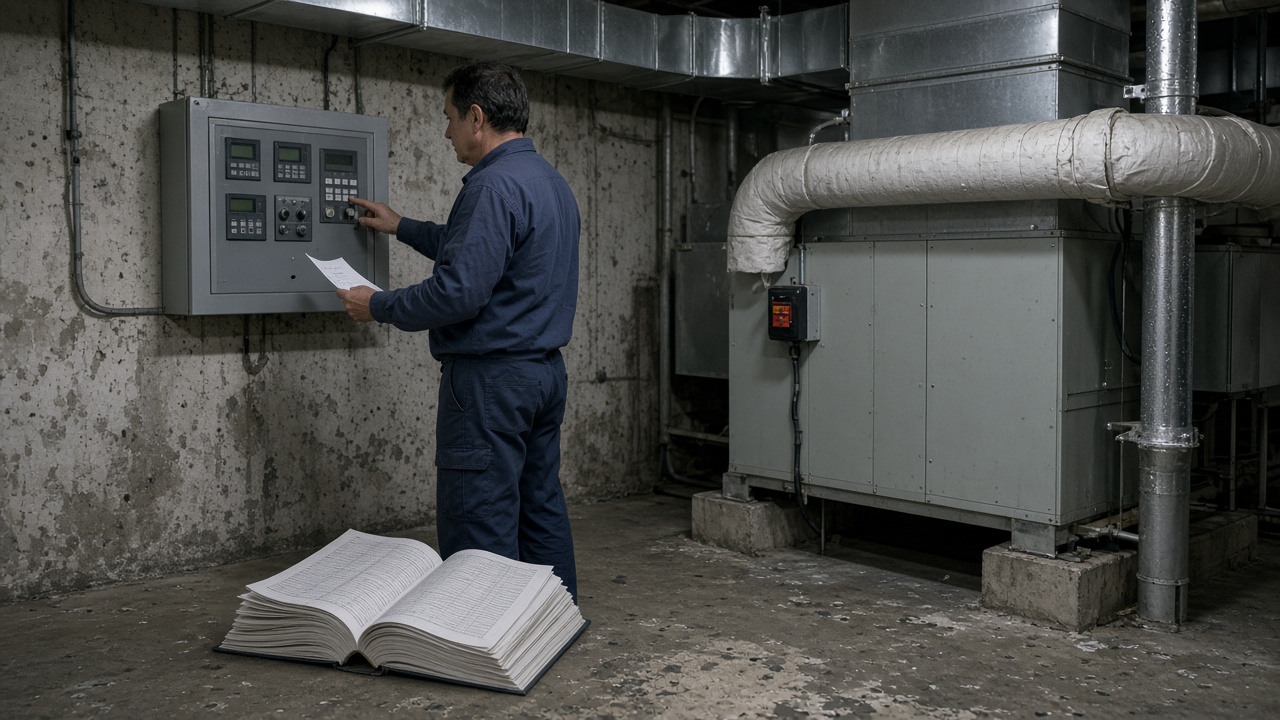
Somewhere in the country there is a facilities team that inherited forty thousand rows they never asked for. Every COBie column populated, every custom field the information standard invented, every parameter the model happened to carry, all of it signed off as a completion object and handed over with the keys. Within a fortnight the duty technician is working from a laminated sheet taped inside a plant-room door, because the sheet has the four things he needs and the register has everything except.
Watch what he asks when the call comes in at half past ten at night. Not who uploaded the row. Not which clash identifier it once carried. Where is it, what is it, is it still under warranty, what spare will I need, and how do I isolate it.
Those five questions are the register. The rest is a museum of delivery metadata, curated at some expense for an audience of nobody.
Where to start
Sit down with the people who will operate the building — not their line manager, the ones who carry the radio. Work back through the last twenty questions they actually had to answer: the night callout, the planned-maintenance week, the replacement, the permit. Keep the fields those questions need, and cut every field nobody has ever asked for.
Two things to resist. Waiting for a consultant to rationalise the schema, which tends to produce a wider sheet rather than a shorter one. And adding a column because the authoring tool already had a parameter, which is how eighty-column registers happen without anybody deciding to build one. ISO 19650, COBie, the Construction Design and Management Regulations and the Building Safety Act each have owners, and each assumes an information model operations can use. None of them writes your query list.
What a facilities team actually asks
Callout. A unit is down. The supervisor needs the tag, the location, the isolation, and the make and model so a contractor can be sent with the right part. Warranty gets asked in the same hour if the failure smells like a defect.
Planned maintenance. The planner lists every instance of a type on a floor or in a system. They need location, type, and the spare or consumable the task consumes. The design-stage parameter set does not come into it.
Replacement. The buyer needs manufacturer, product code, serial, warranty end date and the recommended spare. They do not need the work-breakdown structure that procured the thing.
Permit to work. Isolation first, then location, then how you reach the thing safely. A register that cannot name the isolation point sends people into a drawing hunt at the worst possible moment.
A room complaint. The occupier names a room, never a tag. Location has to resolve to the assets serving that space, and if the only location on the row is a gridline from Stage 3, the complaint dies in a search box.
Five fields, recombined. The tag is the join rather than a sixth curiosity: without AHU-03 both on the casing and on the row, every later query is a guess dressed as a lookup.
Location
Location is the field facilities reach for first, and the one delivery most often leaves as a leftover.
What they need is a place a stranger to the job can walk to: building or block, floor or level, room or space, the system the asset sits in, and how you get to it. "Level 03 plant room west, AHU-03, access from the service corridor, isolation in the same room" is a location. Grid D-7 is a coordination note. Zone 4 typical is not a location at all.
The characteristic failure is a row that inherited the model's storey name, the architect's room code from a superseded schedule, or a package name such as MEP-L3. Those strings were genuinely useful to the people who installed the unit. They are useless at two in the morning. Rooms get recoded, packages close, and the plant stays exactly where it was craned in.
Keep a location operations already use: the room list the occupier will quote, the level names on the wayfinding, the plant-room names written on the key fobs. If the register and the room schedule disagree, the register is wrong. Adding a second "BIM location" column does not resolve that argument — it doubles the hunt.
Access belongs next to location or the query is only half answered. A rooftop unit with no mention of the hatch, the ladder or the need for a mobile platform will be found on a drawing and still not reached safely, which is the same question the health and safety file has to answer.
Make and model
Make and model is how you buy, repair, or refuse a wrong part when it turns up on a pallet.
Keep manufacturer, product code or model, and the serial if the thing carries one. That is enough to telephone a supplier, match a spare, and evidence what was installed if a claim asks later. A type code the project invented — AHU-TYP-01 — is a useful class. It is not a substitute for the plate on the casing.
Cut the authoring-tool family name, the catalogue description that fills half a cell, and "typical" masquerading as a product. Cut the second manufacturer column that still says the specified make after a substitution; the register records what is installed, and if the substitution never reached the row, the next spare order buys the wrong impeller.
Serials belong here rather than in a photograph folder called nameplates_final. A photograph is evidence, not a field, and a planned-maintenance planner will never query a JPEG.
Warranty
Warranty is a date and a counterparty, or it is a PDF nobody opens.
Keep the start date, the end date, what is covered, and who holds it — manufacturer, installer or a named third party. The query is binary and expensive: is this failure still their problem, and who do we ring before we spend? A register that stores see O and M vol. 4 has not stored a warranty. It has stored a hunt, and the hunt happens on the day the money is at stake.
Cut a filename, a ZIP path, and a "warranty received — yes" tick that cannot produce a date. Cut the single warranty blob that mixes duration, exclusions and a sales telephone number. Duration without a start is not a window; a twelve-month warranty whose start was never written down becomes a twelve-month argument between the installer and the client's surveyor.
What the field saves is the replacement that lands just outside the window because nobody wrote the date — the same boring cost warranty and spare-parts data exists to name. If you cannot list, this week, every maintainable item whose warranty ends inside ninety days, the field is decorative.
Spare
Spare is the part the next task will consume, not a dump of the manufacturer's catalogue.
Keep the recommended spare or consumable, its part number, and either where it lives or the lead time if it does not live anywhere. A filter size, a belt, a sensor, a fuse. That is what the planned-maintenance week and the callout both ask for. "Spares as manufacturer's list" sends the planner back into four hundred O and M PDFs to find out which filter.
Cut every SKU the vendor ever sold. Cut the link to a hundred-page catalogue. Cut the "critical spare" flag with no part number behind it, because a flag nobody can order against is decoration.
If the spare is held on site, its store location is a field. If it is not held, the lead time is the field. Facilities will query one or the other; neither of them will read a paragraph.
Isolation
Isolation is how you make the thing safe before you touch it. It is what a permit-to-work system will ask for, and it is the column most often left blank on the grounds that it is in the O and M somewhere.
Keep the isolation point — valve, isolator, breaker, damper — in language a competent person can find: which board, which lock, which valve number, in which room. Keep the permit or lock-out rule if the project has one. Keep a residual where isolation is not local, because a unit that can only be made safe from a riser two floors down is a different job from a unit with an isolator on its own casing, and the difference is an hour and a second person.
Cut "isolate before maintenance", which is a slogan wearing a column heading. Cut the pointer to a generic method statement. Cut the blank isolation column added because COBie had a slot for one.
Where the isolation point lives on a drawing, the register still needs the identity of that point and the current sheet. A drawing hunt at the moment of isolation is how permits fail quietly — the failure permit to work on paper describes at length. Name the point, so the drawing becomes confirmation rather than the only map.
The fields that never get queried
Delivery metadata is not operations data. The columns below arrive because they were cheap to export, not because anyone has ever asked for them in the dark.
01 · Asset tag (the join)
02 · Location, access
03 · Manufacturer, model, serial
04 · Warranty start, end, holder
05 · Recommended spare, part number, stock or lead time
06 · Isolation point, permit or lock-out rule
07 · Classification or type the planner already uses
08 · Link to the current O and M for this tag
A column nobody has ever filtered, sorted or read aloud in a weekly meeting is a candidate for the cut. "We might need it" is how museums start. When a later query does appear — a fire-rating check, a refrigerant type, an inspection interval — add the field then, against that query, and say whose question it answers.
COBie and the project's asset information requirements can still demand more than these five, and sometimes for good reason. Meet the demand where a named owner will read the cell. Just do not confuse a handover completeness score with a register a night supervisor can use.
Running the cut
- Open the register operations will inherit — the COBie sheet, the CMMS import, the spreadsheet in the handover ZIP. Write down every column heading. That list is the current claim.
- Gather twenty real queries: five callouts, five planned tasks, five replacements or stores requests, five permits or access questions. Use last month if the building is live, or the first winter after practical completion if it is not.
- For each query, tick the columns that would have answered it. Location, make and model, warranty, spare, isolation and the tag will take almost every tick.
- Highlight every column with no tick. Those are the cut. Move them to an archive if a contract or an AIR still names them, but get them out of the sheet the night supervisor opens.
- Refuse the next custom column that cannot name the query it serves. "The model has the parameter" is not a query.
Twenty queries is enough; nobody is rewriting the standard here. If the live sheet still runs to eighty columns afterwards, you summarised rather than cut, and it is worth starting again from the questions instead of the heading row.
A test worth running on Monday
Pick one maintainable class — air-handling units, fire dampers, distribution boards — and accept only a record as the answer.
- From a room name an occupier would use, can you list the assets serving that room?
- From a tag, can you read manufacturer, model and serial without opening a nameplate photograph?
- Can you list every item in the class whose warranty ends in the next ninety days?
- For the next planned task on one tag, can you name the spare and either its store location or its lead time?
- For that same tag, can you name the isolation point without opening a ZIP?
You need no new system for this. You need the register, last month's work orders or the first maintenance programme, and one person who has had to find a unit after dark. Where a field cannot answer, write that down rather than rounding it up to "mostly complete".
Then fix it while somebody is still contractually obliged to help. Three changes do most of the work, and the client is the only party who can insist on them. Get the facilities lead in the room before the asset information requirements are signed, so the field list is written against operational queries rather than exported from a template. Make acceptance of the register a milestone in its own right, tested by an operator running the five questions above on a sample, not scored as a percentage of populated cells. And stop accepting three things at handover: a location that is only a gridline, a warranty with no start date, and an isolation column that points at a manual.
That costs money, and it is worth being straight about where. Somebody has to walk the plant and read nameplates, and that is real technician time that belongs in the contract sum rather than turning up as a variation nobody budgeted for. The alternative is paying for the same walk two years later, with no supplier obliged to pick up the phone, out of an operational budget that was never sized for it.
Read next: Monthly Register — March 2026, O and M manuals: from four hundred PDFs to a queryable dataset, Warranty and spare parts data: the boring fields that save millions.