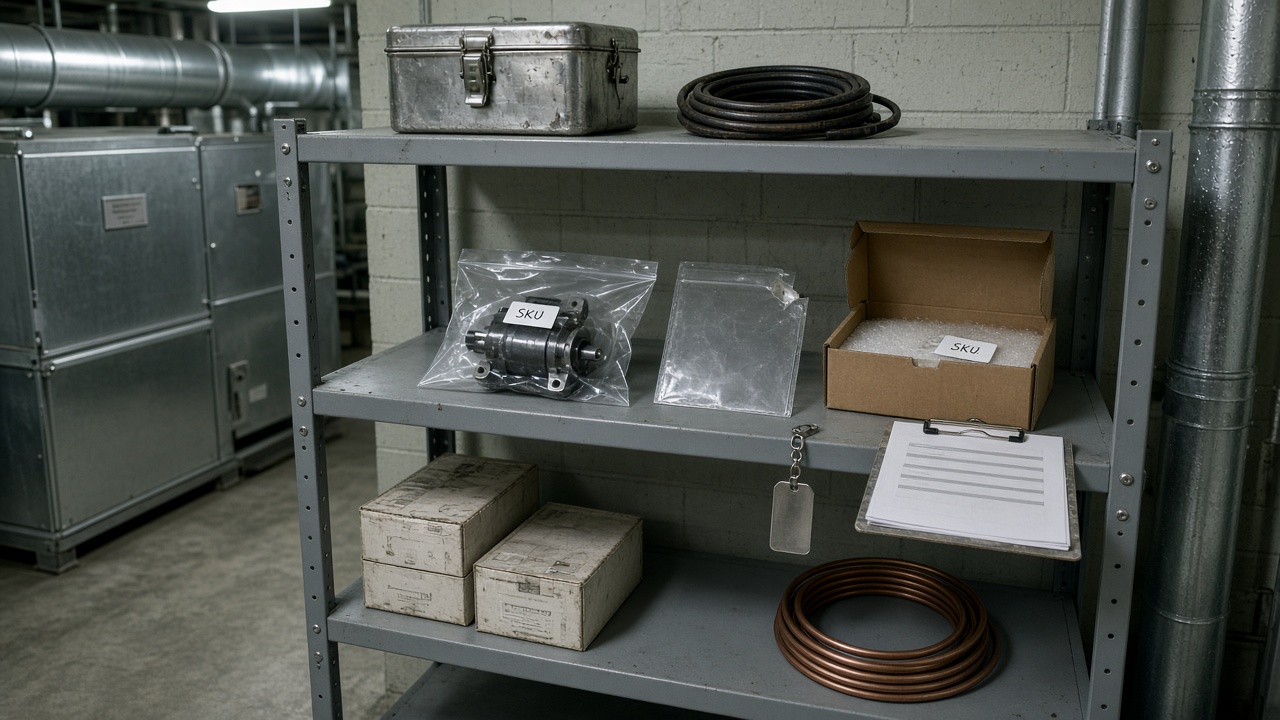
A compressor drops out on a Thursday. By half past eight a maintenance engineer is on the phone to the manufacturer's warranty desk, and the person at the other end wants three things: the serial on the nameplate, the date cover started, and the certificate that names both. He has a tag, a folder called Close-out and a PDF called WARRANTY. The unit is on a roof in the rain, so somebody will go up and photograph the plate. The date is the problem. Nobody wrote down which event started the clock.
Warranty and spare-parts fields look like admin, and there is no honest way to dress them up as anything else. They sit at the bottom of the asset information requirements, they are the last columns a document controller fills, and they are the first columns a handover ZIP leaves blank. Nobody queries them until something has already failed. Then they are the only columns that matter.
What follows is not a survey. It is the ordinary cost of a missing start date, a missing serial, a wrong part number and a lead time nobody stored, reconstructed from rates anyone working in FM would recognise.
The unglamorous fields
Operations will not query a procurement code. They will query a tag, and then they will ask five further questions the delivery team treated as optional.
On the warranty side:
- What type of cover — manufacturer, installer, or design?
- What event started the clock — delivery, commissioning, or practical completion — and on which dated certificate?
- When does cover end, and what is excluded?
- Which serial and which as-installed model does the certificate name?
- Who is the claim contact, and is the certificate in project custody, not a trade mailbox?
On the spare-parts side:
- Manufacturer and model as installed, not as specified.
- Serial, so a later substitution can still be identified.
- Recommended critical spares, with the OEM part number from the nameplate or the parts list, not a brochure SKU.
- Stated lead time, and whether a spare is held or only listed.
- Who can still supply it after the installer has demobilised.
None of that is optional metadata. Those ten facts are the join between the thing that failed and the money that is supposed to follow it. A warranty PDF in a folder named Close-out will not answer a warranty desk, and neither will a parts chapter three hundred pages into an O and M manual. What answers is a fact you can produce from the register, against the tag, without opening a ZIP.
- 01WarrantyFieldType of coverQuestion it answersManufacturerinstalleror design?
- 02WarrantyFieldStart eventQuestion it answersDeliverycommissioningor practical completion — on which certificate?
- 03WarrantyFieldEnd date and exclusionsQuestion it answersWhen does cover endand what is excluded?
- 04WarrantyFieldSerial and as-installed modelQuestion it answersWhich unit does the certificate actually name?
- 05WarrantyFieldClaim contact and custodyQuestion it answersWho is contactedand is the certificate project-owned?
- 06SparesFieldManufacturer and model as installedQuestion it answersNot as specified
- 07SparesFieldSerialQuestion it answersSo a later substitution can still be identified
- 08SparesFieldOEM part numberQuestion it answersFrom the nameplate or parts listnot a brochure SKU
- 09SparesFieldLead timeQuestion it answersStatednot assumed
- 10SparesFieldSupplier after demobilisationQuestion it answersWho can still supply it
Reconstructing a voided warranty
Manufacturers do not pay out of goodwill. They pay when you can prove the installed identity, the start of cover, and — on many plant items — that maintenance was authorised. The typical refusal never goes near a courtroom. It is an email asking for a serial, an install or commissioning date, and the certificate that sat beside them. If those facts were never stored against the tag, the claim is finished before anyone reads the contract.
Take one ordinary event. A mid-size air-cooled chiller loses a compressor inside the manufacturer window. A covered compressor replacement, attended, with access and lift, is often a mid-five-figure invoice if the owner pays — say fifteen to forty thousand pounds once labour, cranage, refrigerant and attendance are in. The manufacturer's first questions are the serial on the nameplate, the date commissioning was accepted, and whether the start date on the certificate is delivery, first run, or practical completion. Those three dates are routinely different by weeks. If the register holds a PDF named WARRANTY and a blank start-date cell, the owner cannot answer, and the claim is refused or delayed until it has quietly become a purchase.
That is one unit. A commercial building will have several items whose cover is worth that conversation: chillers, lifts, generators, fire-alarm panels, façade units, specialist doors. Two refused claims in the first five years, on ordinary plant, is already six figures before anyone has mentioned a process line or a hospital theatre. Typing the serial and the start event at commissioning takes an hour. Reconstructing them after demobilisation takes a consultant a week, and what comes back is still not contemporaneous.
Contractor defects-liability cover fails the same way. If nobody recorded which event started the twelve months, you either claim after the window or you never claim, because you cannot show you were inside it. Design cover fails more quietly still: the certificate exists, the asset it was meant to protect was never linked to it, and the claim turns into a hunt through correspondence.
A voided warranty is rarely a legal finding that cover was cancelled. It is an information finding — the fields that would have made the claim were never captured.
Reconstructing a wrong spare
The second cost is subtler, because the spare arrives. It is simply the wrong one.
Plant gets substituted at procurement. The specified model is not the installed model. The O and M still describes the specified unit. Stores order from the specified parts list, or from a brochure SKU somebody typed into a cell two years earlier. The box turns up. It does not fit. The plant is still down.
Reconstruct one ordinary event. Two technicians for a day, at a fully loaded sixty pounds an hour, is already a thousand pounds of labour before the part. A wrong actuator, variable-speed drive, or fire-damper motor is a few hundred to a few thousand pounds on the invoice, plus a restocking argument, plus a second wait. Add a day of temporary cooling, a hired generator, or overtime to recover a lost service window, and a "simple" wrong spare is two to ten thousand pounds before the correct part has shipped. None of that is dramatic. It is what a mismatched model field costs on a Tuesday.
The field that would have prevented it is the as-installed manufacturer, model, serial and OEM part number, held against the tag, refuseable while the vendor is still contracted. "Spares: see O and M" does not do that job. Whoever orders at six in the morning will not read four hundred PDFs; they will ring the installer's mobile instead, and one day that number stops working.
Reconstructing a long lead
The third cost is time. OEM lead times for a custom coil, a lift controller board, a specialist valve actuator, a matched compressor, or a fire-system card are routinely eight to twenty-six weeks. The recommended spare was in the vendor pack. It was never entered as a field, so it was never bought. The plant fails on a Thursday.
Reconstruct the wait, not a disaster. A hired temporary chiller or generator at a few thousand pounds a week, held for twelve weeks while a coil is fabricated, is already mid-five figures before labour, fuel, attendance and the eventual part. Two technicians covering a degraded system, plus contractor attendance, plus the owner's own coordination, add another five-figure labour bill that nobody capitalises as "missing spare-parts data."
On a commercial office that is uncomfortable. On a process line, a data hall, or a hospital air system, the same wait is billed as downtime. Even a conservative five-figure day-rate for a fortnight is the arithmetic the title is pointing at — not a measured portfolio study, and not a claim that every missing cell costs a million pounds. It is what one long-lead hole costs when the recommended spare was a paragraph in a PDF and not a row you could purchase against.
Lead time is a field in its own right. A spare listed without a lead time is a hope. A critical spare with a twenty-week lead and a quantity of zero is a finding you can still close while the vendor is on the job; after demobilisation it is a purchase order to a factory that no longer has your contract.
Where the millions come from
There is no dataset behind this and nobody has averaged a hundred projects. It is ordinary events, added up.
One refused compressor claim. One wrong spare and a second wait. One twelve-week hire while a long-lead item is made. On a single mid-size building those three, across a decade of defects and replacements, are already mid-to-high six figures if they happen more than once — and they do, because the same blank cells sit on every row. A campus, a portfolio, or a process plant with rotating equipment compounds the same arithmetic. That is the only sense in which these fields "save millions." They never look like millions on the handover schedule. They look like columns nobody wanted to type.
The cheap labour is capture: serial at delivery, start event at commissioning, recommended spares extracted as fields from a refuseable O and M draft, lead time written down while the vendor still answers the phone. The expensive labour is reconstruction: nameplate photographs, mailbox hunts, a consultant rebuilding a register from PDFs the owner already paid for. The twelve-month handover is that reconstruction wearing a programme.
A Monday field test
Nobody needs a consultant for this. The document controller and the facilities lead — or, if facilities have not been invited yet, the quality lead — take ten maintainable assets that will still need a spare or a claim in two years. Chillers, air-handling units, lifts, fire panels, pumps, generators, specialist doors. Do not start with the archive, and do not tidy the folder the night before.
For each tagged asset, produce the following from the system of record, not from a ZIP and not from memory:
- Tag, location, and system an operator will use.
- Manufacturer, model as installed, and serial.
- Warranty type; the dated event that started cover; end date; coverage and exclusions; supplier claim contact.
- The certificate in project custody, naming the same serial.
- Recommended critical spares, each with an OEM part number.
- Stated lead time for each critical spare.
- Whether a spare is held, on order, or only listed.
A pass is boring: the seven facts sit on the row. A fail has a shape you will start to recognise — a tag, a missing serial, a certificate that names a different model, a parts chapter with no part numbers, a lead time of "TBC." Resist averaging the ten assets into a percentage, which invents precision the hour does not have.
What you cannot produce in that hour is a warranty you cannot claim and a spare you cannot order. Recreating it after practical completion will cost more than binding the field at the time, and the recreation will not be contemporaneous.
If the honest answer is that the O and M has a warranties appendix and a parts list, and "we will map them later," the late lesson is already booked in. Later is a Thursday at six in the morning. Later is a manufacturer asking for a serial nobody stored.
Capture them while the people are still on the job
These fields are cheap at three moments and expensive at every moment after.
At delivery, the crate still carries a nameplate and a packing list. Write the serial, the as-installed model and a photograph of the plate into the row. A phone album is not custody.
At commissioning, the start event exists and somebody can date it. Write which event started cover, on which dated sheet, against which tag. If the certificate says commissioning and the register says practical completion, that disagreement is a finding rather than a future tidy.
At the O and M draft, while the vendor can still be refused, extract recommended critical spares as fields: part number, quantity recommended, lead time, who supplies. A draft that only offers a parts chapter is refuseable. A draft that arrives as a ZIP after the account is closed is whatever the owner is left holding.
Those three moments belong in the same readiness habit as tags, inspection and test plans, and the issued set. If you run a review at sixty per cent complete, these columns are part of the register starting. They are not a close-out leftover.
ISO 19650, CDM, the Building Safety Act, NEC, FIDIC, JCT, COBie, MOMRA and the project's own asset information requirements each have owners, and each assumes a contemporaneous record of what was installed, what is covered, and what can be replaced. None of them treats a late ZIP as proof that a claim will be paid, and none treats a method like this one as a stamp. A system that keeps a warranty PDF in one cupboard and a parts list in another, without the serial and the start event that join them to the tag, is two cupboards.
Which leaves the question of who moves first, and it is not the maintenance engineer on the roof. Clients can name the seven fields in the asset information requirements, tie a payment milestone to them rather than to the pack arriving, and put the facilities team in as a reviewer of the O and M draft instead of the recipient of the final version. Principal contractors can move serial capture out of the close-out plan and into the delivery process, and make the commissioning manager accountable for recording the start event on the day it is accepted. Specialist subcontractors can expect to be asked for OEM part numbers and lead times while the account is still open, and price that properly instead of absorbing it. None of this is free: it is a few hours per asset, spread across people who are already busy, plus the unpopular business of refusing a draft that looks finished. Skip it and the bill still arrives, just later, itemised as cranage and hire and overtime, with nobody's name against the blank cell that caused it.
Read next: O and M manuals: from four hundred PDFs to a queryable dataset, A handover acceptance checklist for owners, The twelve-month handover: why owners wait a year for data they already paid for.