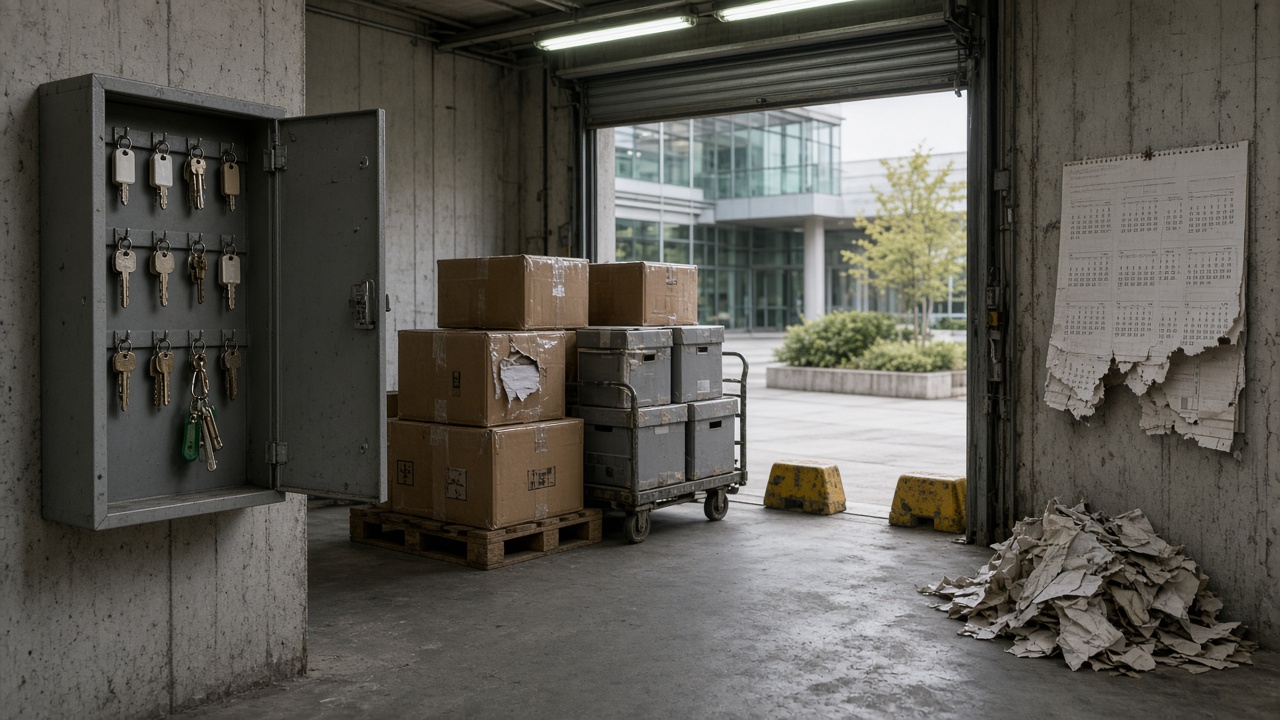
A year after practical completion, an owner's asset team is still working from a spreadsheet somebody built by walking the plant rooms with a phone camera and a clipboard. The building has been occupied since the keys moved. Rent is coming in, the maintenance contractor turns up every week, the lifts are under contract. What nobody has is the thing the construction contract already paid for: a register that says which unit is which, what manual belongs to it, what it was set to when it was left, and when its warranty started. That is still being assembled out of four hundred PDFs, a rejected COBie workbook and a crate of redlined prints in a store cupboard on level two.
Ask the facilities manager how long this has been going on and you get a shrug and a date. Ask what is left to do and you get a longer list than you expected.
The twelve-month handover is not a delay in the post. It is what you get when a project treats handover as a pack rather than as a change in the state of the information. A pack can be late, thin, unqueryable and still be recorded as issued. The year is the time it takes to rebuild, from those packs, the three things operations will actually live on: a manual someone can find against a tag, a tag that matches a register, and a drawing that matches the plant.
Practical completion is a commercial gate, not an information gate
By the time the keys move, most jobs can point at plenty of evidence that the record exists. Folders have names. Models have been federated. Somebody is on BIM. COBie appears in the employer's information requirements. The health and safety file has a line in the programme and a person against it. Practical completion is then treated, informally and almost universally, as the moment the record becomes the owner's.
It is not that moment, and the contract never said it was. Practical completion is a legal and commercial gate: it says the works are complete enough for the next state, occupation and the release of half the retention. It says nothing at all about whether the information is complete enough to raise a work order. Moving keys is a physical act. An asset register is a set of statements about installed plant that a different organisation, staffed by people who were never in a coordination meeting, can query without opening a ZIP. Those two acts get scheduled as though they were one, and the second one quietly slips a year.
Which is why the wait gets described as a lag. The contractor is assembling the final O and M. The as-builts are "being updated". The tags are "being confirmed". Twelve months becomes a disappointing interval rather than something the programme designed. The unofficial set in the site trailer, the clash nobody closed, the model that froze when coordination stopped — each has a sibling at the end of the job, and the sibling is the year an owner spends paying again for a register the works already funded.
Already paid for is a contract fact
That phrase does a lot of work, so it is worth being precise about it. Every one of the objects operations is waiting for was priced.
O and M manuals are a deliverable. They sit in the specification, in the exchange information requirements, and in the document register as placeholders that turn amber and then green. Vendors are paid to write them. Contractors are paid to collect them. The owner paid for that collection in the tender sum, whether or not anyone can find it as a line.
Asset tags are a deliverable too. Labelling, unique references, a schedule that maps tag to location to system: priced as identification works, not offered as a favour. The installer is paid to fix a plate to the unit. The information manager is paid to keep the list. The owner paid for both halves and usually receives one.
As-builts are a deliverable. Redlines, record drawings, a model marked as-constructed — they are in the programme, they have a last responsible moment, and in more contracts than the industry likes to admit they are a condition of retention. Somebody is paid to produce them. The owner paid for a record of what was built, not for a record of what was intended.
Commissioning records, warranties, spare-parts lists, training attendance, residual risks, the health and safety file: same pattern throughout. The construction price included the information. So the year after occupation is not when this material gets created — it is when somebody first tries to make it operable, and discovers that "submitted" and "queryable" were never the same fact.
A green cell on a deliverable register is a statement about a file. Operations needs a statement about a building. Most of the trouble in this article comes from a programme that treated those as interchangeable.
What arrives, and what a technician can use
What turns up at practical completion is usually a volume. A share link, or a hard drive in an envelope. Four hundred PDFs in a folder called O and M. A COBie workbook exported once, from a model that stopped moving when the last coordination meeting ended. A box of redlined prints. A labelling schedule still written in procurement codes. A commissioning folder whose tests were typed up in the final fortnight, in one handwriting. A health and safety file that is a binder of other binders.
None of that is a register, and volume is not the same currency. Nobody can raise a work order against a ZIP. A technician standing in front of an air-handling unit at seven in the morning cannot open four hundred PDFs, guess which one describes this unit, and take the serial on trust. An as-built that is last week's issued drawing with a red cloud on it, sitting in a crate, is not a statement about the plant. A tag on the casing that appears in no list the owner holds is not an identity; it is a sticker.
The fields a facilities team will actually query are dull. Tag. Location. System. Manufacturer, model, serial. Warranty start. As-left setpoint. The title and revision the test was run against. The manual that belongs to this unit rather than to its family. The spare that fits. The residual risk still sitting on this system. Almost all of those were knowable while the installer and the commissioning engineer were still in the room with the cover off. Almost all of them are first written — or first believed — months after those people demobilised.
This is why quality records are handover records, and why teams tend to learn it too late to act on it. An inspection and test plan that never met an asset tag becomes fiction once it is transcribed into the O and M. A commissioning hour that was not written down becomes a folder of photographs. An issued set that was never pinned to installed plant becomes an archaeology project. The year is those reconstructions, run one after another, months after the only people who could have written the row have gone.
The ordinary year
The sequence is common enough that naming a job would flatter one site and let the rest off.
Occupation. Keys move and the building gets used. Soft landings, where they exist at all, are a meeting series rather than a register. The contractor's information manager is already on the next job, and the residual site team is a defects gang, not a records team. Operations inherits the plant on day one and the paperwork as a promise.
The first quarter. Somebody starts chasing "the final pack". Versions multiply: draft O and M, final O and M, final-final, "as issued for handover". Vendors resend the same PDF they sent at procurement. Document control files it. Facilities still cannot find the unit. A consultant is brought in to "structure the manuals", and that is the first invoice after the one the owner has already paid.
The second quarter. The owner works out that there is no asset register they are willing to accept. There is a COBie dump, or a contractor schedule, or a list of tags that do not match the plates, or plates that do not match the rooms. So someone walks the building with a camera and a spreadsheet, typing serials off nameplates and guessing locations from a general arrangement. That is the second payment: labour to rebuild identity out of the fabric, because the project record never held identity as identity.
The third quarter. As-builts are still open. The model is the coordination model. The redlines are in the crate. Record drawings, when they surface, disagree with both. A designer is re-engaged, or a measured survey is commissioned, to draw what is there. Third payment: a second drawing job for a building that was already bought as a drawn building.
The fourth quarter. The maintenance system is loaded from the reconstructed spreadsheet. Warranties have been running since practical completion, or since a test date nobody can now prove. The first planned maintenance cycle runs on folklore — wrong filter size, wrong valve, a manual for the unit next door. The owner ends the year with something that looks like a register, having occupied the building for twelve months and paid for the information twice, and it is still not finished, because the as-builts and the manuals do not agree with the tags.
| Window | What operations holds | What the labour actually is |
|---|---|---|
| Occupation | Keys, and a promise of a pack | Running the building |
| First quarter | Draft, final and final-final O and M | Chasing and filing volumes |
| Second quarter | Plates, and a rejected schedule | Walking the plant and typing identity |
| Third quarter | Redlines, and last issued drawings | Paying for the building to be drawn again |
| Fourth quarter | A spreadsheet loaded as a register | Maintaining on folklore |
Nobody in that sequence needs to have been careless. The vendor wrote a manual. The installer fixed a plate. The document controller filed a PDF on the day it arrived. The designer issued a construction set. Every step is locally reasonable, and the year is the chain.
Why the manuals take months
An O and M manual is meant to be the operating instruction for the thing that was installed. What most projects collect is a vendor catalogue PDF, a generic method statement, and a folder named after a package.
That collection can be perfectly complete as a transmittal and close to useless in a plant room. Complete means a file arrived. Useful means a technician can work out, on the spot, which manual belongs to this tag, which version of the plant it describes, and where the as-left information lives, because it is certainly not in the brochure.
Typical packs fail that test for ordinary reasons, and it is worth being specific about them.
The PDF describes the product rather than the instance. It covers a family. It does not carry the serial, the as-left setpoint, or the accessory that was actually fitted on the day. The commissioning sheet that would have made it specific was typed up later, or never — which is why capturing commissioning data during commissioning, not after is a handover problem rather than a quality hobby.
The filename is a package name. Four hundred PDFs with package names are a pile, not a join to a tag. Somebody has to open every one of them, and that somebody is hired after occupation, because during the works filing was treated as the job.
The manual is often a scan of a binder assembled for the witnessing visit. Pages are missing. The contents list does not match the sections. There is no search in it that will survive a facilities login.
Warranties and spare parts sit in email, or on a supplier page nobody will maintain, or in a schedule that uses the procurement code the installer never labelled. The boring fields that save real money are exactly the ones nobody wrote against the tag while the unit was open.
The year is how long it takes to turn that pile into something a maintenance system can point at. The labour is not authoring — authoring was paid for in the works. The labour is joining: this file to this tag, in this location, with this warranty start. Joining after demobilisation is slow because every join has become an inference.
Why the tags are still a project
A plate on a casing is not an asset register. Neither is a spreadsheet. A register is a set of identities operations will still trust after everyone who installed the plant has left the country.
Typical jobs have all three objects and none of the joins.
The plate went on when the unit arrived, or when an inspector asked why it had not. The number on it may be the manufacturer's, the contractor's, the designer's, or a room code from an early layout. Two packages can tag the same system in two different ways. One package can change a number after a substitution and leave the old plate in place because the new labels are coming.
The schedule was exported from a model, or from a procurement list, or from a COBie sheet applied once and never revisited. It uses the identities the model held when coordination stopped, not the ones the installer wrote on the door. COBie is not the villain here; end-loading it is. A workbook produced to close out a deliverable is a file. A register produced while the installer is still on site is a fact you can maintain.
Inspections and test plans, where they existed, ran against packages and hold points rather than against the tag the operator will eventually use. That is why tying inspection and test plans to asset tags from day one matters more than it sounds: it is the only cheap moment to make the tag real. Once the tester has gone, the tag becomes a photography problem.
The year is the walk. Someone goes back around the building and types what they can see, spending labour the installer already spent when the cover was off, and produces a list that looks complete. Completeness is not contemporaneity. A row typed in month eight is somebody's claim about an asset. A row written when the plate went on is the asset.
Why as-builts turn into a second drawing job
As-built is one word covering three different objects, which is a fair part of why none of them arrives.
There is the last issued construction drawing. That is often what gets handed over, because it exists, it has a title block, and it plots. It is as-issued, not as-built. The plant moved. The route changed. The substitution was instructed in a mailbox and never made it back to a sheet.
There is the redline. It lives on a print in a crate, or on a mark-up that was never incorporated, or in a model view nobody published. It is contemporaneous in the way a drawing pinned up in a hut is contemporaneous: locally true, officially nowhere.
There is the record drawing, or the as-constructed model. This is supposed to be the published fact, and it is scheduled after practical completion because nobody would pay to keep it current while the works ran. By the time it is drawn, the people who knew about the change have gone, the redlines contradict each other, and the owner commissions a survey to establish what they own.
That survey is a good part of the year, and it is the third payment. The owner paid for design information, paid again for construction information, and now pays to have the building drawn a third time, because the project never treated as-built as a state of the issued set. The unofficial set in the trailer and the crate of redlines are the same failure at two different dates. One of them delays a pour. The other delays operations by a year.
A digital twin that froze at practical completion is that same object with better branding. Federation is a record of what was coordinated, not a record of what was built. Operations cannot query a clash that was never closed, and they cannot maintain a duct that only exists in the last happy model.
Paying twice
Set out as money, the pattern is harder to argue with.
First payment: the construction contract. O and M, tagging, as-builts, commissioning records, warranties — all priced, all programmed, frequently "delivered" as files.
Second payment: the reconstruction. A data-cleansing consultant. A mobilisation team typing serials. A designer re-engaged for record drawings. A maintenance-system implementer who takes one look at the COBie dump and declines to load it. Soft-landing hours that are really archaeology. A temporary maintenance contract written against incomplete identity, which means call-outs that take twice as long and spare parts that turn out not to fit.
Then there is what the owner pays in operations and never sees on an invoice. Planned maintenance using the wrong media. A warranty claim refused because the start date cannot be shown. A residual risk that sat in the health and safety file and never reached a permit. Energy wasted on setpoints nobody recorded as as-left. A fire strategy that still assumes a damper somebody omitted. Hours spent walking plant rooms with a binder because the register is not trusted.
Paying twice is the polite version. A few owners pay a third time, when the reconstructed register turns out to be wrong and the first year of occupancy becomes the real survey.
This is not a claim about a percentage of lifecycle cost being lost at handover; that figure needs a denominator, and where the thirty per cent of lifecycle data lost at handover actually goes takes it apart separately. What needs no statistic at all is the labour you can watch happening: people retyping, rewalking and redrawing facts the project had in the room and did not keep.
Nobody owns the year
PIM to AIM has no natural owner, and that is the real reason the wait is a year rather than a fortnight.
Project information models are owned, in practice, by people paid to finish a job: the contractor's information manager, the document controller, the package managers, the designers still answering RFIs. Their incentive runs out at practical completion, retention and demobilisation. Asset information models are owned, in practice, by people who were never in the coordination meeting: the facilities manager, the owner's technical lead, sometimes a managing agent who arrives after occupation. Their incentive begins when the keys move. Between those two incentives sits a gap with no budget line and no name on it.
The gap is usually dressed as process. There is a handover meeting. There is a transmittal called Handover Pack. There is a clause about as-builts within a stated number of weeks. What none of that produces is a person who can refuse occupation-quality information the way a document controller can refuse a suitability code. Without that person appointed before practical completion, operations invents a third model — the spreadsheet the facilities team trusts, which is neither the project model nor the asset model, and which will be retyped from scratch when the next contractor arrives.
Progressive handover is the industry's name for not leaving the join until the end, and validating asset data while the installer is still on site is straightforwardly cheaper than a year of inference. A handover readiness review at sixty per cent complete is the same point made earlier, when there is still time to act on it. If you cannot demonstrate at sixty per cent that tags, manuals and as-built responsibility have named owners, you have already bought the year; the invoice simply has not arrived.
Owners who want a gate rather than a hope can start from a handover acceptance checklist and refuse a handover that cannot produce the issued set, the asset register and the residual risks on the same day. Acceptance twelve months late is closer to settlement than to acceptance.
What the year costs while it is still running
The wait is not empty time, which is the part that gets underestimated. The building is in use throughout.
Every work order raised in that year is a bet that the identity is right. Every permit is a bet that the residual risk file matches the plant. Every warranty claim is a bet that a date can be proved. Soft landings turn into a complaints log, because the information that would have prevented the complaint — the as-left setpoint, the correct manual, the tag that matches the room — is still in a crate.
The owner's own organisation learns the wrong lesson from all this. It learns that digital handover means a pack that arrives late. It staffs a mobilisation team as though reconstruction were normal, because by now it is. It writes the next employer's information requirements with more file types listed and the same missing owner. Then the next job repeats the year.
Meanwhile safety and compliance do not wait for the register. The Building Safety Act, CDM, the golden thread, Gulf digital-handover mandates: each of them assumes a contemporaneous record of what was built and how it was left. A spreadsheet typed in month eight is not that record, and a duty-holder who has to produce the current fire strategy in month three cannot borrow one from next year. Continuous assurance is what the quality pillar calls the alternative: verification that does not wait to become an event. The twelve-month handover is what you get when verification was an event, the event was practical completion, and what changed hands was a volume.
Software did not buy the year off
There is a software version of the reassurance. The CDE was bought. The model was federated. Somebody licensed a twin. COBie was exported. So the year should not exist.
Systems store. They do not decide that this PDF belongs to that tag, that the plate on the casing is the identity operations will use, or that a redline has become the published as-built. Those are decisions, and each needs an owner, a moment, and the authority to refuse: this file is not accepted, this row is not the register, this drawing is not as-built. Buy the best product on the market and those three refusals still have to be somebody's job.
A share link full of manuals is storage. A model nobody will mark as superseded is storage. A twin that froze at practical completion is storage. The year is what an owner spends turning storage into statements, and no licence renewal shortens it.
What to change, and who has to change it
Almost all of this is fixable before the keys move, and none of the fixes are free — which is the point, because the money is being spent either way, just later and at a worse rate.
If you are the client or the appointing party, put the join in the contract rather than in the aspiration. Name the person who accepts asset information, and give them the same right of refusal the document controller has over a suitability code. Tie a slice of retention to a register that operations has actually queried, not to a transmittal called Handover Pack. Ask for tags, serials and as-left values at the point the cover is still off — which means paying the installer and the commissioning engineer for the recording, in their rates, rather than expecting it as goodwill.
If you are the principal contractor, the cheapest version of this is to stop treating the asset register as a deliverable that gets assembled and start treating it as a register that gets populated weekly, package by package, from the day the first unit lands. That is a resourcing decision more than a software one, and it will cost you an information role that stays past practical completion instead of ending at it.
If you are the owner's asset team, the useful move is a rehearsal rather than a review. Pick three units in different systems, six months before completion, and try to answer the ordinary questions: which manual is this, which revision was it tested against, when does its warranty start, what spare fits. Do it with the people who will be doing it for real, and do it while the installer is still contactable. Whatever you cannot answer in that half hour is the shape of the year you are about to buy, and there is still time to price it into somebody else's scope.
And whoever is running the next employer's information requirements — write fewer file types and one more name.
Read next: Where the thirty per cent of lifecycle data lost at handover actually goes, From PIM to AIM: the transition nobody owns, Progressive handover: validating asset data throughout delivery.