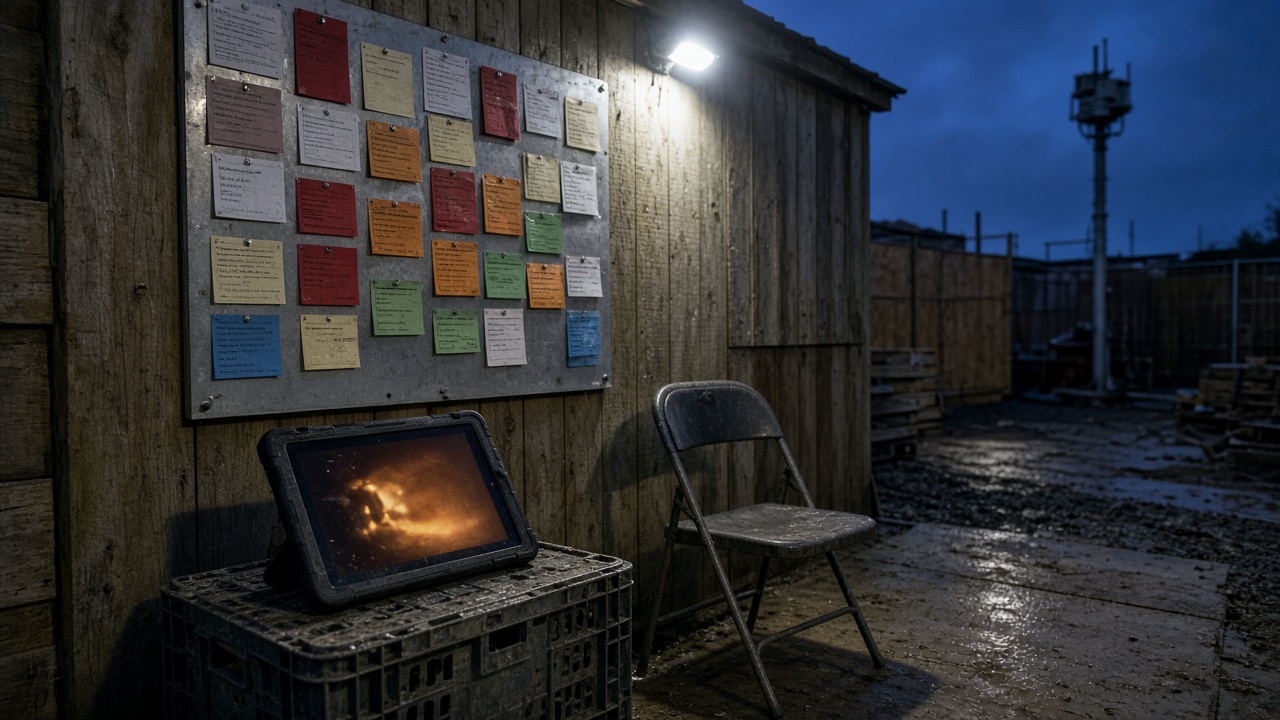
The demonstration usually opens on a wall of amber. Cameras on the fence line, a live risk score, a language model that has read last week's method statements and thinks two of them disagree with the isolation on the board. The room nods along, because it is genuinely impressive. Then somebody at the back — usually a safety advisor who has run sites rather than slide decks — asks who stops the work when the score goes red. That question is rarely on the slide.
Three claims get stacked as though they were one product: that a machine can see a hazard, that seeing it amounts to control, and that control has therefore been purchased. The industry is still arguing the first, which is a capability question. The other two are where the money and the liability sit.
If a system flags a condition and nobody is named to stop the work, what you have is a dashboard. If it misses the condition and the file afterwards shows that a model was watching, you have handed the other side an alibi. Both the promise and the evidence matter. Neither moves a duty.
What is being sold
The pitch rests on a quiet assumption: that the industry acquired governance on the day it acquired a detector. Folders have names. Models have federations. Somebody is "on AI". A mast on the fence line never blinks. A risk score turns amber while a meeting watches it happen. The construction phase plan, the permit board and the health and safety file all get discussed as though they had grown a nervous system.
In that account, spotting is the control. A missing helmet becomes a closed loop. An open edge becomes a notification. A stale permit becomes a row on a screen. The labour that used to mean walking the board, closing the isolation and writing the residual risk into the file is reframed as latency, which the model has helpfully removed. Duty-holders stay on the appointment; the watching, we are told, is now continuous.
It sells because it collapses three different acts into one verb. Detection is a signal. Governance is a named person who has to change the work, withdraw an instruction, or record — with a date on it — that the signal was wrong. A model can get better at the first. It does not become the second by speaking in the first person.
The promise also relocates time without saying so. Paper permits fail in sequence: the pad, the walk for signatures, the tear-off, the night shift that inherits a copy still looking live. Documented safety activity has grown for years while official injury rates flattened. The AI pitch reads all of that as a bandwidth problem — give the site more eyes and the sequence will close itself. That is the claim under test.
What the evidence actually carries
Strip out the customer anecdotes and what remains in the published record is narrow, and mostly visual. In decent light, with a camera close enough to resolve the object, current detectors can flag a missing helmet, a missing vest, sometimes a missing harness, a person standing inside a plant envelope, somebody crossing a drawn line. Those figures describe a detector on a test set. They do not describe a reduction in injuries. The fall-off when you change domains is already sitting in the method sections: weights trained on clean, well-lit albums lose precision in rain, at night, in dust, at distance. A score earned on stock photography is not a score earned on a British site in February.
The rest of the duty was never something a camera could see. A helmet detector does not install edge protection. A vest detector does not separate people from plant. A harness detector does not know whether the line is clipped, whether the scaffold was inspected that morning, or whether the man on the roof was named on the permit at all. CDM 2015 still assumes pre-construction information, a construction phase plan that is alive rather than filed, and a health and safety file that can be produced when somebody asks. No model assembles those objects. None of them appoints a principal designer, closes a permit, or records residual design risk against an issued revision.
The official outcome series does not close the gap either. Great Britain's construction fatal-injury rate fell for decades and, across the recent window the Health and Safety Executive will stand behind, has flattened. The preferred non-fatal series has not shown a further statistically significant fall against the late 2010s. There is no accredited national statistic for pages of method statement, live procedures per worker, or hours of safety administration, and no official series attributing a drop in RIDDOR events to an analytics layer once you control for edge protection, competence and permit discipline. Until that study exists, cost the miss rather than the demonstration.
The law prices the footage before anyone gets round to pricing the benefit. Images of people are personal data. Purpose limitation means a company already running cameras for security has not, by that fact alone, authorised an all-day score attached to named workers. A data-protection impact assessment, a proper conversation with the workforce and a retention rule belong in the evidence pack rather than in a footnote added after the pilot. Somebody's union rep will ask, and so will the client's FM lead who inherits both the system and the recordings.
What all that supports is a type of help rather than a transformation. A signal, on a visible object, in conditions that resemble the training set, provided a person is still there to act on it. Nobody bought safety governance in the same box as the model. Cite the test set, the RIDDOR year and the lawful basis, and leave the hole where the outcome study should be.
When the model flags
A flag is not a control until somebody with authority treats it as one.
The first failure is the unowned alert. The mast sees an open edge. The classifier sees a missing vest. The language model sees a method statement that does not match the isolation on the board. The notification lands in a channel, a dashboard or a mailbox belonging to "H&S" in the abstract, which on a Friday afternoon means nobody in particular. No one has been named to stop the work, withdraw the permit or write the residual risk into the file. The row stays amber. The gang carries on. After the event the project can produce a screenshot proving the system noticed, which is a contemporaneous record that the condition was visible and still unowned.
The second failure is volume dressed up as vigilance. A camera running all shift produces more events than a supervisor can honestly close. False positives cost real time: somebody has to dismiss the vest hung over a chair, the helmet scored as a head, the branch waving in the exclusion zone. Usually it is the person you least want parked in a cabin clearing a queue. If you cannot say how many alerts were actioned, by whom, against which issued instruction, and what class of harm they were aimed at, then what you have is a feed. A feed with no closer behind it is the unofficial set in a new jacket — locally current, and no use at all the week someone has to reconstruct who knew.
The third failure is the transfer fantasy. "The system flagged it" gets treated as though the duty moved with the notification, and it did not. The Health and Safety at Work etc. Act 1974 still puts duties on employers and on those who control the work. CDM 2015 still puts holdings on a client, a principal designer and a principal contractor — named people, or organisations with organisational capability, not a vendor's process diagram. The Building Safety Act, where it applies, still puts the golden thread on an accountable person who has to produce the current record. A model can be an input to all of that. It cannot be appointed to any of it.
A flag that changes the work has a short anatomy: this condition, this location, this issued title and revision or this permit identity, this person who stopped or continued the work, this date and time. Leave out the person and it is theatre. Leave out the pin to the issued set and it is an anecdote about a camera. Leave out the time and you are back where the paper permit left the industry, with a signature nobody can place in the day.
When the model misses
The miss is the more expensive gap, because it arrives dressed as clearance.
A false negative is not a quiet hole in a precision table. On a live site it becomes a statement the workface over-reads. The mast is up, so the edge is watched. The model did not alarm, so the isolation must be sound. The score stayed green, so the construction phase plan must still be the document everyone is working to. None of that reasoning appears in the brochure, and all of it is how people use a system they have been told is always on. A detector the site has begun treating as clearance is a hazard in its own right. Cost that one first.
Afterwards the file tries to split. The vendor points at the published error rate, the lighting, the occlusion, the domain shift, the purpose limitation that cropped the frame. The principal contractor points at the mast that was hired as a safety control. The client asks who was watching the watch. Those are procurement sentences, and not one of them is a defence. Whoever was required to plan, manage and monitor the work still had to plan, manage and monitor it. A model that stayed silent does not become the person who should have stopped the gang.
The miss has an information shape the industry already recognises. The unofficial set in the trailer exists because the official cupboard cannot be trusted on a Tuesday afternoon. An AI miss that nobody records is that same failure at machine speed: the system of record said clear, the workface had a condition, and the reconstruction months later has a gap precisely where a contemporaneous note should sit. Embeddings are not exhibits. Prompt logs are not transmittals. A confidence score is not a permit.
Whoever has to stand that reconstruction up is carrying the project long after the last gang has gone home, and rarely the person who signed the licence. The question is whether anyone can say, without three days of digging through channels, what was flagged, what was missed, who was named to act, which instruction was current, and which alerts were later withdrawn as wrong. If nobody can answer that, a regulator will read the archive of alerts for what it is: a very large folder that was running.
The gap nobody has staffed
The gap is not that the models are weak. They will get better — at hats, at text, at clustering yesterday's near-miss cards. The gap is that capability can improve while the holding stays vacant.
On one side: continuous spotting, a demonstration in good light, a dashboard that proves somebody bought the future.
On the other sit the same three objects CDM already named: pre-construction information, a construction phase plan that is live, and a health and safety file that can still be produced. On a higher-risk building, add a golden thread that has to remain current. Those objects have duty-holders. They do not have inference layers. Regulation 8 still says a designer or contractor must not accept an appointment without the skills, knowledge, experience and organisational capability, and clicking through a licence agreement confers none of it. A principal designer who is only a name on a form does not become resourced because a classifier has started reading the drawings they were meant to coordinate.
Between the two sides stands the person nobody has named. The one who may stop the work. The one who may overrule the model's sentence and leave the issued set standing. The one who owns the exception when the model is wrong, and the condition when it says nothing at all. Pilots die of that absence while the licence is still in date, and so, more slowly, does everything the licence was bought to deliver.
Name the closer before the cameras go live. The principal contractor can do it this month: a person who may stop the work, reject the model's sentence, and write the miss when the score stays green. The client paying for the mast can withhold the go-live until that name exists, every flag carries a pin to a permit or an issued title, and a data-protection impact assessment plus a workforce conversation sit in the pack rather than in a footnote.
Those three things cost more than the hardware. They are also the whole difference between a signal a supervisor can act on and a folder a regulator will later read as proof that the condition was visible and still unowned.
Read next: Computer vision on site: what it catches, what it misses, what it costs, CDM 2015, ten years on: what the regulations assume about information, What the labour-exposure data says about construction and AI.