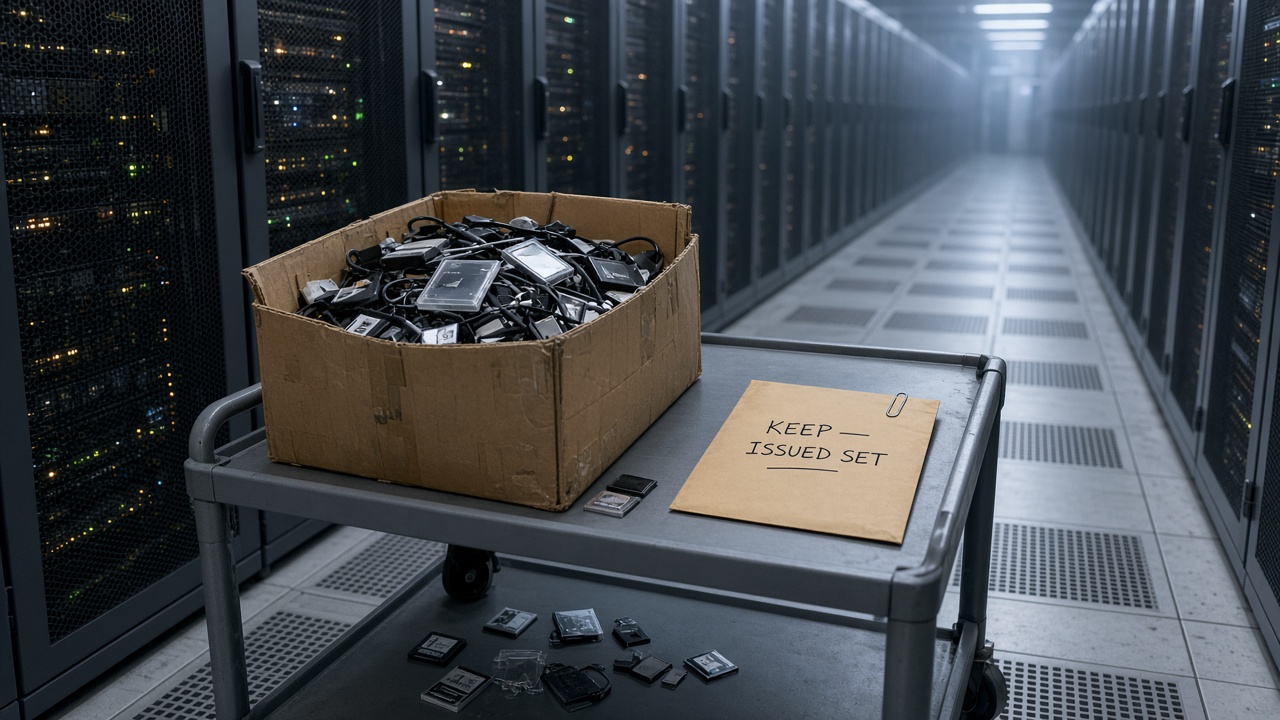
Every capture demo goes the same way. A phone, a 360 walk, a scanner on a tripod: tap, walk, register, compare to the model. The site engineer who watched it will happily run a scan every Friday until somebody tells him to stop. What nobody prices is the year after that, when the library is still hot, still triplicated, and still cannot answer one question about what was built to which revision. Somewhere in the same organisation a data manager watches that line on the cloud invoice climb and cannot say which half of it is evidence.
A smaller camera will not fix that. What fixes it is deciding, before the instrument leaves its case, what the file has to answer and what happens to everything else.
Photos
A progress photograph is a claim: this work, in this place, on this date, against this issued instruction. Four facts. Lose one of them and you are left with a picture.
You know the album. A burst of near-identical frames of the same face of concrete. Sky. Welfare. A corridor that could be any floor. A crop with no title block in it, forwarded at ten past seven, sitting in a messaging thread nobody treats as the record. Camera filenames are not metadata, and “Site progress — September” is a folder rather than a register.
Keep the frame that locates the work — a grid line, an opening, a joint, the face of a pour against something that still exists on the drawing. One or two files, not the burst. Write the date, the level or zone, the activity, the container number and revision, and who took it, on the day, in the place the file will live. Reconstructing that three months later from a photographer’s memory is not a contemporaneous record, whatever the file properties say.
Discard the unlocated, the duplicate, the beauty shot, the arrival photo, anything you cannot point at on a current sheet. Once the keep is in the record, the copy in the thread is a discard too.
One exception worth naming: a photograph of work built to a superseded print is not progress evidence at all, it is evidence that two instructions were live at once. That is often the most valuable image on the job. File it as what it is.
Scans
A scan is a measurement somebody intends to query. It is not a weekly flythrough.
Terrestrial laser, photogrammetry, a 360 walk: the demo shows motion; the work is comparison. Concealed services before close-up. As-built against the issued general arrangement before the next lift goes in. A volume, a clash, a setting-out check. If nobody is going to overlay it, measure from it, or produce it later as proof of the condition that was covered up, leave the instrument in the van.
Keep the registered product that answers the named question, at the density that question needs. A pour does not need a colour scan of the welfare cabin behind it. A riser close-up does not need the whole floor at millimetre spacing. Record the purpose, the date, the control or coordinate system, and the drawing or model the scan will be read against.
Discard the unused raw stations once registration has been accepted — or push one cold archive to the back of the shelf if the appointment demands reconstructability, which is not the same as a second hot copy. Discard the overlapping just-in-case walk and the decorative export nobody will produce as evidence. Scan what you will query; the rest is a remarkably expensive photograph.
Reality data
Reality data is a compound object, and that is where the arithmetic turns. Control, registration, point cloud, mesh, ortho, viewer tiles, and a video someone rendered because the cloud looked impressive in a progress meeting. The demo shows one walk. The invoice shows the walk plus the native plus the exchange format plus the client copy plus the cache the viewer refuses to open without.
Keep the registered product, the survey control that makes it locatable, and — where the contract or the health and safety file will later ask for a reconstruction — one archive of the raw. That is the information container. Name it, give it a purpose and a date, and place it against the issued model or drawing it was captured to.
Discard viewer caches, share copies, and the third export run off in case their software is different, once the receiving party confirms they can open the agreed format. Discard the flythrough; a video is not a measurement. Discard any cloud that cannot be tied to an issued identity, because one that will not overlay is scenery with a file extension.
Level of information need, in the ISO 19650 sense, applies to a point cloud as it does to a door. Purpose, milestone, actor, then geometry and documents. “Scan the building” is a volume knob: it produces everything the instrument can store and none of the fields a later decision will need.
How the bill actually grows
Capture looks cheap because the expensive parts are invisible at the start. The phone is already in someone’s pocket. Scanner hire is one line on a weekly sheet. Cloud storage in month one rounds to nothing.
The curve does not come from the first gigabyte. It comes from every trade capturing independently while nobody culls.
Duplication is the quiet multiplier — the same JPEG sitting in the phone, the thread, the cabin laptop and the CDE is four invoices for one claim, and the same scan in native form, an exchange format and a folder marked for the client is three libraries. Derivatives finish the job. A walk becomes tiles; a cloud becomes a mesh. Hot storage is priced on what you keep available rather than what you once captured, and egress at handover prices the whole pile again the moment an owner or an incoming contractor asks for all the reality data.
Then there is labour, which never makes it onto the slide. If producing the photograph of that pour against that revision means opening three drives and phoning a leaver, what was bought was a search. An album of unlocated images contains no contemporaneous record of the activity in dispute, and you tend to discover that in the week you can least afford to.
After practical completion the curve keeps climbing unless somebody wrote a retention rule. Hot forever is a decision; it is just rarely a written one. Cold, then gone, is the cheaper sentence — with exceptions for the keeps a later duty will want: concealed work, as-built of what was covered, whatever the health and safety file or the golden thread will be asked to show. Those are a handful of files, not the album.
Keep and discard, on one sheet
Fill this in on a Friday against the week that actually happened.
01 · Photo
02 · Scan
03 · Reality data
A keep with nothing in the “must carry” column is a discard you have not admitted to yet. Do not average the week into a percentage; write down the filenames that failed.
Tie it to the issued set
Capture comes after the identity, not before it. An issued set is a bounded act — these containers, these revisions, this purpose, this date — and a progress file that cannot name that act is tied to a morning rather than the work.
- Write the week’s questions first. Three to seven of them. “Was the level-four penetrations package complete before the ceiling closed?” is a question. “Get some photos” is not.
- Write the issued identities each question sits on. Sheet number, revision, purpose. If the supervisor cannot say them, fetch the register rather than capturing against “the drawings”.
- Capture only what answers those questions. One locatable photo, or one scoped scan, per question.
- Index before you leave the area. The four facts for a photo; purpose, control and issued comparison for a scan. If it is not written that hour it will not be written at all.
- One home for keeps. The phone and the thread are capture paths, not the record. Once the keep has landed, every other copy is a discard.
- Withdraw the previous visual when the revision moves. Yesterday’s current photo is now history against an old identity. Label it that way or somebody will reuse it as though C02 never happened — the same split the cabin set already has with the CDE.
- Cull on Friday. Unlocated out, duplicates out, unused stations out. Carry last week’s failed indexes forward until they are either completed or thrown away.
Six extra minutes a visit if the register is in order. Considerably longer if it is not, and the length of that delay is itself the finding.
What the record has to answer
A valuation, a covered-up service or a claim never asks whether the site took photos. It asks what was built, from which issued identity, and whether anybody can show the condition that was closed in.
The file should answer, without somebody spending a day on archaeology:
- Which question was the capture for, on which date, by whom?
- Which information containers were current — number, revision, purpose?
- Where was the work — grid, level, zone — in a form that still matches the drawing?
- For a scan or a cloud: what was registered, on what control, against which issued model or sheet?
- What was discarded, and under which rule?
Keep the index boring. A line on the daily report, a register row, a filename carrying the container and the date. No second management system is needed; attach capture to the issued set already being run. The daily report is a reasonable home for it, provided every field on that report has a reader, the photo line included.
Where to push this
Most of the decisions above are not the site engineer’s to make, which is why they never get made. Whoever writes the EIR sets the retention rule; whoever appoints the survey sets the purpose. So the changes worth asking for sit with the appointing party and the principal contractor.
Three of them. Put a retention and culling rule in the information requirements, naming who culls, how often, and what moves to cold storage at practical completion — it is a paragraph, and its absence is what turns capture into a subscription. Make every scan appointment state its purpose, its control and the issued set it will be compared against before anyone books the instrument; a scope written as “capture the building” should come back marked. And add the keeps a later duty needs — concealed services, as-built of covered work — to the handover specification as named containers with revisions, rather than a drive labelled Reality Data.
None of that is free. Culling is somebody’s hour every Friday, cold archive still carries a monthly cost, and writing purpose into a survey scope means a conversation with a designer who would rather scan everything and decide later. Set that against the price of one adjudication spent proving what sat behind a ceiling. For a test of whether any of it has landed, ask for last month’s most important photograph by sheet number and revision, and time the room.
Read next: Daily reports that someone actually reads, Monthly Register — September 2025, The site team has the truth. The office has the system. Neither talks..