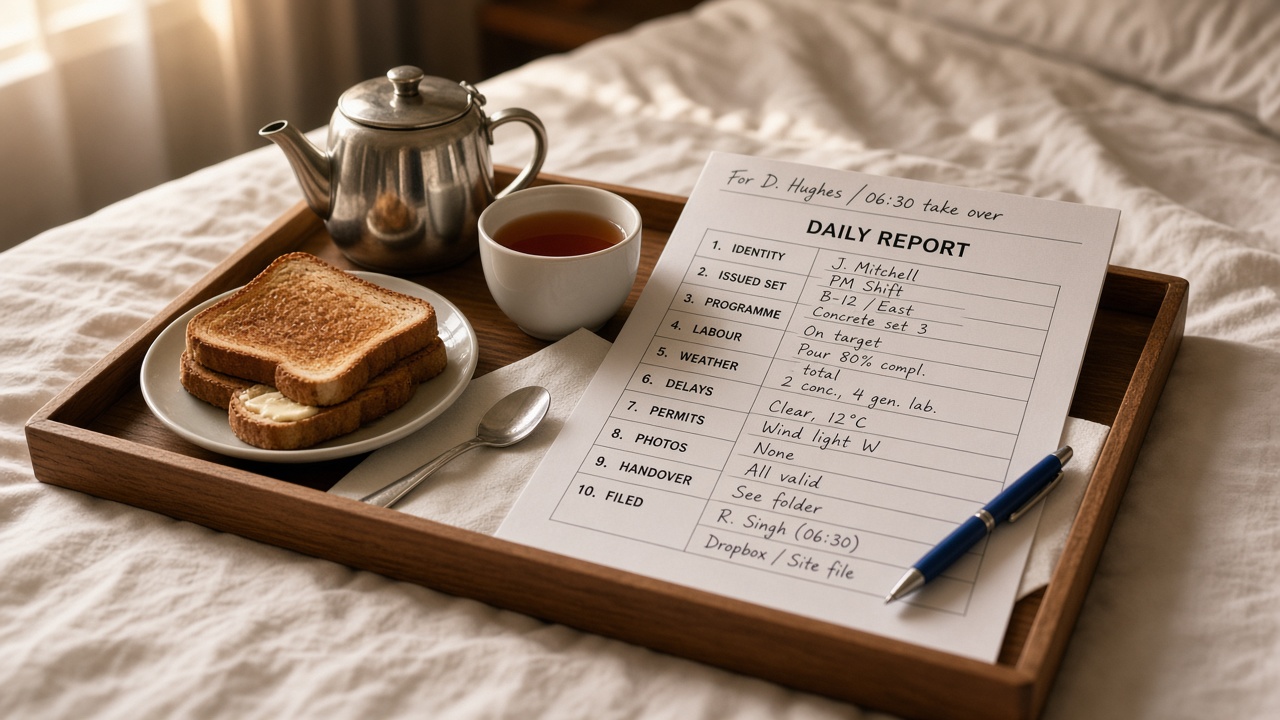
Six in the evening, the cabin is emptying, and a supervisor is filling in the daily. Weather: overcast. Visitors: client rep, two of them. Progress: works progressed as planned. Three minutes, form filed, coat on, gone. Nobody will open it. The supervisor knows nobody will open it, which is exactly why it took three minutes.
A daily report worth writing is a short list of facts a named person will use tomorrow morning. What separates it from the diary above has nothing to do with tone or effort, and everything to do with whether each field has a reader and whether the work is tied to the issued set — these sheets, these revisions, this purpose — instead of to a paragraph about the day.
So take the form you already have, go through it field by field, and strike anything you cannot hand to a named person. Print what survives, time-box it, and get it filled before the shift leaves rather than on Friday from memory. Nobody needs a second site diary.
Diary or report
A diary answers "what happened." A report answers what the next person can act on, and against which issued identity.
The diary is the easier one to write, which is most of why it wins. It gives the weather, names whoever walked the site, restates the method statement, and closes on a sentence that would fit any Tuesday in the calendar. The file grows nicely. Then an opening moves overnight, something goes wrong at it a fortnight later, and the project can prove only that a report was filed — not which revision the gang built from, not which activity was held, not when the rain actually stopped the pour.
That gap is the entire practice. The report is already happening; the missing act is treating it as a contemporaneous record of work against the issued set rather than a narrative the author owes to a form.
ISO 19650, NEC, FIDIC and JCT all assume that somebody can afterwards reconstruct what was current, who was on the job, and what stopped the work. None of them asks for a novel. They ask for facts that survive a reader who was not there.
Who has to read it tomorrow
If you cannot name the reader, delete the field.
- The next-shift supervisor reads handover: open constraints, live permits, which prints are current.
- The planner reads work against the programme: activity identities, not "progressed satisfactorily."
- The quantity surveyor reads labour, plant, and standing time that can be reconciled to a package.
- The document controller reads the issued-set line: sheet numbers, revisions, purpose of issue.
- The commercial manager reads named delays and instructions, timed, because notice clocks run from awareness rather than from a weekly wrap.
- The health-and-safety file reads incidents, near misses, and the permit numbers in force — not a toolbox-talk essay.
A project director who tells you he reviews the dailies is not reading the weather line, and never was. A client who has never opened the PDF is not a reason to keep a visitor list. Write for the six jobs above. Anything serving none of them is diary.
The test: every field has a reader
Before you keep a heading, put four questions to it.
- Who opens this field tomorrow, and what do they do with it?
- Can the fact be checked against another record — register, timesheet, permit board, weather station — without a reconstruction?
- Does it name an issued identity, where the work depended on one?
- Would deleting it change anybody's action this week?
Answer "nobody," "no," "we just say the drawings" and "no," and you have found a field that exists to be stored. Enough of those and people stop starting the form at all.
The template
One page, one shift, one area. The author should be the person who ran the work, not whoever types fastest on a Friday. Findings as facts. Nothing summarised as "mostly fine."
1. Identity
Fields: project, date, shift, area or zone, author's name and role.
Reader: anyone reconstructing later — and the next supervisor, who has to know which hut this page belongs to.
A report without a zone is a note. Two gangs on the same grid produce two truths, and one undifferentiated "site" line quietly merges them into something that was never true anywhere. The date and shift are the contemporaneous claim. A report typed on Friday about Monday is a reconstruction however honest the author, so file it before they leave — or write down that it was filed late. Late is a finding, not an embarrassment.
2. Issued set worked to
Fields: drawing or information-container numbers, revisions, purpose or suitability as issued, date of the set.
Reader: the document controller, the designer answering an RFI, the commercial file, and anyone who later asks what the workface was allowed to rely on.
This is the line that turns a diary into a report. "Worked to the drawings" names a folder. A-4102 at C03 and S-2281 at C02, issued Friday for construction, names an instruction. Where the hut print and the register disagree, write both identities down; that disagreement is the most valuable thing on the page, and it is a great deal cheaper here than in a claim two years on.
If you cannot fill this line without opening an inbox, the report is not ready. Fetch the issued list before the shift starts, the way a toolbox talk that cites a revision has to fetch it before everyone gathers. A crop on a phone will not do. It has no title block.
Do not attach the whole pack either. Cite the sheets the area actually used. Thirty numbers nobody checked is the diary habit in a new costume.
3. Work against the programme
Fields: activity identity (the code the programme already uses), location, what was completed, what was not, and why in one line.
Reader: the planner, the package manager, the QS who has to value the week.
"Works progressed as planned" has no reader, because it cannot be plotted, delayed or paid. "Zone B soffit pour — activity 4.12 — completed to grid 12; stop-end at 12 held for C02 opening move" can be all three. If the activity is not on the live programme, say so. That is already a finding: the report and the programme have split.
Name the delta only. The gang does not owe anybody a coordination history. They owe what a later reader cannot see from the hut — the bay that did not happen, the hold that appeared at nine, the work that moved to another zone because the issued sheet was wrong.
4. Labour and plant
Fields: trade or package, headcount or hours, plant items that worked or stood, standing-time start and stop if they stood.
Reader: the QS and the package manager.
A novel about who was "busy" is diary. Hours that reconcile to a timesheet or a gang-box are a report. Plant that ran is only interesting because the commercial file may later ask whether it stood instead. If nobody ever reconciles the excavator line, delete the excavator line; a field that is never compared against another record is decoration.
And do not carry yesterday's labour numbers forward. Copied labour is how a report nobody reads stays plausible for months.
5. Weather as a contract fact
Fields: condition, start and stop of lost time, which activity stopped, source of the reading if you have one.
Reader: the commercial manager, and only when the contract or the work cares.
"Overcast" has no reader. "Rain stopped the Level 4 slab pour 10:40–14:20; activity 4.12" has one. NEC compensation events, JCT weather provisions and most time-bar regimes care about contemporaneous lost time, not a forecast copied off a phone at teatime. Where the weather did not stop work and the contract needs no daily reading, delete the line. A weather field surviving because the pad in 1994 had one is why people stop reading at sentence two.
If the contract does need it daily, keep it dull: reading, times, activity. No atmosphere.
6. Constraints, delays and instructions
Fields: named event, time first known, affected activity, issued-set dependency if the delay is a sheet or an RFI, instruction number if one arrived.
Reader: commercial, for the notice clocks; the planner; the document controller.
This is not the complaint box. "Awaiting information" is diary. "RFI-184 unanswered; S-2281 C02 opening still 300 millimetres off the architectural set; activity 4.12 held from 09:10" is a report, and it is also the beginning of a reconstruction somebody will be grateful for. If an instruction arrived, cite it the way you cite a drawing: number, date, what it changed. A verbal "carry on" that nobody writes here will not exist later, whatever anybody remembers.
Notify early even where the full impact is still unknown. A notice preserves rights. A Friday paragraph about a Monday hold does not.
7. Hold points, visitors and permits
Fields: the inspection or hold that authorised or stopped work; permit numbers in force in the area; a visitor only where they issued or withdrew an instruction.
Reader: the next supervisor, health and safety, whoever owns the hold.
"Client walked the site" is hospitality. "Building control hold on fire-stopping Zone B until inspection of the C02 detail; permit HW-14 live until 18:00" is a report. Toolbox-talk minutes belong on the attendance sheet. Permit essays belong on the permit. This line is a pointer: which numbered thing is live, and does it still match what is happening at the workface.
Where the board in the cabin and the copy in somebody's pocket disagree, write that down. A daily report is allowed to record a split. It is not allowed to smooth one over.
8. Photographs
Fields: two to six images, each captioned with location, time, and the issued sheet it illustrates.
Reader: the QS, the next shift, a later commercial file.
Forty uncaptioned progress shots is a storage bill. One photograph of the stop-end at grid 12, captioned against S-2281 C02, does actual work. A photograph that cannot be tied to an identity is diary with a lens on it. The longer argument about retention sits in progress capture; here, take pictures that defend a line you have already written.
9. Handover to the next shift
Fields: open constraints, live permits, which prints are current on the rack, what the incoming supervisor must not assume.
Reader: the person who starts at 06:30, and the one who decides whether this report gets read at all.
Leave this block empty and the rest of the page is a file for later. Fill it as though the incoming supervisor will not open the CDE, because on a wet Tuesday morning they will not. Tell them which A1 is live and which one is dead. Issue without withdrawal is how two revisions stay live overnight, and a report that names the dead print is doing document control at the workface.
10. Filed
Fields: time filed, by whom. If late, say so.
Reader: anyone who has to decide whether this is contemporaneous.
A signature is not a state change. It is a claim about when the facts were written down, and it should be treated as one.
- 01IdentityKey fieldsProjectdateshiftarea/zoneauthorReaderAnyone reconstructing laterthe next supervisor
- 02Issued set worked toKey fieldsContainer numbersrevisionspurpose/suitabilitydateReaderDocument controllerdesigner answering an RFIcommercial file
- 03Work against the programmeKey fieldsActivity identitylocationcompleted/notone-line reasonReaderPlannerpackage managerQS
- 04Labour and plantKey fieldsTrade/packageheadcount/hoursplant statusstanding timeReaderQSpackage manager
- 05Weather as a contract factKey fieldsConditionlost-time start/stopactivity stoppedsourceReaderCommercial manageronly when the contract cares
- 06Constraints, delays, instructionsKey fieldsNamed eventtime knownaffected activityinstruction numberReaderCommercialplannerdocument controller
- 07Hold points, visitors, permitsKey fieldsInspection/holdpermit numbersvisitor only if they instructedReaderNext supervisorhealth and safety
- 08PhotographsKey fieldsTwo to six captioned images tied to an issued sheetReaderQSnext shiftcommercial file
- 09Handover to next shiftKey fieldsOpen constraintslive permitscurrent printswhat not to assumeReaderIncoming supervisor
- 10FiledKey fieldsTime filedby whomReaderAnyone judging contemporaneity
Fields to delete
Delete these, unless you can name tomorrow's reader in a sentence.
- "Works progressed satisfactorily."
- Weather that did not stop work and is not a contract reading.
- Visitor lists that authorised nothing.
- Labour or plant lines nobody reconciles.
- A restatement of the RAMS or the induction.
- Yesterday's paragraph with today's date.
- A dump of every drawing in the package.
- Materials received, unless a shortage or a reject changes tomorrow's work. Delivery notes already live on the ticket.
If the form you inherited still carries those headings, strike them on the master and tell the authors you have done it. An unread field trains people to skip the ones that matter.
How to fill it on a Monday
Run this on the report you already file.
- Fetch the issued set before the shift. Sheet numbers and revisions at the top of the page. If you cannot get them, stop and ring the register. Do not brief or report from a memory of what was issued last week.
- Name the activities, then the facts. Complete, incomplete, held. A line each, no atmosphere.
- Time the delays as they happen. Reconstructing them at half five from radio traffic is guesswork with a timestamp.
- Reconcile the hut rack before you file. Does the print match the issued-set line? If it does not, the report has documented one instruction while the workface still holds another. Fix the print, or write the split.
- Fill handover last, on the same page. The next shift is your first reader. If they need to phone you to interpret it, the page failed.
- File before the author leaves. A late report is allowed. An undated reconstruction is not.
Fifteen extra minutes where the register is in order, longer where it is not — and that delay is itself worth recording.
What a later reader will ask
A claim, a near-miss investigation or a principal-contractor audit will not ask whether the site kept dailies. It will ask what the work was built from, who was there, what stopped, and when the project first knew.
The contemporaneous file should answer that without anyone reconvening the original crew:
- Which area, which shift, which author?
- Which information containers were current — number, revision, purpose?
- Which programme activities moved, and which did not?
- What labour and plant can be reconciled?
- What event was first known, at what time, against which sheet or instruction?
- What did the next shift inherit?
Where those answers live only in a supervisor's memory, the project has a diary. Where they live on a form reading "works as planned, weather fine," it has a slogan with a date on it.
Limits
No template is a certification, and filling a form well discharges none of ISO 19650, CDM or the contract on its own. The principal contractor still owns the master, though, and that is the lever. Strike the diary headings on the copy that gets printed — weather that stopped nothing, visitor lists, "progressed as planned" — name the six readers who remain, and tell the authors the rest is gone. Fifteen extra minutes at the end of a shift is the price where the register is in order; a Friday reconstruction of Monday's pour is the one that currently gets written. If the incoming supervisor still has to phone to interpret the page, sit with them until they do not have to.
Read next: Halving RFI cycle time without buying anything, Progress capture: photos, scans and reality data without the storage bill, The site team has the truth. The office has the system. Neither talks..