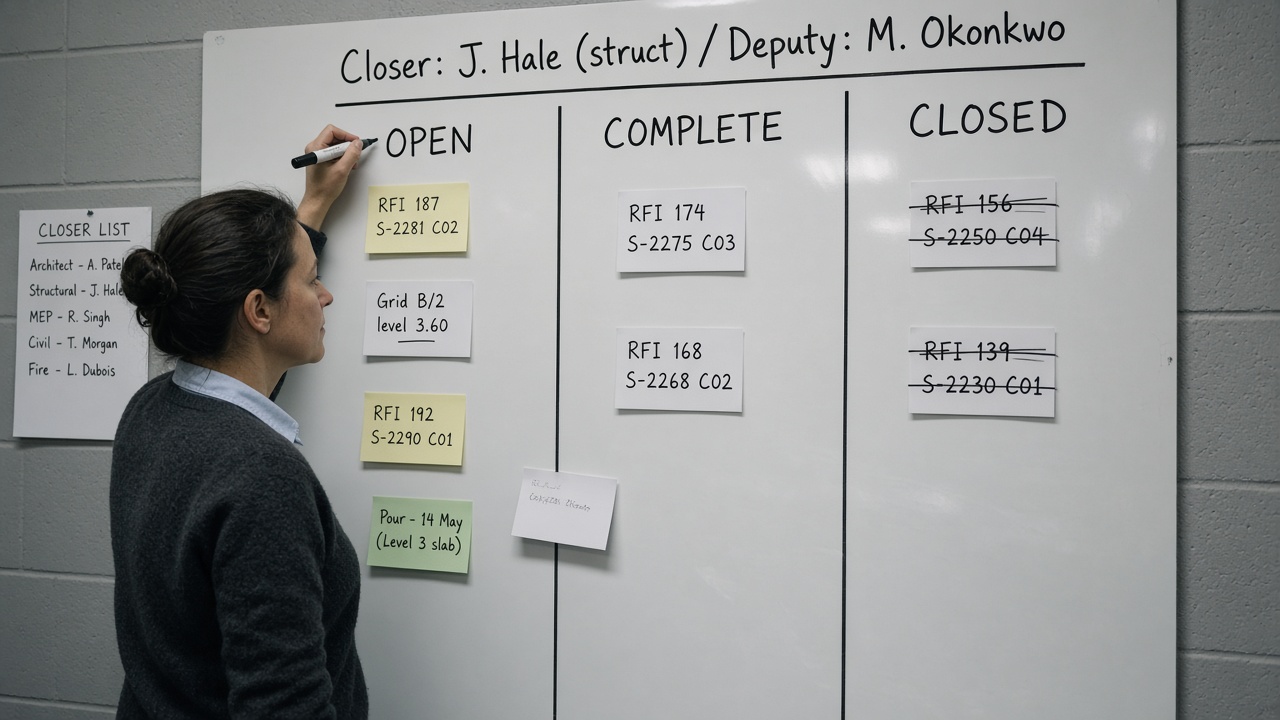
A site engineer raises a query at ten past seven, before the gang breaks out, because the opening in front of him does not look like the one on his print. It lands in a mailbox. Three weeks later it comes back as a paragraph in a thread, from a design lead who has been carrying it between two other deadlines, and nobody can say which revision the answer belongs to. That is a three-week RFI. Perhaps one of those days was design.
Cycle time, if it is going to mean anything, is the elapsed days from a question that can be answered to an answer the site is allowed to build from — not the days a portal shows “open”, and not the days until somebody replies that they will look at it. Most of the elapsed time is waiting: for a named closer, for the question to become complete, for someone to work out which revision it was asked against.
A new inbox will not touch that, and neither will a better form with a nicer number. What moves the clock is three rules enforced on whatever register you already keep: who is allowed to answer, what a complete RFI must cite, and which issued set the question is pinned to. None of it needs a procurement, and you can start on the live package this week.
Where the days actually go
Time a dozen live RFIs the way a claim will later time them. Raise date. First complete citation. Named closer assigned. Answer issued. Site told. That is the clock. What most dashboards show — “open” to “closed” in a mailbox — invents a precision the job does not have.
The characteristic waste is a bounce, and it goes like this. The site asks whether an opening is still 900 millimetres. The office asks which opening. The site sends a phone crop with no title block in it. The designer answers against last week’s plot, because that is what is open on the desk, and in the meantime the register has moved. The answer lands as a paragraph in a thread; nobody can say which revision it authorised. So the question is either still open, or stamped closed and unusable. Half the cycle lives in that loop.
Three defects produce it:
- Nobody named who may close it, so it sits in a company mailbox or somewhere in a coordination pile.
- The question was incomplete, so the first week goes on reconstructing facts the raiser already had in their hand.
- The question was not pinned to an issued identity, so a new revision quietly changes what “the drawing” means while the RFI is still travelling.
Fix those three and the tooling stops being the argument. What follows is a name, a gate and a pin, then an hour on Monday that runs on a spreadsheet, a paper log, or the register already sitting in the cabin.
Name who can answer
An RFI without a closer is a rumour with a number.
“The architect”, “the consultant”, “design” and “the package” are organisations, and organisations do not answer at 07:10. A named person in a named discipline, with a named deputy, answers. Everything else waits for whoever next opens a shared inbox.
Write the rule before the next raise:
- The raiser names a discipline, not a company. A structural opening goes to structural; fire-stopping goes to fire. Obvious, and still the step most logs skip, which is why everything lands on the lead consultant.
- Document control, or the package manager, names a closer — a person allowed to issue the answer — plus a deputy for leave. If nobody can be named from the directory they already hold, it is a draft, not an issued RFI.
- Some questions do not belong on the register at all. Where the contractor’s own package engineer can answer from the issued set — a dimension already on C02, a clause already in the published specification — that is a read rather than a query. Numbering it inflates the register and teaches the site to outsource looking things up.
- Nor do contractual notices, variations and “please confirm we may proceed” belong there. Put them in the same column as a gridline query and a two-day clarification ends up queueing behind a commercial letter.
Authority is the part people fudge. The closer has to be allowed to bind the project for that class of question. A graduate who can comment but cannot issue does not qualify, and neither does a mailbox the team monitors. If the only person who can bind is the project architect, you have named a bottleneck, and you should expect the cycle time bottlenecks produce.
Publish the list where raisers already look — the cabin wall, the front of the log, the weekly coordination pack — and update it when people rotate. A stale name behaves much like no name at all.
What a complete RFI has to cite
A complete RFI can be answered without a return visit to the raiser. The first week of most open RFIs is not design work; it is reconstruction, usually of things the raiser could see from where they were standing.
So refuse to issue — no number, no clock, nothing sent — until the citation is complete. This is not about prose quality. It is a short list of facts:
- Title and revision of the container the question concerns: sheet number and issued revision, or specification clause and issued revision, or model state if that is what the job builds from. “The drawings” will not do.
- Location the closer can find without a tour — grid, level, detail number, room, chainage. A crop helps. A crop with no title block is decoration.
- The question, in a form that can actually be closed: a dimension, a yes or no, a choice between two issued details. “Please advise” does not qualify. “Is the opening on S-2281 C02 still 900 wide, or has C03 moved it?” does.
- What the raiser already holds — the print in the hut, the spec page, a photograph of the built condition if the query concerns a clash with reality. If something has already been built, say so. A query that hides an as-built condition burns the closer’s first day.
- What happens if the answer is late — pour date, delivery, booked gang — stated as a fact rather than as pressure. The closer needs the clock, not a threat.
All of that fits on one side of a sheet, and none of it needs a portal. It needs a document controller willing to hand a draft back unmarked instead of being helpful and issuing an incomplete number. Being helpful is how a log fills up with questions nobody can answer. Most raisers learn after one return.
The characteristic incomplete RFI cites a superseded print, or cites no revision at all, which brings us to the expensive part.
Pin the question to an issued set
A revision is an issued identity: this title, this series, this purpose, this supersede. An RFI raised “per the latest drawings” is floating, because “latest” means whoever last plotted. The closer answers against the identity open on their screen; the site reads that answer against the identity in their hand. Those two can already differ on the morning the query goes out, and they very often differ by the morning it comes back.
Pinning is four facts written down before the RFI is numbered:
- The issued set the question is asked against — the transmittal or register state, not “whatever is current”.
- The exact revision of each cited container.
- The purpose of that issue — for construction, for information, for coordination — so nobody treats an information-only answer as an instruction to build.
- What happens if a new revision issues while the RFI is open: the pin stays, and the closer says in writing whether the answer still holds against the new identity, or the RFI is re-raised against the new pin. Silence does not count as an update.
That fourth rule is the one jobs skip. C02 is live when the question goes out. C03 publishes on the Wednesday. The answer arrives on the Friday as though nothing had happened, and the site now holds two instructions and one closed stamp. Pinning makes the collision visible: either the answer is good for C03 and somebody has written that down, or the clock restarts on a complete citation of C03.
You cannot pin a crop, and you certainly cannot pin a spoken “just use the opening on the wall”. Where the raiser only has a photograph from a messaging app, the first job is to recover the issued identity — title, revision, transmittal — or else to mark the query honestly as asked against an unofficial artefact. That still counts as a pin. It tells the closer they are being asked about the hut set rather than the published container, which is a good deal cheaper than an answer that quietly assumed the office file.
Withdrawal belongs here too. If the cited revision is superseded before the answer issues, the RFI is not open against the drawings; it is open against a dead identity. Close it as superseded and re-raise, or re-pin it in writing. Leave it as it is and you end up with a closed RFI that authorises last month’s sheet.
An hour on Monday, on the log you already keep
Four columns on the register you already have — spreadsheet, paper book, or whatever you paid for years ago — and somebody prepared to refuse a row that is missing one of them.
| Column | What it holds | Fail |
|---|---|---|
| Closer | Named person and deputy, not a company | “Design” / a mailbox |
| Citation | Title, revision, location, a question that can be closed | “Please advise” / no revision |
| Pin | Issued set, purpose, rule if a new revision lands | “Latest drawings” |
| Clock | Raise of the complete citation; answer issued; site told | Clock started on an incomplete draft |
Give it one hour on Monday, against the live package rather than the archive.
- Return or reject every open row with no closer, no complete citation or no pin. Do not chase them as though they were live, because they have not started.
- Close or reclassify every row the contractor can answer from the issued set already in their hands. Those were reads that got given a number.
- For every complete, pinned row, check the cited revision is still current. If it is not, re-pin or close and re-raise before anyone spends another day answering a dead identity.
- Write down the three dates that matter: complete raise, answer issued, site told. If “site told” is blank, it has not closed. A paragraph in an office thread has told nobody on site.
Carry last week’s failures forward. A log that quietly resets its incompletes every Monday is theatre.
The labour in that hour is refusal, and refusal is where the halving comes from. Every incomplete row you number is a week donated to reconstruction. Every unnamed closer is a pile with no owner. Every unpinned query risks an answer about the wrong sheet.
How you know you halved it
Measure the clock you defined, on a sample of twenty RFIs, before you change the rules and again four weeks later.
- Median days from complete citation to the answer the site was told about. Not from the first email, and not from “raised” on an incomplete form.
- Bounce rate: the share of numbered RFIs that came back asking for a revision, a grid or a closer. Above a third and you are still issuing drafts.
- Unpinned share: rows whose citation is “the drawings”, or a crop with no title block.
- Wrong-closer share: rows that sat in a mailbox or bounced between disciplines.
Halving shows up in those four numbers rather than in how many RFIs a dashboard counts as closed. Closed-and-unusable is how a job looks fast while the deck still waits.
You will not get a laboratory, and your mileage will vary with the contract. What you get is a direction. If complete-to-told falls by half and the bounce rate collapses, the process is working. If the dashboard merely looks cleaner because you stopped numbering drafts, that is also the process working — volume was never cycle time.
Where this stops
Some questions genuinely take design time. A coordination collision that has not been resolved yet is not a process failure, and none of this makes a late opening move itself. What the three rules remove is the waiting that was never design in the first place.
Give the document controller a written right — from the principal contractor, or from the appointing party if the protocol is still open — to return any row that lacks a named closer, a complete citation or a pin. Put that right in the information protocol rather than in an email that dies with the thread. The cash cost is almost nothing: an hour a week on the log you already keep. The real cost is the first refused number, and the programme argument that follows it. Pay that once, in writing, and the waiting that was never design starts to fall out of the clock.
Read next: The site team has the truth. The office has the system. Neither talks., Revision control and version control are not the same thing, Drawing register hygiene: a weekly checklist.