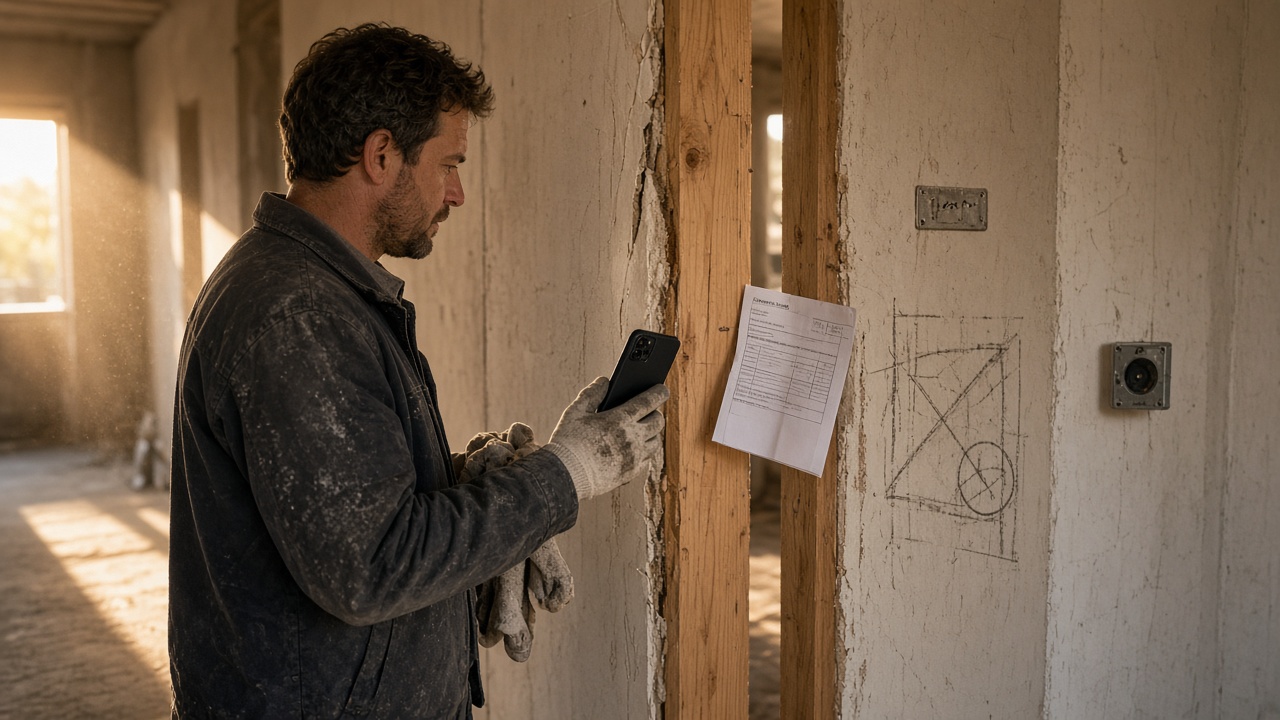
Watch who actually closes a defect and the design fault shows itself in about ten minutes. The list was built for the person walking the floor with a tablet: room codes, priority colours, a description box that will swallow four hundred words, ten mandatory fields, and a portal the raiser lives in every day. The person who has to close the item is a trade supervisor with a booked return visit, a van outside and perhaps ten minutes between two other jobs. If they cannot find the item, photograph it, tell which issued sheet it relates to and mark it done without ringing the logger, the register will simply sit there. What happens instead is that the main contractor walks the floor a second time and closes the items itself, for nothing.
Snag, punch and defect are three names for one information problem. Defect will do here.
The argument that snagging lists are where projects go to die is well rehearsed by now. The more useful question is what you change on Monday, on the register you already keep, so that the installing company opens it.
Designed for the closer, not the logger
The logger is the clerk of works, the package manager, the contract administrator, the client's representative — whoever walks the floor and writes the item. They have time, a tablet, and a mental map of the area they have just walked. The closer is the installing company: a named person at the trade who has to come back, fix the work and prove it.
Write the acceptance test before you write another item. A named person who was not on the walkthrough can, without ringing the raiser:
- Walk to the location.
- See what is wrong from the photograph and one closable sentence.
- Know which issued sheet and revision the item is about.
- Mark the work done with an after photograph of the same frame, and leave the item ready for someone else to accept.
If any of those four fail, the workflow was designed for the logger, and the trade will wait to be walked around again. That second walk is the main contractor doing the closer's job and then calling it chasing snags.
Assignment to “M&E,” “the contractor,” or “all trades” does not name a closer. Organisations do not return on Thursday; a named company and a named role do, and a named person with a named deputy does better still. If you cannot pull one out of the directory you already have, the item is a draft. It has not started.
Why a list the office loves dies on site
Office lists fail in fairly predictable ways, and none of them is that the trades will not engage.
The form is too long. Nobody is completing ten fields to close one scratch on a reveal. The closer will complete four: I am here, this is the after photograph, this is the same pin, it is done.
The location only the raiser understands. “Level 4 corridor, as discussed” is a memory, and the person who had it has gone to another job. The closer has a gang and a van. If the item cannot be walked to from the text and the photograph, it will either sit untouched or be closed against the wrong door.
The photograph shows a room. A general view of a corridor is hospitality. The closer needs the scratch, the missing seal, the unpainted reveal — and enough of an adjacent feature to stand in the same place.
There is no issued identity. “Per the drawings” floats free the moment a new revision publishes, and the closer has no way of knowing whether they are correcting C02 or a mark-up that never left the hut. Close-out against a floating instruction cannot be proved afterwards.
Close-out is locked to the logger. The trade can fix the work and still not move the item, because “closed” is a desktop state the office performs after a second inspection. What that teaches, within a fortnight, is that filling in the form finishes nothing. So they stop filling it in.
A licence the trade does not have is the same lock wearing a procurement costume. If the closer cannot reach the item on the device they already carry, or on a printed extract of their items, they are not on the workflow at all. They have been shown a screen.
The last mile is physics: gloves, glare, dust, no signal on the fourth floor. A defects item that assumes a clean thumb and a ten-field form was not designed for the closer so much as hoped at them.
The photograph
The photograph is how a stranger stands in the raiser's footprints. Everything else in the item is commentary on it.
A usable before photograph shows the defect rather than the room, with one adjacent identifiable feature in the frame — a door number, a grid mark, a junction, a window — so that the closer can find the same spot again. A crop that could be any reveal on the floor is not a photograph. It is a rumour with pixels.
The after photograph has to be the same frame: same height, same angle, same adjacent feature. That is the only way a reader six months later can see the work happened to this item and not to a neighbouring one. A sunny progress shot of the corridor will not do, and forty uncaptioned images in a folder are a storage bill with a filename convention.
Caption three facts on or beside the image — location, time, and the issued sheet the item is pinned to. The longer argument about what to keep and what to bin lives in progress capture; the modest requirement here is pictures that defend the item.
The closer must be able to take the after shot without a desktop upload path and without peeling off a glove for a five-minute form. If the only route for a photograph is a cabin PC and a naming convention, you have designed the evidence step for the logger. The trade will text a crop to the package manager instead, and you are back to performing their close-out for free.
Nobody is asking for a studio. One honest frame beats a gallery. If the defect is on the back of a door, photograph the back of the door; if the lighting is poor, say so in the caption rather than inventing a second visit for a better picture that nobody will ever make.
Where it is
Location is a walk-to instruction, not a vibe.
Write something a person who was not on the tour can use: level, grid, room or space identity, and — where the work sits on a face — elevation, chainage, or which side of the opening. “Level 4 corridor” does not locate anything if the floor has four corridors. “See photo” is not a location. “As discussed on Friday” is a fond memory of a conversation.
A pin on a plan helps only if the plan is the issued set, at the same title and revision the item cites. A pin on a marketing floorplate, a fire-strategy cartoon or last month's plot gives the job a second map, and two maps are how the closer ends up at the wrong door photographing the wrong frame.
Where the room schedule and the architectural set disagree on the number, write both identities down. That disagreement is a finding in its own right, and it is far cheaper here than in an argument about whether D-412 was ever the door that got snagged.
Then test the open items with a stranger's test. Hand the location line and the photograph to someone who has not walked the area — a new assistant, an engineer off another package — and see whether they can say which opening, which face, which end of the room. If they cannot, rewrite the item before you assign it. Items that fail that test are drafts, and numbering them trains the trade to ignore the register and wait for a guided tour.
The issued-set pin
A defect that is not pinned to an issued identity is a complaint. Pin it and the same words become an instruction: this title, this revision, this purpose, this work.
Four facts, settled before the item goes to the trade:
- The container — sheet number, specification clause, or the schedule identity the work actually follows. “The drawings” is not a container.
- The revision as issued, not “latest.” Latest means whoever plotted most recently.
- The purpose of that issue — for construction, for information, for coordination — so that nobody treats an information-only mark as a build instruction.
- What happens if a new revision publishes while the item is open: either the pin stands and the raiser says in writing that the item still holds against the new identity, or the item is re-issued against the new pin. Silence is not an update.
That last rule is the one jobs skip, and it costs the most. C02 is live when the scratch is logged. C03 publishes on the Wednesday and moves the door. The closer arrives on Friday and closes a condition the new sheet has already changed. Green cell on the register, two instructions at the workface.
You cannot pin a crop, and you cannot pin a spoken “the door on the left.” Where the raiser only has a photograph from a messaging app, the first job is to recover the issued identity — or to mark the item honestly as raised against an unofficial artefact. An unofficial pin is still a pin: it tells the closer they are being asked about the hut set rather than the published container, which is cheaper than a close-out that quietly assumed the office file.
Withdrawal belongs with the pin. If the cited revision is superseded before the work is done, the item is not still open against the drawings; it is open against a dead identity. Re-pin it in writing, or close it as superseded and re-raise. Leaving it open is how a closed defect ends up authorising the previous sheet.
Two acts, not one: close-out and acceptance
Close-out is a state change the closer can finish. Acceptance is a state change the raiser, the contract administrator or the clerk of works performs afterwards. Run them together in one cell and the trade learns that the form does not finish anything.
The closer's close-out is four facts, written at the time:
- The work is done, in one sentence that answers the original closable sentence.
- An after photograph of the same frame.
- The same issued-set pin, or a written re-pin if the register has moved.
- Name, company, date and time. A signature carries a claim about when the facts were written, which is precisely why it should not be added on the Friday.
“Ready for review” — or whatever your register already calls the trade-complete state — has to be reachable by the installing company on the device they use, or on a printed extract of their items. If only the logger can move the item, the logger will keep walking the floor and ticking boxes, and the main contractor keeps re-performing the closer's record under the heading of quality control.
Acceptance can stay as strict as you like. The trade does not have to be allowed to issue itself a clean certificate. It does have to be allowed to say we have finished this item and attach the evidence. The reopen rule sits with the accepter: if the after photograph is the wrong frame, or the pin has moved and nobody re-pinned it, send it back. Do not quietly re-close it from the office, because silent office close-out is how the trade stops sending photographs at all.
File the close-out when it happens rather than in a Friday sweep from memory. A late close-out is fine if it says it is late. An undated reconstruction is folklore with a stamp on it.
Quality records are handover records. A defect closed without a pin and a matching after photograph will be retyped into the handover pack by somebody who was never there — the same unpaid labour, arriving later and more expensively.
What a usable item contains
One item. One location. One closer. The author of the raise should be the person who saw the work, not the person who types fastest after the walk. Write the defect as a fact that can be closed, not as a complaint about the package.
- 01IdentityWhat it holdsItem numberpackageinstalling companyFail“Various” / no number
- 02LocationWhat it holdsLevelgridroom or spaceface if it mattersFail“Level 4 corridor” / “see photo”
- 03PinWhat it holdsTitlerevisionpurposerule if a new revision landsFail“The drawings” / “latest”
- 04What’s wrongWhat it holdsOne sentence a stranger can closeFail“Poor workmanship” / “as discussed”
- 05Before photographWhat it holdsDefect plus one identifiable adjacent featureFailA rooma crop with no context
- 06CloserWhat it holdsNamed company and named role or personplus a deputyFail“M&E” / “the contractor”
- 07Close-outWhat it holdsAfter photograph of the same framenamedatesame pinFailOffice tick / no photograph / Friday reconstruction
- 08AcceptWhat it holdsSeparate from close-outnamed accepterFailCloser and accepter are the same cell
All of that fits on one side of a sheet, and none of it needs a new product. What it needs is somebody willing to send an incomplete item back unmarked rather than be helpful and issue it anyway. Helpfulness is how a register fills up with items that cannot be closed. Raisers learn after one return: complete it here, or it does not start.
Do not attach the whole pack, either. Cite the sheet the item actually uses. Thirty drawing numbers nobody has checked is the old diary habit in a new costume.
What to refuse
Refuse to issue — meaning do not give it a number the trade will see, do not start the clock, do not send it — until a stranger could close the item. Completeness here means the table above, not prose quality.
Delete or return anything where you cannot name the closer's next action in one sentence:
- Priority colours that change nobody's sequence.
- Duplicate items for the same location with no reason they are two jobs.
- Essays restating the specification. The pin already cites the clause.
- Visitor names from the walkthrough who authorised nothing.
- A restatement of the method statement.
- “Works to be completed as per drawings.”
- After photographs taken from a different floor because the light was better.
- Close-out performed by the package manager from the cabin because the trade “don't do the app.”
If the form you inherited still carries those habits, strike them on the master and tell the raisers you have done it. An unusable field trains people to skip the ones that matter, and an unusable item trains the trade to wait for a tour.
One hour on Monday, on the register you already have
You do not need a new inbox. You need the columns you already keep — spreadsheet, paper book, or the register in the system somebody already paid for — and one person prepared to refuse a row that is missing a closer, a location, a photograph or a pin.
Run the hour against one live package and one floor. Not the archive.
- Extract the trade's items only. A hundred-item building list is a logger's document. The closer gets the rows assigned to their company, because a short list gets opened and a long one does not.
- Return every open row that fails the stranger's test: no walk-to location, no before photograph, no pin, no named closer. Do not chase those rows as though they were live. They have not started.
- Re-pin, or close and re-raise, every row whose cited revision is already dead.
- Give the closer a route to ready-for-review that does not need the logger's login. A printed extract they can annotate and photograph is perfectly allowed. A state they cannot reach is not.
- Keep accept separate. The office reviews evidence; it does not silently re-perform close-out.
- Write the dates that matter: complete raise, trade close-out, accept or reopen. If the trade close-out cell is empty and the row is green, the office closed it. Carry that one forward rather than resetting the incompletes every Monday, which is theatre.
Most of the labour in that hour is refusal, and refusal is what makes the workflow one the subcontractor will use. Every incomplete row you issue is a return visit you have donated. Every unnamed closer is a pile with no owner. Every unpinned item is a close-out that may already be about the wrong sheet.
How you know they are using it
Login counts tell you nothing. Items moving without a second guided walk tell you everything.
Take a sample of twenty items on one package, before you change the rules and four weeks after:
- Bounce rate: the share of issued items that come back as “cannot find,” “which door,” or “which revision.” If that share is above a third, you are still issuing drafts.
- Office-closed share: items whose close-out name is the package manager or the clerk of works rather than the installing company. That share is the unpaid labour, in plain numbers.
- Unpinned share: rows citing “the drawings,” or a crop with no title block anywhere near it.
- Same-frame share: close-outs whose after photograph is visibly the same pose as the before. Where it is not, you have a gallery rather than a close-out.
None of that is laboratory work and it will not survive a statistician. It gives you a direction, which is what you need. If bounce rate collapses and the trade's own name starts appearing on close-out, the process is working. If the dashboard looks cleaner because you stopped numbering drafts, that is also the process working. Volume was never use: two hundred items nobody will open is a list, and forty a named closer can finish is a workflow.
Where this stops
ISO 19650, CDM, the Building Safety Act, NEC, FIDIC, JCT and the project's own BEP each have owners, and a template is not a certification in any of them. What they assume is that a defect can be tied to an issued container and closed with a contemporaneous record, which is all the method above is trying to make ordinary.
Some items will still need a joint inspection. A latent condition, a disputed responsibility, a detail nobody has resolved yet — none of those is a process failure, and no amount of column discipline will make a missing revision issue itself. The package manager who already keeps the register can still start on Monday: one live package, the trade's rows only, every incomplete sent back, and a route to ready-for-review that does not need the logger's login. It costs an hour and an argument with whoever has been closing from the cabin. Skip the hour and you keep issuing lists the trades will not open.
Read next: Snagging lists are where projects go to die, Capturing commissioning data during commissioning, not after, The last mile: getting information to a gloved hand in direct sunlight.